

Searching for remote jobs in Singapore can open up great options: no daily commute, more flexibility and sometimes access to employers based overseas. But a remote listing can mean very different things. It might be a normal local job with work-from-home days, a contract role paid by a foreign company, or, at worst, a scam dressed up as easy money.
This guide is about what to check before you apply and before you sign. If you already have a remote role and want to make it work day to day, our guide on making hybrid and remote work work covers routines and communication.
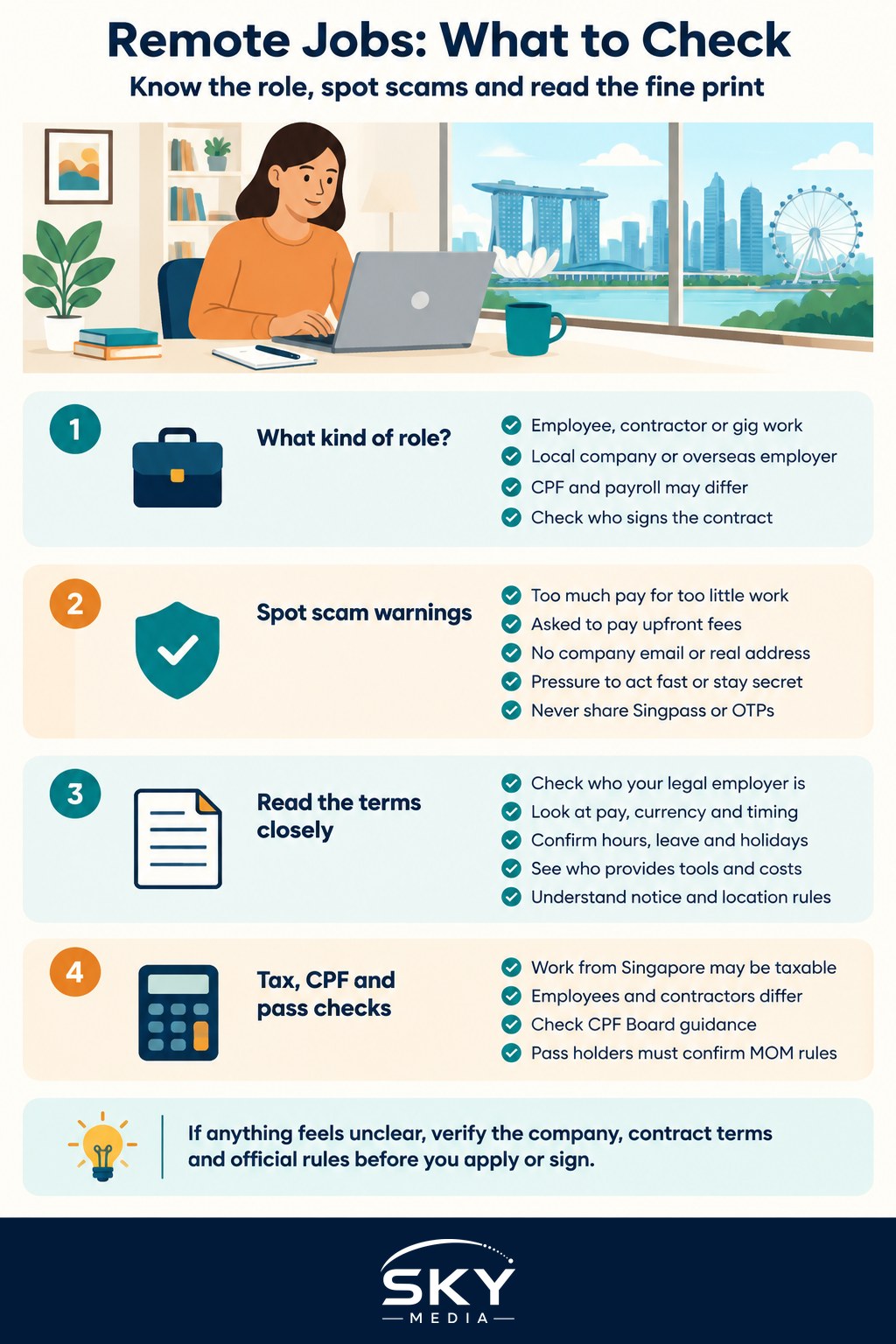
Know What Kind of Remote Role It Is
Before anything else, work out what the job actually is. The same word “remote” covers several setups, and each comes with different protections and responsibilities.
| Type of role | Who employs you | What usually applies | Key things to check |
|---|---|---|---|
| Local employee, remote or hybrid | A Singapore company | Singapore employment law, CPF for eligible employees, payslips | Whether remote is permanent or can be withdrawn, equipment and allowances |
| Employee of an overseas company via a local entity or employer of record | A Singapore-registered entity hiring on behalf of the overseas firm | Usually similar to a local employee | Which entity signs your contract, who pays CPF and handles payroll |
| Contractor or freelancer for an overseas company | No employer; you invoice a client | You are self-employed, so you handle your own tax and CPF matters | Payment terms, currency, invoicing, what happens if the client stops paying |
| Platform or gig work | You work through an online platform | Platform terms, usually self-employed | Fees, payout rules, how disputes are handled |
The distinction between employee and contractor matters a lot. As an employee you generally get employment protections and your employer handles payroll obligations. As a contractor, you are running a small business, even if it feels like a job.
Red Flags That Suggest a Scam
Job scams often target people looking for flexible or work-from-home roles. Be very cautious if you see any of these:
- High pay for very little work, such as liking posts, rating products or “boosting” sales.
- Requests to pay money upfront, for training, equipment, deposits or to “unlock” earnings.
- Contact only through messaging apps, with no company email, website or verifiable address.
- Pressure to act fast or keep the opportunity secret.
- Requests for your Singpass details, bank login or one-time passwords. No legitimate employer needs these.
- Being asked to receive and transfer money for the company. This can involve you in money laundering.
Simple checks help: search the company name with words like “scam” or “review”, look up Singapore businesses on ACRA’s Bizfile portal (the Accounting and Corporate Regulatory Authority’s business registry), and check that the recruiter’s email matches the company’s real domain. The Singapore Police Force and the National Crime Prevention Council share scam alerts and advice through their official channels, including ScamShield. If an offer feels too good, it usually is.
Read the Employment Terms Carefully
A legitimate remote offer should come with clear written terms. Before you accept, check:
- Who your employer is. The name on the contract tells you which company is legally responsible for paying you.
- Pay, currency and payment schedule. Overseas employers may pay in another currency, which exposes you to exchange rate swings and transfer fees.
- Working hours and time zones. A role “flexible” on paper can mean regular late-night calls if the team is in Europe or the Americas.
- Leave, sick days and public holidays. Whose public holidays apply, Singapore’s or the employer’s home country?
- Equipment and costs. Who provides the laptop, software and internet, and are there any allowances?
- Termination and notice. How much notice is required on both sides?
- Where you are allowed to work from. Some roles are remote within Singapore only; working from another country can raise tax and legal issues for you and the employer.
For employees of Singapore companies, the Ministry of Manpower (MOM) website explains the Employment Act and who it covers. For contractor roles, the Tripartite Alliance and MOM also publish guidance on fair contracting and self-employed persons. Check the official sites for the latest rules.
Tax and CPF: Points to Understand
This section is general information, not financial or tax advice. Rules can change, so confirm details with the Inland Revenue Authority of Singapore (IRAS) and the CPF Board.
Income tax. If you are a Singapore tax resident working from Singapore, income for that work is generally taxable here, even if the employer is overseas. As an employee of a local company, your employer typically reports your income to IRAS. If you work for an overseas company or as a contractor, you are more likely to need to declare the income yourself when you file. Keep records of payments received and any business expenses.
CPF. CPF (Central Provident Fund) contributions apply to eligible employees of employers in Singapore. If you work for an overseas company with no Singapore entity, or as a contractor, your situation may be different. Self-employed persons have their own obligations, such as MediSave contributions when certain conditions are met. Check the CPF Board website to understand what applies to you, and factor this into how you compare a contractor rate with a salaried offer.
Insurance and benefits. Remote contractor roles rarely come with medical cover, so budget for your own health insurance and income protection where needed.
If You Are a Pass Holder or Newcomer
If you hold a work pass or a Dependant’s Pass, check carefully before taking any remote role, including one with an overseas employer. Whether you can work, and for whom, depends on MOM rules for your specific pass. Do not assume that working online for a foreign company is automatically allowed. Confirm current requirements on the MOM website before you start.
If you are moving to Singapore and hoping to keep a job from home, our guides on remote work and relocating to Singapore and remote work for a China employer from Singapore explain the extra steps in more detail.
A Pre-Application Checklist
Run through these questions before you hit “apply” or sign an offer:
- Can I verify the company exists, through its website, registration or reviews?
- Is the role clearly described, with realistic pay for the work?
- Have I been asked for money or sensitive login details? (If yes, stop.)
- Do I know whether I will be an employee or a contractor?
- Who pays me, in what currency, and how often?
- Do the working hours suit my time zone and family life?
- Do I understand my likely tax and CPF position?
- If I hold a pass, have I checked MOM rules for working in this role?
Remote work can be a genuine step up in flexibility and income. A little checking before you apply protects you from scams and from unpleasant surprises in the fine print, so you can enjoy the benefits with confidence.