

More employers now show pay in their listings, and in Singapore you will often see a monthly figure like “$4,500 to $6,000” on a job post. That range is useful information, but only if you read it carefully. A salary range in job ads tells you how the employer has budgeted the role, roughly where you might land, and sometimes how much room there is to grow. It does not tell you exactly what you will be paid.
This guide explains how to interpret a posted band for three decisions: whether the role fits you, how to negotiate within it, and what it suggests about your progression. It is general information, not financial advice. For details on CPF contributions or employment terms, check the CPF Board and the Ministry of Manpower (MOM).
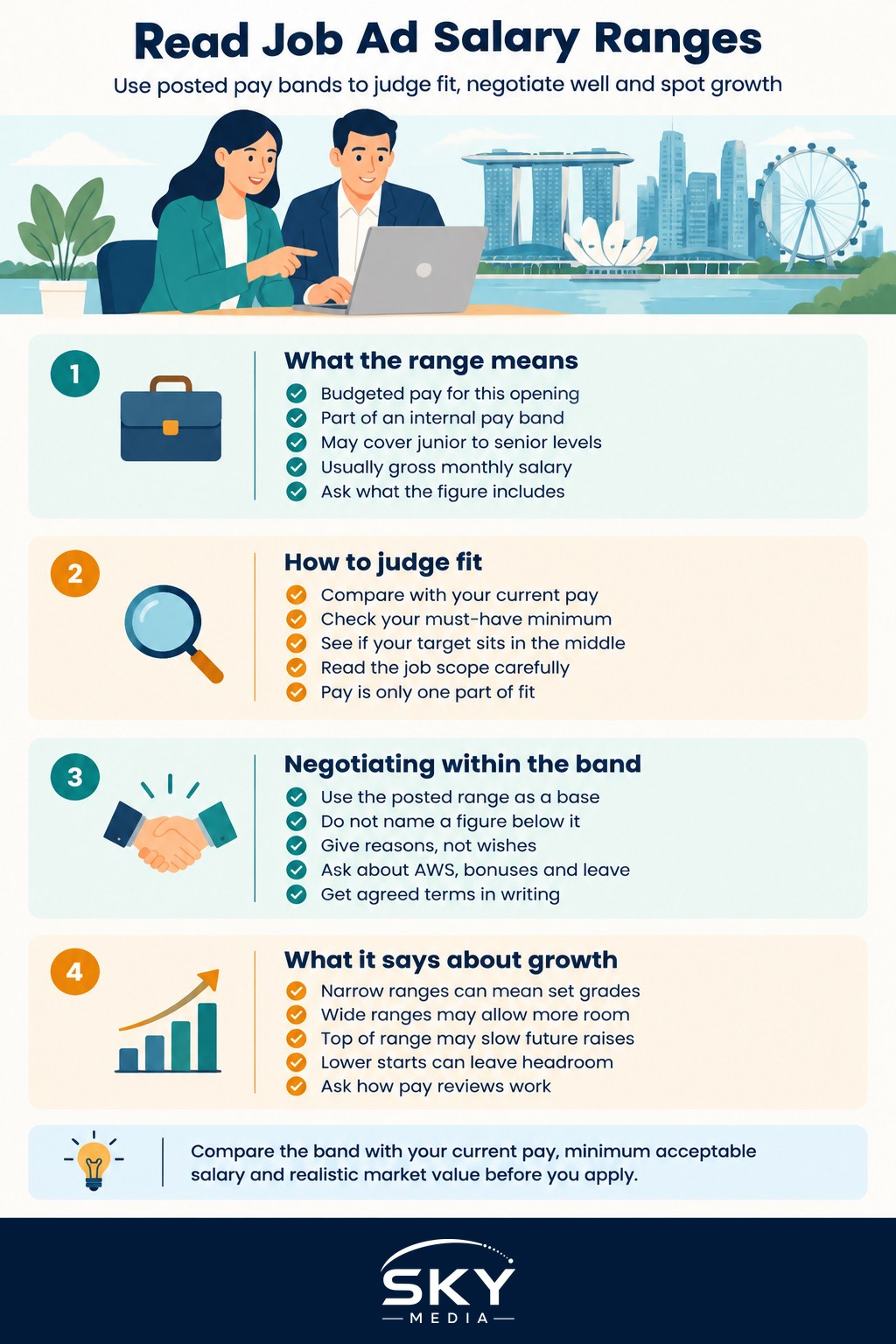
What a Posted Salary Range Usually Represents
Employers set ranges in different ways, so read the band as a signal, not a promise. Common patterns include:
- The budget for this hire. The range reflects what the hiring manager has been approved to pay for this particular opening.
- A slice of an internal pay band. Many organisations have grade bands for each level. The advertised range may be only part of that band, often the lower or middle portion, leaving room for later increases.
- A combined range for different levels. A wide range may mean the employer will hire at junior or senior level depending on who applies.
Pay attention to what the figure includes. In Singapore, job ads usually quote gross monthly salary, meaning before your employee CPF contribution is deducted if you are a citizen or permanent resident. Ads may not mention the Annual Wage Supplement (AWS, often called the 13th month bonus), variable bonuses, allowances or commission. Ask what is included before you compare two jobs.
On MyCareersFuture, the government-backed job portal, listings show a salary range, which makes it easier to compare roles. On other platforms, some employers still leave pay out, so you may need to ask during screening.
Using the Range to Judge Fit
Before you apply, compare the band to three things: your current pay, your must-have minimum, and your realistic market value from your own research.
- If your minimum sits above the top of the range, the role is unlikely to work unless the employer is flexible on level. It may still be worth one question to the recruiter, but do not spend hours on the application.
- If your target sits in the middle, you are in a good position. Your experience will determine whether you land at the midpoint or above it.
- If the range is well above what you earn now, read the requirements carefully. The role may be more senior than your current one. That is not a reason to skip it, but be ready to show why you can do the job.
- If the range is very wide, ask which level the team is really hiring for. A spread that large usually means more than one possible title.
Remember that pay is only part of fit. Hours, flexibility, learning opportunities and team culture matter too, and some of these can be negotiated as discussed in negotiating a job offer beyond the salary.
Where You Are Likely to Land in the Band
Most employers do not start new hires at the very top of their posted range, because it leaves no room for pay increases and can create gaps with existing staff. Where you land usually depends on how closely you match the requirements.
| Your profile against the job | Likely position in the range | How to approach the conversation |
|---|---|---|
| Meets the basic requirements, still learning parts of the role | Lower part of the range | Focus on growth plans and a review after a set period |
| Meets all requirements with relevant experience | Around the middle | Anchor on your results and comparable roles |
| Exceeds requirements or brings rare skills | Upper part of the range | Give specific evidence of impact and ask for the upper portion |
| Clearly above the level of the role | Top of range or a higher grade | Ask whether a more senior title or band is possible |
This is a general pattern, not a rule. Some employers pay a fixed rate for a role, and others have room above the advertised band for exceptional candidates.
Negotiating Within a Posted Range
A posted range changes negotiation in useful ways. You no longer have to guess the employer’s budget, and you can anchor on numbers they have already published.
- Avoid naming a figure below the range. If asked for your expected salary, it is reasonable to say you are looking at a figure within their posted band, based on your experience.
- Anchor with reasons, not wishes. Link your request to specific skills, results or certifications that match the job description.
- Clarify the full package. Ask about AWS, bonuses, allowances, leave and benefits. Two offers with the same base pay can differ a lot in total value.
- Ask about the review cycle. If the base cannot move, ask when the first salary review happens and what it is based on.
- Get it in writing. Before you resign from your current job, make sure the agreed salary and key terms appear in your written offer or employment contract.
Stay professional throughout. Employers expect some negotiation, and a calm, evidence-based request rarely harms an offer.
What the Range Says About Progression
The band also hints at your future at the company.
- Narrow ranges often suggest a structured grading system. Increases may come mainly through promotion to the next grade, so ask what that path looks like and how long it typically takes.
- Wide ranges can mean more room for raises within the same title, but also less clarity about how raises are decided.
- Starting near the top of a range feels good on day one but may mean smaller increases until you move up a level.
- Starting lower can leave more headroom, provided the company actually reviews pay regularly.
It is fair to ask in an interview how pay reviews work, how often they happen and how performance is measured. The answers tell you whether the band is a ceiling or a starting point.
Common Mistakes When Reading Salary Ranges
- Treating the top figure as the offer. Plan around the middle unless you clearly exceed the brief.
- Comparing monthly with annual figures. Convert everything to the same basis, and remember to account for AWS and bonuses separately.
- Ignoring take-home pay. For citizens and PRs, employee CPF contributions reduce monthly take-home pay. Check current contribution rates on the CPF Board website.
- Assuming a missing range means low pay. Some employers simply prefer to discuss pay later. Ask politely at the screening stage.
- Overlooking the job scope. A higher range sometimes comes with heavier responsibilities or longer hours.
Used well, a salary range in a job ad saves time for both sides. It helps you skip roles that will never meet your needs, negotiate from a clear starting point, and ask better questions about where the job can take you.
Explore more: Understanding Salary Benchmarks in Singapore and Salary Negotiation in Singapore.