
Choosing a school is one of the first big decisions you will make after moving here, and it is rarely as simple as picking the nearest campus. The choice between international schools Singapore families favour and the local MOE system shapes your child’s daily routine, your budget, and how easily they can move on later. This guide walks you through both paths in plain terms so you can weigh them with confidence.
Singapore is known for strong academics whichever route you take. The real question is which environment fits your child, how long you plan to stay, and what you can comfortably spend.
The local system: MOE schools explained
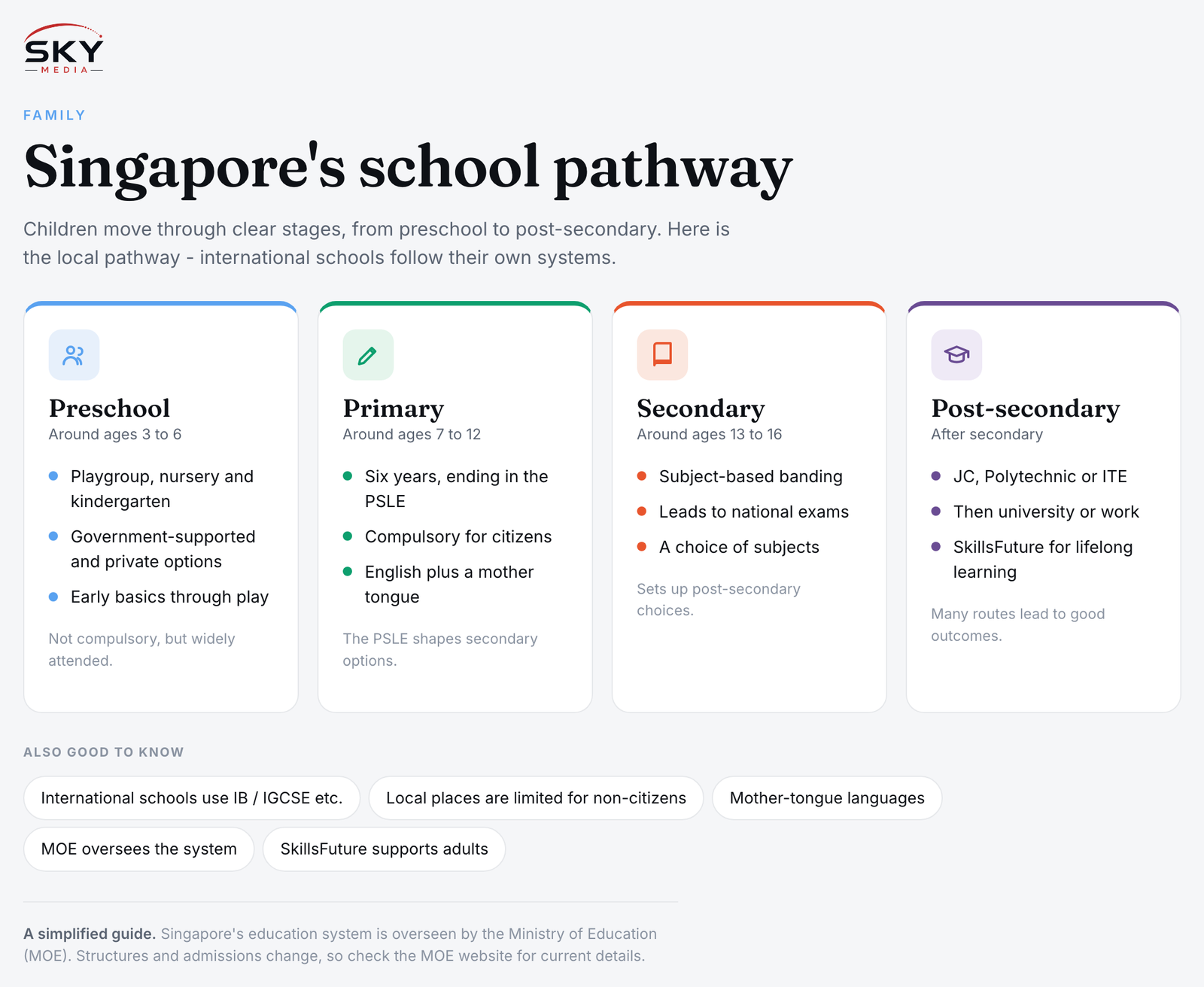
Local schools singapore residents rely on are run or overseen by the Ministry of Education (MOE). Children typically start at six with six years of primary school, then move to secondary school, and later to junior college, polytechnic or the Institute of Technical Education. The medium of instruction is English, with a compulsory “mother tongue” language (Mandarin, Malay or Tamil) for most students.
A defining feature is the Primary School Leaving Examination, or PSLE, sat at the end of Primary 6. It has traditionally influenced which secondary schools a child can enter, though the exact scoring and posting rules have been reformed over the years. Think of it as a national checkpoint rather than a single make-or-break test, and read the current MOE explanation before forming a view.
Admission priority and foreigner access
School admission to a popular MOE primary school runs through a phased registration exercise that gives priority in a clear order:
- Singapore citizens are placed ahead of permanent residents.
- Permanent residents are placed ahead of international students.
- Proximity to the school and existing sibling or alumni links can also matter.
For newcomers, the honest picture is that foreigner access to mainstream MOE schools is limited. International students usually enter through a separate placement route where seats are offered only after citizens and PRs are settled, and availability varies year to year. Some families sit an admissions test such as the AEIS for foreign students. If the local system appeals to you, contact MOE early and do not assume a place is guaranteed.
International schools: curricula and who they suit
International schools singapore hosts are private, fee-paying campuses that follow an overseas or globally recognised curriculum. They are popular with expatriate families, with parents who move often, and with locals seeking a particular teaching style (though local children generally need approval to attend).
Common curricula include:
- International Baccalaureate (IB): an inquiry-led programme ending in the IB Diploma, recognised by universities worldwide. If curriculum ib continuity matters to your family, this is often the anchor choice.
- British / IGCSE and A Levels: familiar to families arriving from the UK and many Commonwealth systems.
- American: high school diploma with Advanced Placement, suiting families heading to or from the United States.
- Other national systems: French, German, Japanese, Indian and more, each serving its own community.
International schools tend to offer smaller classes, broad co-curricular options and a diverse student body. The trade-off is cost and, at sought-after campuses, waitlists. Popular schools can fill year groups well ahead, so apply early and ask to be waitlisted rather than waiting for a perfect slot.
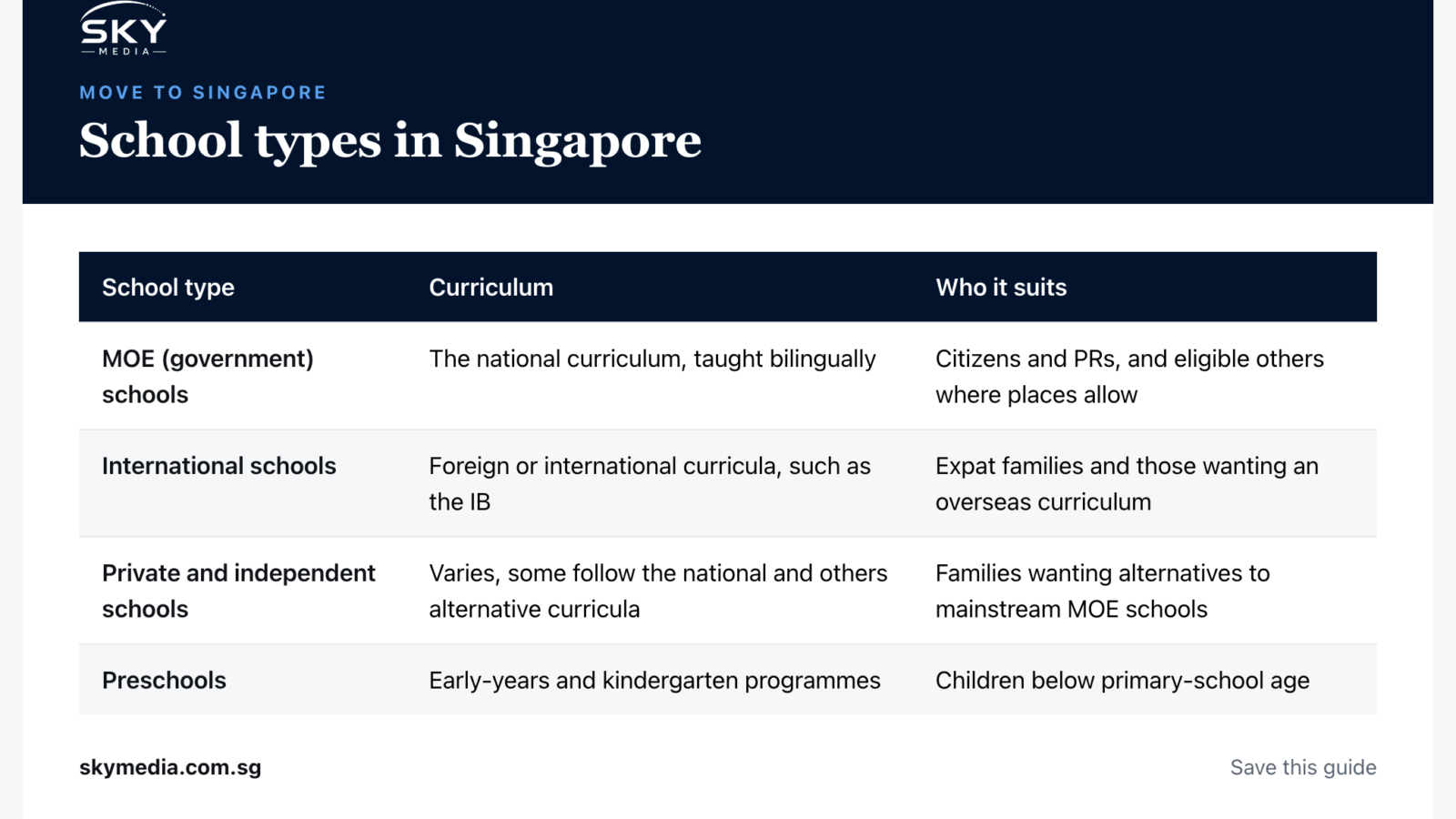
Here is how the main types of school compare:
| School type | Curriculum | Who it suits |
|---|---|---|
| MOE (government) schools | The national curriculum, taught bilingually | Citizens and PRs, and eligible others where places allow |
| International schools | Foreign or international curricula, such as the IB | Expat families and those wanting an overseas curriculum |
| Private and independent schools | Varies, some follow the national and others alternative curricula | Families wanting alternatives to mainstream MOE schools |
| Preschools | Early-years and kindergarten programmes | Children below primary-school age |
A quick word on fees
Fees deserve a clear-eyed look. As a rough guide, international school tuition typically runs from the low tens of thousands of dollars a year at the lower end to substantially more at premium campuses, and that is before registration deposits, uniforms, transport, exam charges and annual increases. MOE schools charge foreign students monthly fees too, which are far lower than international schools but still meaningful and reviewed periodically.
Treat every number you read as a starting point, not a quote. Fees and admissions rules change regularly. Always confirm the latest directly with MOE and with each school’s admissions office before you budget or commit.
Preschools: a brief note
If your child is younger, preschool (childcare and kindergarten, roughly ages eighteen months to six) is a separate landscape. Options range from government-supported anchor operators to private and international preschools, with fees and waitlists to match. Citizens and PRs can access subsidies that foreigners generally cannot, so factor that in and check current details with the Early Childhood Development Agency (ECDA).
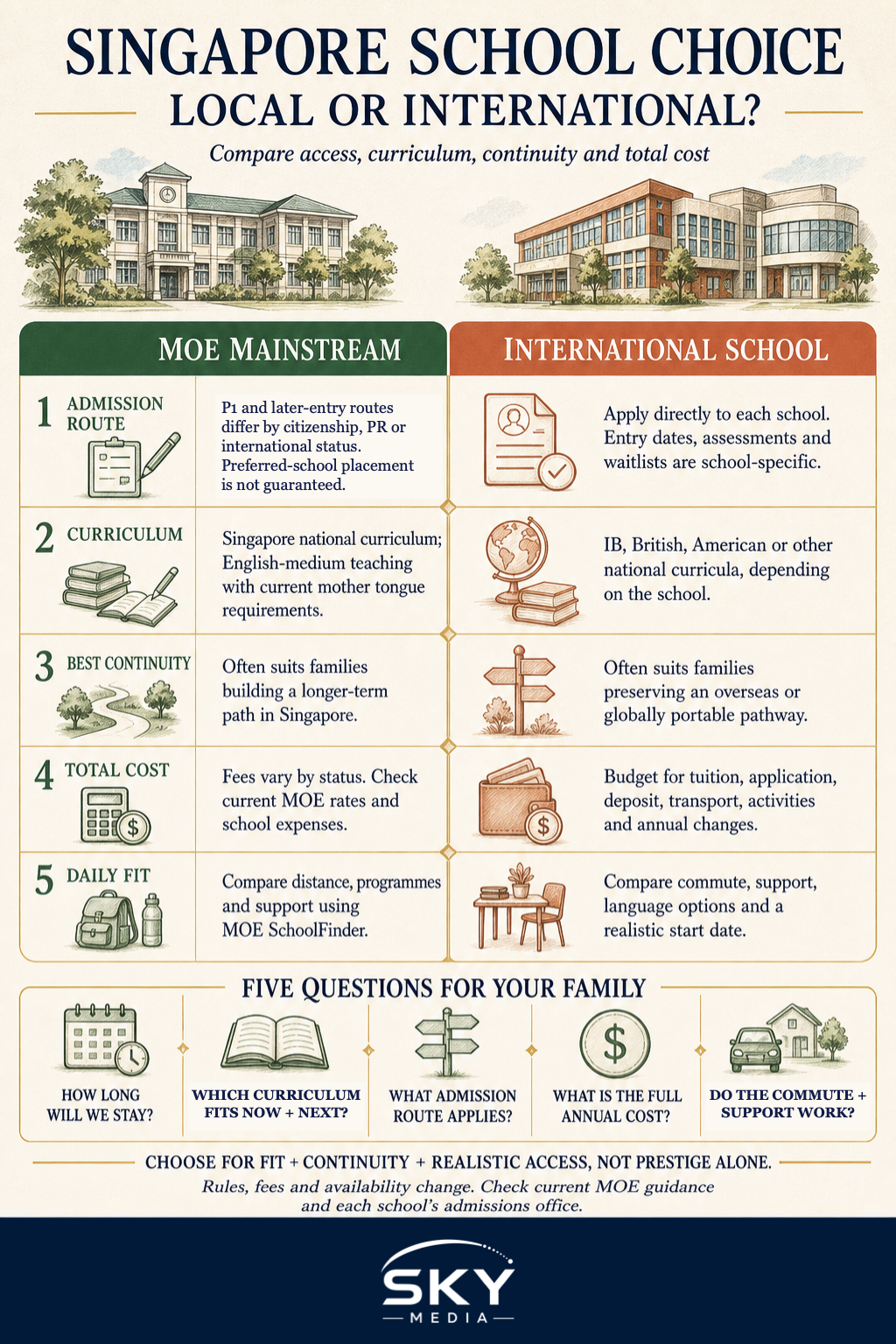
How to choose: four practical questions
Rather than starting with league tables, start with your own situation. These four questions usually point to the right fit.
- Length of stay. Here for two or three years and likely to move again? An international curriculum that travels well, such as the IB, reduces disruption. Settling long term or aiming for local roots? The MOE path may serve you better and costs far less.
- Budget. Be realistic about the full annual cost, not just headline tuition. International fees can be a major line in a family budget; MOE foreign-student fees are gentler on the wallet.
- Curriculum continuity. Match the school to where your child has come from and where they are likely to go next, so they are not forced to switch systems mid-stream.
- Language. MOE schools require a mother tongue language, which suits some families and challenges others. International schools offer more flexible language pathways.
Quick checklist before you apply
- Shortlist by curriculum and location, then check current fees on each school’s site.
- Confirm foreigner admission rules and timelines with MOE for local schools.
- Ask each international school about waitlists and realistic start dates.
- Visit campuses (in person or virtually) and speak to current parents.
- Budget for the full year, including deposits and extras, not just tuition.
- Sort your family’s immigration status early, as it affects eligibility.
The right school is the one that fits your child and your circumstances, not simply the most famous name. Take your time, verify everything with official sources, and give yourself a longer runway than you think you need, especially where waitlists are involved.
Explore more: Dependant’s Pass family guide · Where to live in Singapore