

Parent Relief is one of the most widely claimed personal reliefs in Singapore, and also one of the most commonly double-claimed. The reason is simple: when several adult children support the same mum or dad, each of them may assume they can claim the full amount. They cannot. Parent relief siblings arrangements need a quick family conversation every tax season, and getting it right avoids letters from IRAS (the Inland Revenue Authority of Singapore) and awkward conversations later.
This guide focuses on that coordination: how the sharing works, how to decide the split, and what to do when siblings disagree. It is general information, not tax advice. Reliefs and their conditions can change in Singapore’s annual Budget, so confirm the current rules on IRAS before filing.
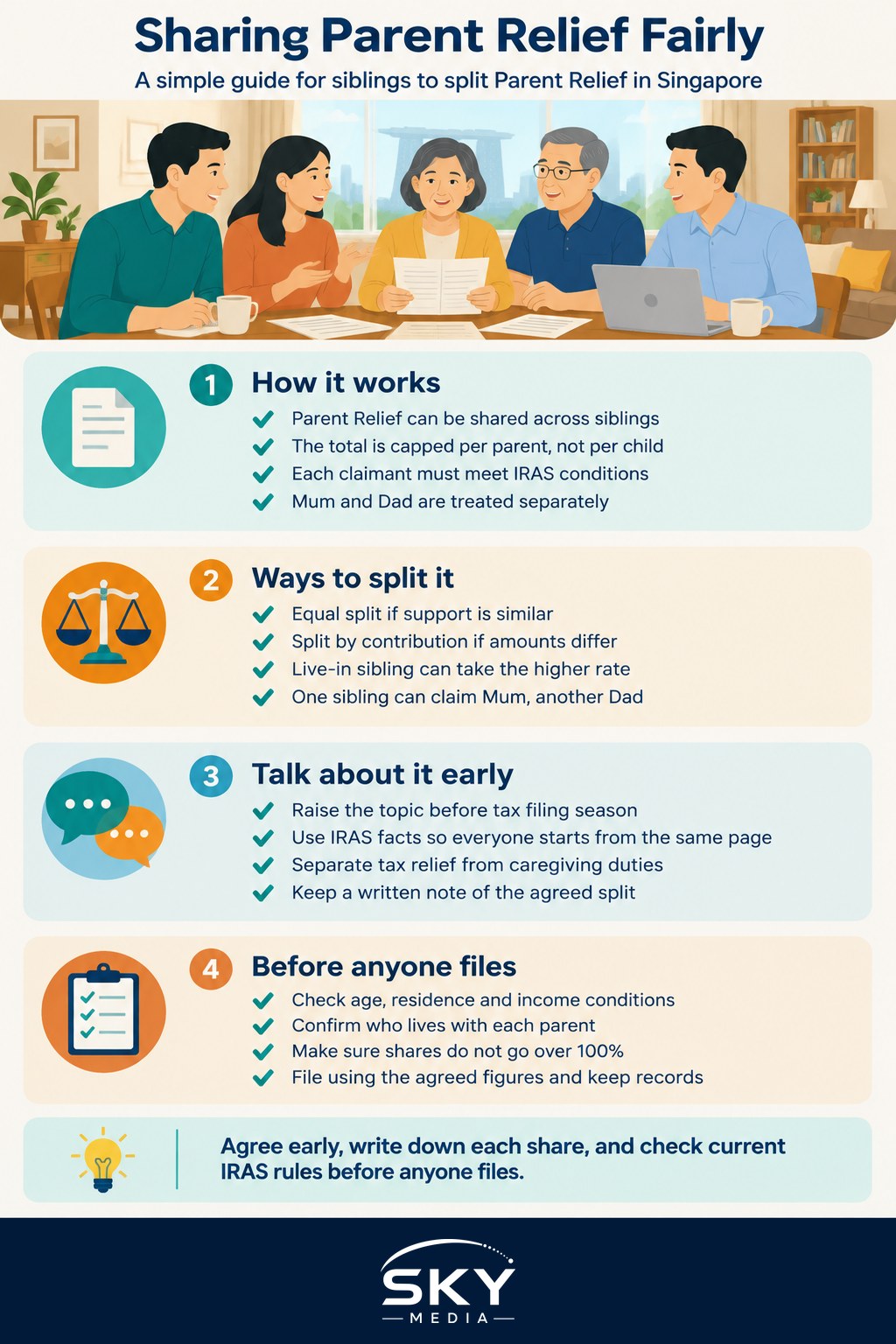
How Parent Relief Works in Brief
Parent Relief lets you reduce your chargeable income when you support a parent, grandparent, parent-in-law or grandparent-in-law. IRAS sets conditions that generally cover:
- Age or disability. The parent must meet a minimum age, or be physically or mentally disabled.
- Residence. The parent must be living in Singapore.
- Their income. The parent’s own income in the previous year must not exceed the limit set by IRAS.
- Your support. You must have supported the parent financially by at least the amount IRAS specifies, or lived with them in the same household.
The relief amount is higher if the parent lives with you than if they live elsewhere, and a higher Handicapped Parent Relief applies if the parent is disabled. Check the current amounts and thresholds on IRAS, as they are reviewed from time to time. For a broader look at reliefs for supporting family, see Tax Reliefs and Rebates for Parents in Singapore.
The Sharing Rule Siblings Need to Know
The core principle is that Parent Relief is capped per parent, not per child. If three siblings support the same mother, the three of them share one relief for her, in whatever proportion they agree on.
A few points follow from that:
- Each claimant states their share. When filing, each sibling indicates the parent’s details and the percentage or amount they are claiming.
- The total cannot exceed the cap. If the shares add up to more than the full relief, IRAS will adjust the claims, which usually means letters and revised assessments for everyone.
- Each parent is counted separately. Mum and Dad are two separate reliefs. One sibling could claim for Mum while another claims for Dad.
- In-laws count too. A married sibling can claim for their spouse’s parents, which means your parents-in-law may also be claimed by your spouse’s siblings. Coordination stretches across both families.
- Sharing is built in. Unlike Grandparent Caregiver Relief, which only one person can claim per caregiver, Parent Relief is designed to be shared.
If siblings cannot agree, IRAS has rules on how claims will be treated. Do not rely on that as a fallback. Agree first.
Ways Families Split Parent Relief
There is no single right way to divide the relief. What matters is that everyone agrees and the totals add up.
| Approach | How it works | Works well when |
|---|---|---|
| Equal split | Each sibling claims the same share for each parent | Siblings contribute roughly equally to support |
| By contribution | Shares follow how much each sibling actually gives | Contributions differ a lot between siblings |
| Live-in sibling claims | The sibling living with the parent claims the higher live-in relief | One sibling is the main carer at home |
| Highest tax bracket claims | The sibling who saves the most tax takes the larger share | Siblings agree to optimise the family’s total tax |
| One parent each | One sibling claims Mum, another claims Dad | There are two siblings and two eligible parents |
A few practical points when choosing:
- Tax savings vary by income. A relief saves more tax for someone in a higher bracket. Giving a bigger share to the highest earner can lower the family’s total tax, but only if the others are comfortable with it.
- Watch the overall relief cap. Total personal reliefs per person are capped at $80,000 per Year of Assessment. A sibling already near the cap gains little from extra Parent Relief.
- Check each claimant qualifies. A sibling who did not meet the support condition cannot claim, even if the family agrees.
- The live-in amount depends on actually living together. Only siblings who live in the same household as the parent should use the higher live-in rate. Others claim at the not-living-together rate for their share.
Having the Conversation Without Friction
Money talk between adult siblings can be sensitive, especially when one sibling does more of the caring. Tax relief is a small part of supporting a parent, but it can stand in for bigger feelings about fairness.
- Raise it early. A short message in the family group chat in March is easier than a scramble the night before the deadline.
- Keep it factual. Share the relief amounts and the conditions from IRAS so everyone works from the same information.
- Separate tax from care. The sibling doing the most hands-on caregiving may not be the one who benefits most from the relief. Some families agree to split the relief one way and balance things in other ways, such as sharing costs differently.
- Write it down. A shared note listing who claims what percentage for each parent saves the same discussion next year.
- Review yearly. Jobs, incomes and living arrangements change. What made sense last year may not this year.
If wider tension comes up, our guide to Coordinating Elderly Care Among Siblings covers how families divide caregiving responsibilities more broadly.
Related Ways to Support Parents Through Tax
Parent Relief is not the only option. If your parents need more retirement savings, cash top-ups to their CPF retirement account may qualify for a separate relief, subject to conditions and caps set by CPF Board and IRAS. That relief is also something siblings should discuss, since parents’ accounts have limits on how much they can receive. Read more in Topping Up Your Parents’ CPF for Tax Relief.
A Sibling Checklist Before Anyone Files
- Confirm each parent and parent-in-law still meets IRAS’s age, residence and income conditions.
- List every sibling, and every spouse, who might claim for each parent.
- Agree the percentage each person will claim, and make sure the totals add up to no more than 100 per cent per parent.
- Confirm who lives with each parent, for the live-in amount.
- Each person files with the agreed figures before the mid-April deadline. Check the exact date on IRAS.
- Keep a record of what was agreed.
If a mistake slips through, IRAS allows you to correct your return or object to your assessment within a set period. A short family agreement each year keeps the relief working as intended, as a small recognition of the support you all give your parents.
Official sources: IRAS
Further reading: NSman Tax Relief Explained: Self, Wife and Parent Relief