

For a small, dense city, Singapore hides a surprising amount of green. Hiking Singapore is one of the easiest and most rewarding ways to escape the traffic and the malls for a morning, whether you have lived here for years or only just arrived. You can be standing under a rainforest canopy, watching monkeys crash through the branches, less than half an hour from the city centre. This guide walks you through the best-known nature trails Singapore has to offer, with rough difficulty and length for each, what wildlife to expect, and how to stay comfortable in the heat.
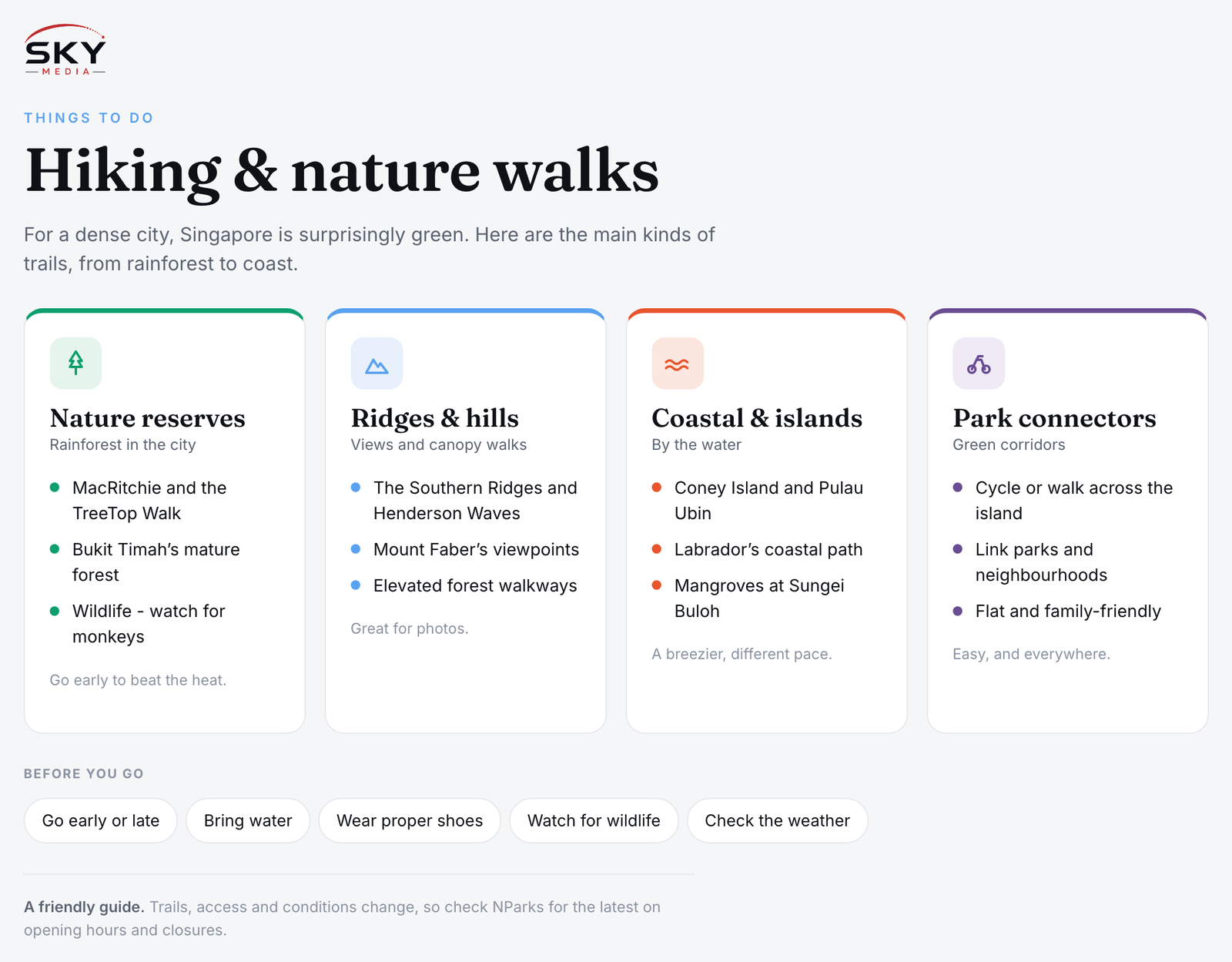
What “hiking” means here
Set your expectations correctly and you will enjoy every outing. There are no mountains and no altitude to worry about. The real challenge is the climate: it is warm and humid all year, so a flat, shaded 5km walk can feel tougher than it looks. Most trails are well maintained, clearly signposted and family friendly, with the odd steeper or rougher section noted below.
Distances and timings here are a rough guide only. Take them as a starting point and go at your own pace.
The best trails
MacRitchie and the TreeTop Walk
The MacRitchie Reservoir is the classic introduction to nature trails Singapore locals return to again and again. Boardwalks hug the water, and a network of paths threads through mature secondary rainforest. The headline attraction is the TreeTop Walk, a free-standing suspension bridge strung high across a valley, giving you an eye-level view of the forest canopy.
- Difficulty: moderate, mostly for the distance
- Length: the full loop to the TreeTop Walk and back is roughly 10km to 11km and can take 3 to 4 hours
- Good to know: the TreeTop Walk is one-directional and closes on Mondays, so check before you go
You will almost certainly meet long-tailed macaques here. Keep your distance, hold on to your bag, and never feed them.
Bukit Timah Nature Reserve
If you want a proper climb, the Bukit Timah hike delivers. This reserve protects one of the last patches of primary rainforest in the country and includes Bukit Timah Hill, the highest natural point in Singapore at around 164 metres.
- Difficulty: moderate to challenging on the steeper summit routes
- Length: the main paved summit road is short but steep; combining it with the surrounding nature trails makes a 3km to 6km outing
- Good to know: the summit road is the gentlest way up, while the side trails are rockier and more of a workout
Monkeys are common near the entrance and car park. This is exactly where the “do not feed” rule matters most.
The Southern Ridges and Henderson Waves
The Southern Ridges is a chain of green spaces linked by walkways and bridges that let you traverse several hilltop parks without touching a main road. The star is Henderson Waves, a sculptural pedestrian bridge whose curving timber ribs make it the highest and arguably the prettiest of its kind here, especially at dusk.
- Difficulty: easy to moderate
- Length: the full connected route runs roughly 10km, but you can join or leave at many points for a shorter walk
- Good to know: much of the route is elevated and breezy, which makes it more forgiving in the heat than a closed-in forest trail
Coney Island
Out on the northeast coast, Coney Island (Pulau Serangoon) is a flat, rustic park of casuarina trees, grassland and quiet beaches. It feels wonderfully remote for somewhere so accessible.
- Difficulty: easy
- Length: the main path across the island is around 2.5km one way
- Good to know: there is little shade in places and no shops inside, so bring your own water
Look out for monitor lizards near the water and a rich variety of birds.
Chestnut Nature Park
Chestnut is Singapore’s largest nature park and the go-to spot if you want dedicated, separated trails for walking and mountain biking. The hiking trails wind gently through regenerating forest.
- Difficulty: easy to moderate
- Length: the hiking trails total several kilometres split across a north and south section
- Good to know: walking and cycling routes are kept apart, which makes it relaxing on foot
The Rail Corridor
The Rail Corridor is a long, green ribbon following the old railway line that once ran the length of the island. It is flat, straight and open, making it ideal for a gentle long-distance walk or a run.
- Difficulty: easy
- Length: the full corridor stretches roughly 24km, so most people do a section at a time
- Good to know: it links up with parks and neighbourhoods along the way, so it is easy to plan a manageable stretch between two stations
Pulau Ubin and Chek Jawa
For a genuine day trip back in time, hop on a bumboat to Pulau Ubin, an island that preserves the kampong (village) life of old Singapore. The highlight for nature lovers is Chek Jawa, where a boardwalk loops out over one of the richest intertidal ecosystems in the region.
- Difficulty: easy to moderate, depending on how far you explore
- Length: the Chek Jawa boardwalk loop is around 1km; getting there and exploring more of the island adds up quickly
- Good to know: time your visit for low tide to see the mudflats at their best, and consider renting a bicycle to cover more ground
Wildlife here is the main event: wild boar, monitor lizards, mudskippers, crabs and plenty of birdlife.
Here is how some of the best-known trails compare:
| Trail | Difficulty | Highlight |
|---|---|---|
| MacRitchie and the TreeTop Walk | Moderate | A suspension bridge over the forest canopy |
| Bukit Timah Nature Reserve | Moderate to hard | Singapore’s highest hill and old rainforest |
| Southern Ridges | Easy | Henderson Waves and elevated city views |
| Coney Island | Easy | Flat, rustic and breezy by the sea |
| Pulau Ubin and Chek Jawa | Easy to moderate | Kampong life and rich coastal wildlife |
Wildlife you will meet
Part of the joy of hiking Singapore is sharing the trail with its residents. The two you will see most often:
- Long-tailed macaques: clever, bold and used to people. Do not carry food in your hands, do not make eye contact if one approaches, and never feed them. Feeding is both harmful and, in protected areas, against the rules.
- Monitor lizards: large but shy, often near water. They will almost always move away from you. Give them space and enjoy the sight.
You may also spot squirrels, wild boar (especially on Ubin), snakes and a wonderful range of birds. Watch, photograph, and leave everything where it is.
Heat and hydration
The climate is the one thing that catches newcomers out, so treat it seriously.
The heat is the trail’s real difficulty. Respect it and everything else is easy.
Quick tips before you set off:
- Start early, ideally soon after sunrise, or head out in the late afternoon to dodge the midday sun.
- Carry more water than you think you need. Roughly a litre per person for a short walk, more for the longer loops.
- Wear light, breathable clothing, a hat and proper walking shoes with grip for the wet, rooty sections.
- Use sunscreen and reapply, and bring insect repellent for the shadier forest trails.
- Watch the sky. Afternoon thunderstorms are common, so have a rough plan for shelter and turn back if you hear thunder.
- Know your exit points on the longer trails so you can cut a walk short comfortably.
Trail etiquette
A few simple habits keep these places pleasant for everyone and safe for the wildlife:
- Keep to the marked paths, both to protect fragile habitats and to keep yourself safe.
- Take all your litter home, including fruit peel and tissues.
- Do not feed any animal, ever.
- Keep noise down so you and others can actually hear and see wildlife.
- Give way to others on narrow boardwalks, and keep left where paths are shared with cyclists.
Best times to go
Weekday mornings are the quietest and coolest window, and you will have the boardwalks nearly to yourself. Weekends are busier but still enjoyable if you arrive early. There is no true off-season here, so any month works; just plan around the daily heat rather than the calendar, and always check whether a specific trail, such as the TreeTop Walk, has a rest day before you travel.
Lace up, fill your bottle, and go and find the wild side of the city.
Explore more: The best parks in Singapore · A guide to Pulau Ubin · Surviving the Singapore heat