
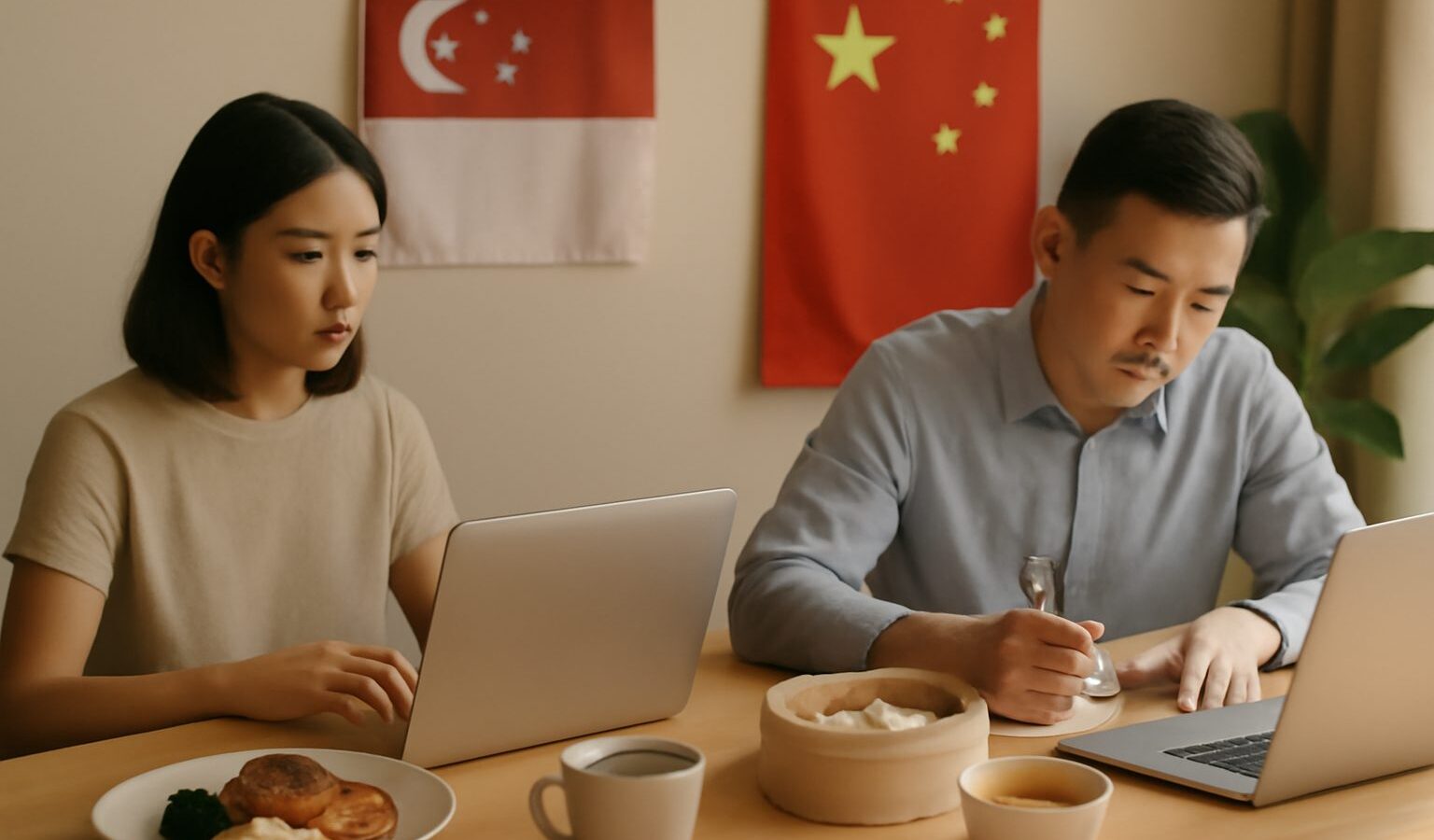
If you have recently moved from mainland China and started a job here, the biggest surprises are rarely about the work itself. They are about the rhythm of the office, who speaks when, and how a simple message gets sent. Understanding Singapore work culture early saves you from small misreadings that add up. This guide compares the workplace norms you knew in China with what you will meet here, in a practical and even-handed way, so you can settle in without second-guessing every email.
None of this means one system is better than the other. Both places have serious, hard-working professionals. The point is to help you map the new environment onto the familiar one, then adjust the few habits that actually matter.
Hours, Pace, and the 996 Contrast
The most talked-about difference is time. In parts of China’s tech and startup world, “996” (9am to 9pm, six days a week) became shorthand for long, always-on hours. Singapore’s default is different. A standard office week is closer to Monday to Friday, roughly nine hours a day including a lunch break, with the weekend genuinely off for most white-collar roles. Overtime happens, especially near deadlines or in finance, law, and consulting, but it is not usually treated as a badge of loyalty.
Staying late for its own sake is not expected and can even read as poor planning. What managers value is that the work is done well and on time. If you finish early, leaving is normal, not suspicious. Presence matters less than output.
That said, “work-life balance” here is a norm, not a guarantee. Some industries and some bosses are demanding. The healthy approach is to deliver reliably, communicate when something will slip, and protect your own hours without making a show of it. Employment terms, leave, and overtime rules are set out by the Ministry of Manpower (MOM), and specifics change, so check the current position on the MOM website or your contract rather than assuming.
Hierarchy, Meetings, and Speaking Up
Chinese workplaces often run on clear seniority, where deference to the boss (领导) shapes how much a junior person says in the room. Singapore sits in a middle position. There is real respect for seniority and titles, but the distance is usually smaller and the tone flatter than you may be used to.
In meetings, you are often expected to contribute even as a newcomer. Silence can be read as disengagement rather than politeness. You do not need to challenge your manager bluntly, but offering a considered view, asking a clarifying question, or flagging a risk is welcomed. Disagreement is fine when it is framed around the work, not the person.
A few practical habits help:
- Address people by their first name unless told otherwise; many bosses prefer it.
- In a group discussion, wait for a natural gap, then make your point concisely.
- If you disagree, lead with the shared goal, then your concern: “To hit the launch date, I think we should test this first.”
- Do not assume the most senior person will decide everything; teams here often reach decisions together.
Communication: Email, Teams, and the WeChat Gap
This is where newcomers stumble most. In China, much work life runs through WeChat, including group chats with the boss, quick voice messages, and files passed around informally. In Singapore, the backbone of professional communication is email, with Microsoft Teams, Slack, or WhatsApp for quicker exchanges depending on the company.
Email carries weight here. It is the record, the trail, and the polite default for anything that needs confirming. A well-structured email with a clear subject line, a short ask, and a sign-off is a real professional skill. Instant messages are for speed and coordination, not for decisions that need documenting.
Two habits worth adopting quickly. First, keep a paper trail: after a verbal agreement or a call, a short “confirming what we discussed” email is normal and appreciated, not distrustful. Second, mind the boundary. Messaging a colleague at midnight is not automatically expected, and many people mute work chats after hours. Voice messages, so common on WeChat, are used sparingly here; a typed message is usually preferred because it can be scanned and searched.
Multicultural Teams and English as the Working Language
Singapore teams are genuinely mixed: Chinese, Malay, Indian, Eurasian colleagues, plus people from across the region and the world. English is the working language, even in offices with many Mandarin speakers. Meetings, emails, and documents default to English, and switching into Mandarin in a mixed group can unintentionally exclude others.
Your English does not need to be perfect. Clear and polite beats fluent and fast. Colleagues are used to a range of accents and will meet you halfway. What helps most is learning the local shorthand over time and being comfortable asking someone to repeat themselves. If you want structured help, that is a common and unremarkable step for newcomers, not a mark against you.
The multicultural setting also shapes etiquette: be mindful of dietary needs at team meals (halal, vegetarian), respect the mix of festivals, and keep humour gentle until you know the room. Small awareness goes a long way.
China vs Singapore Workplace Norms at a Glance
The table below sums up the everyday contrasts. Treat it as a general guide; every company and boss is different.
| Workplace norm | Mainland China (common pattern) | Singapore (common pattern) |
|---|---|---|
| Typical hours | Long days common in some sectors, 996 in parts of tech | Standard weekday hours, weekend usually off |
| Main channel | WeChat groups, voice messages | Email as the record, Teams/Slack/WhatsApp for speed |
| Hierarchy | Clear deference to seniority | Respect for seniority, flatter and more open |
| Speaking up | Often cautious with the boss | Contributing in meetings is expected |
| Working language | Mandarin | English, in multicultural teams |
| Feedback style | Can be indirect or given privately | Direct but polite, often constructive |
| After-hours contact | Often expected in some jobs | Frequently muted; boundaries respected |
Feedback, Trust, and How to Adapt
Feedback in Singapore tends to be direct but courteous. A manager may tell you plainly what to fix, without it being personal or a loss of face. Equally, you are allowed to ask for feedback and to say when you need help. Admitting you are unsure is seen as sensible, not weak, as long as you then follow through.
Trust here is built through reliability and clear communication rather than long hours or after-work socialising, though team lunches and the occasional gathering do help you belong. To adapt smoothly:
- Deliver on what you promise, and flag slippage early.
- Default to email for anything important; keep messages clear and brief.
- Speak up in meetings, respectfully, even when junior.
- Use English in mixed groups, and be patient with your own progress.
- Respect people’s off-hours the way you would want yours respected.
Give yourself a few months. The norms become second nature faster than you expect, and the flatter, more documented style often feels like a relief once you settle in.
This article is general information, not professional advice. Employment rules and rights change, so verify your specific terms with your contract and the Ministry of Manpower (MOM).
Explore more
Strengthening your English at work pays off quickly, so see learning English for Mandarin speakers in Singapore for practical, low-pressure options. For the wider culture shift beyond the office, mainland vs Singapore Chinese culture and settling in Singapore, a guide for newcomers from China help you find your feet.