

If an interviewer has ever said “tell me about a time when you…”, you have faced a behavioural question. These questions assume that how you handled real situations in the past is the best predictor of how you will handle them in the new job. The STAR method interview framework gives you a simple structure for answering them: Situation, Task, Action, Result. It keeps your story focused, shows your judgement and ends on evidence rather than vague claims.
Behavioural questions are common in interviews across Singapore, from banks and multinationals to the public service and SMEs. This guide explains each part of STAR, gives worked examples set in local workplaces, and shows the mistakes that make good stories fall flat.
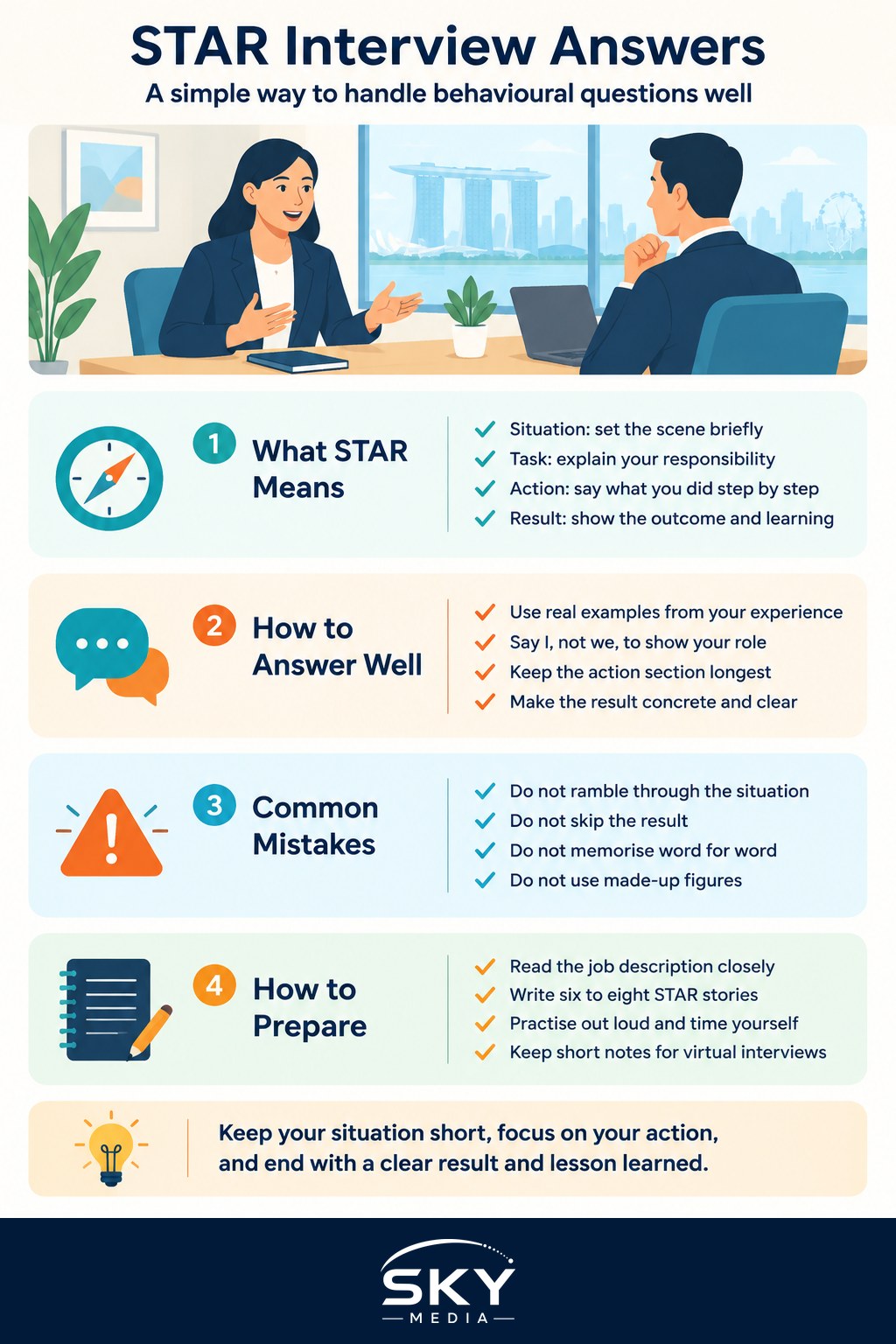
What Each Letter Means
Situation. Set the scene in one or two sentences. Where were you, what was your role and what was going on? Give just enough context for the interviewer to follow.
Task. Explain what you were responsible for, or the problem you needed to solve. This is your goal, not the team’s general goal.
Action. Describe what you did, step by step. This is the heart of the answer and should take the most time. Use “I”, not “we”, so the interviewer can see your contribution.
Result. Share the outcome. Where possible, make it concrete: a deadline met, a complaint resolved, a process that became faster, feedback you received. Then add what you learned or would do differently.
A good rough split is about 15% Situation, 10% Task, 55% Action and 20% Result. A full answer usually runs one and a half to two and a half minutes when spoken.
STAR Done Well vs Done Poorly
| Part | Weak answer | Strong answer |
|---|---|---|
| Situation | Long backstory about the company’s history | One or two sentences of relevant context |
| Task | “We had to fix things” | “I had to clear a backlog of 40 customer refund cases in two weeks” |
| Action | “We worked hard and communicated” | Specific steps you took, in order, with reasons |
| Result | “It went well” | A clear outcome plus what you learned |
The example numbers in your own answers should be real ones from your experience. Interviewers often probe further, and invented figures are easy to expose.
Worked Example 1: Handling a Difficult Customer
Question: “Tell me about a time you dealt with an unhappy customer.”
Situation: “I was a customer service executive at a telco retail outlet in a heartland mall. On a busy Saturday, a customer came in upset because his mobile line had been suspended while he was overseas.”
Task: “My job was to calm the situation, find out what had gone wrong, and get his line working before he left the shop if possible.”
Action: “First I moved him to a quieter counter so we could talk properly. I listened without interrupting and repeated back what I understood. I checked his account and found the suspension came from a missed payment after his card expired. I explained it plainly, without blaming him, helped him update his payment method, and called our back-office team to request reactivation. While waiting, I showed him how to set up auto-payment reminders in the app.”
Result: “His line was restored within the visit. He later left positive feedback mentioning me by name. I also flagged to my supervisor that expired-card suspensions were a common complaint, and we started reminding customers about card expiry at the counter.”
Notice how the action is detailed and personal, and the result includes a small improvement beyond the single case.
Worked Example 2: Working Through a Team Conflict
Question: “Describe a time you disagreed with a colleague.”
Situation: “In my previous role as a marketing executive at an SME, a colleague and I were jointly planning a Great Singapore Sale campaign. We disagreed on whether to spend more on social ads or on in-store promotions.”
Task: “We needed to agree a plan and submit it to our manager within a week.”
Action: “I suggested we each list our assumptions and look at results from the previous year’s campaign together. I pulled the data on which channel had brought in more first-time customers. It turned out both channels performed well for different products. I proposed a split plan and offered to track results weekly so we could shift budget if one channel underperformed.”
Result: “Our manager approved the plan, and the weekly tracking let us move some budget midway. More importantly, my colleague and I worked well together on the next two campaigns because we had a shared way to settle disagreements.”
Worked Example 3: For Fresh Graduates
You do not need years of work experience to use STAR. Projects, CCAs, internships, part-time jobs and National Service all count.
Question: “Tell me about a time you showed leadership.”
Situation: “In my final year at polytechnic, I led a five-person team on a capstone project for an industry partner.”
Task: “Two weeks before submission, one teammate fell ill and we were behind on testing.”
Action: “I redistributed his tasks based on each person’s strengths, set up short daily check-ins, and took over the testing schedule myself. I also emailed our supervisor early to explain the situation, rather than waiting until the deadline.”
Result: “We submitted on time and the partner adopted part of our prototype. I learned that raising problems early builds trust.”
Common Mistakes to Avoid
- Saying “we” throughout. The interviewer is hiring you. Credit the team, but make your role clear.
- Choosing a story with no real challenge. Pick situations where something was at stake.
- Skipping the result. Many candidates trail off after the action. Always land the ending.
- Using a negative result without reflection. A failure story is fine if you show what you learned and changed. This is the best way to handle “tell me about a mistake”.
- Memorising word for word. Know your key points, but speak naturally. Interviewers can tell when an answer is recited.
- Rambling on the situation. If you are two minutes in and still explaining the background, cut it short.
For questions that are less about past behaviour and more about putting you on the spot, see How to Answer Tricky Interview Questions.
How to Prepare a STAR Story Bank
- Read the job description. List the competencies it stresses, such as teamwork, problem-solving, customer focus, leadership or handling pressure.
- Write six to eight stories. Aim for at least one per competency. Many good stories can be adapted to several questions.
- Jot each in STAR form. Keep notes to bullet points, not scripts.
- Collect real outcomes. Look back at emails, appraisals or project reports for facts you can cite honestly.
- Practise out loud. Time yourself and ask a friend to ask follow-up questions like “why did you choose that?” or “what would you do differently?”
- Prepare for virtual interviews. Many Singapore employers use video calls for first rounds. Keep a short note of story headings beside your screen, not full scripts.
When the interviewer asks if you have anything for them, be ready with good questions too; our guide on questions to ask your interviewer can help.
Final Tips
The STAR method interview approach works because it turns vague strengths into evidence. Keep the situation short, put your energy into the action, and always finish with a result and a lesson. With a bank of well-practised stories, most behavioural questions become a matter of picking the right one and telling it clearly.
Further reading: How to Prepare for a Technical or Coding Interview · One-Way Video Interviews: How to Record Answers That Impress · How to Pass a Phone Screening Interview With HR