

Starting a consulting business in Singapore is one of the lowest-cost ways to turn hard-won expertise into income. You are selling knowledge and judgement, not stock, so your main outlay is your own time. That said, the freedom cuts both ways: no employer feeds you work, and clients pay for outcomes rather than hours in a seat. This guide walks through the honest realities, from defining what you sell to pricing it and winning the first few clients, so you can build something steady rather than lurching from project to project.
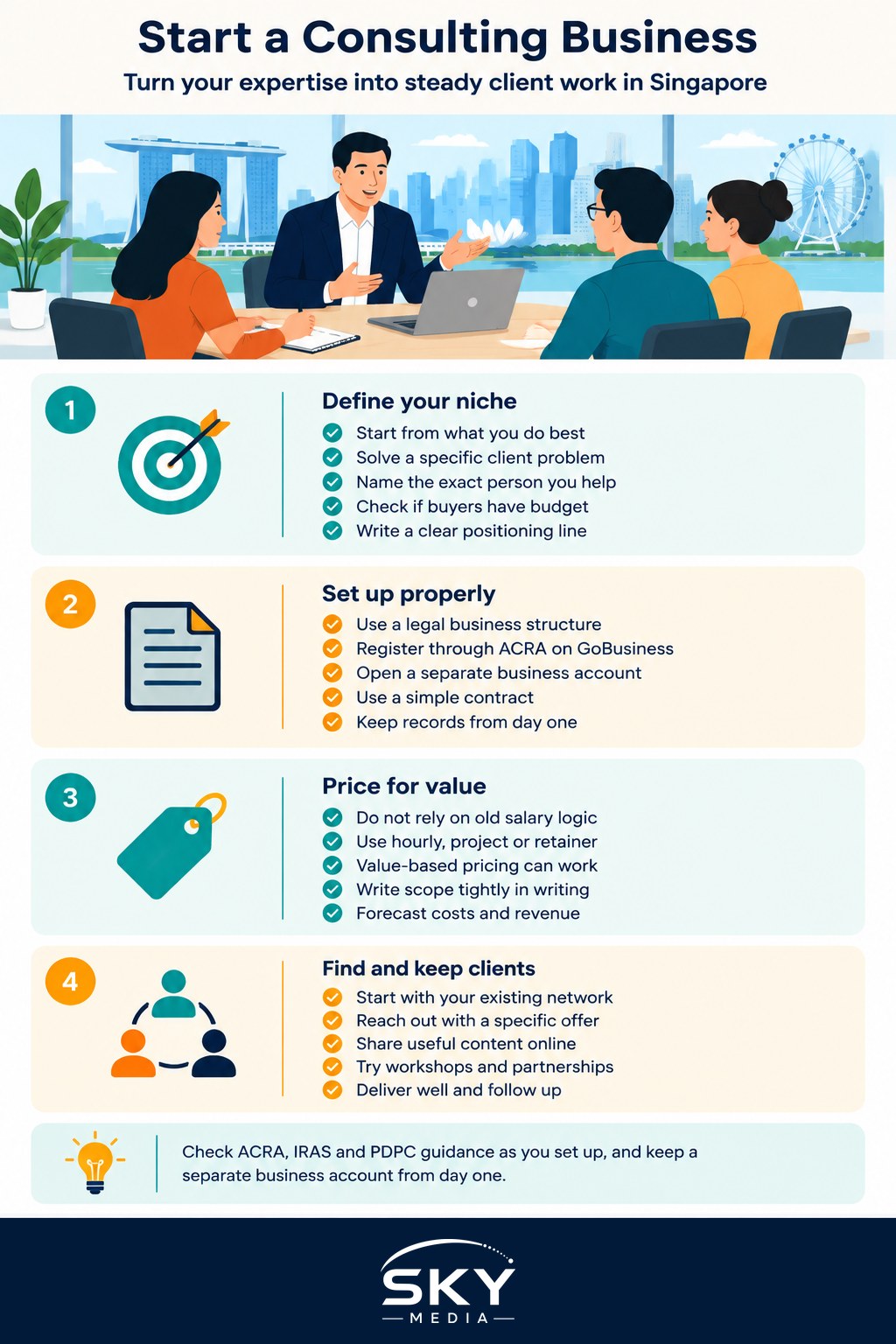
Defining What You Actually Consult On
The most common mistake is being a generalist. “I help businesses grow” tells a client nothing and puts you up against everyone. A sharp niche does the opposite: it makes you the obvious call for a specific problem, lets you charge more, and makes referrals easier because people can describe what you do in one sentence.
Start from the overlap of three things: what you are genuinely good at, what clients will pay to solve, and where you have credibility or a track record. A useful test is to name the exact person who hires you (a HR director at a mid-size firm, a founder preparing for a funding round) and the specific pain you remove.
- Write your positioning as: “I help [who] to [outcome] by [how].”
- List problems you have already solved for an employer or side project.
- Check whether real buyers exist and have budget, rather than assuming demand.
If you are moving from a hobby or side interest rather than a corporate role, it is worth pressure-testing the demand first. Our guides on validating a business idea and doing lightweight market research for a small business both help you confirm people will pay before you commit.
Setting Up the Business Properly
Consulting has a low barrier to entry, but you still need a legal structure so you can invoice, open a business account, and sign contracts. In Singapore most solo consultants begin as a sole proprietor and some incorporate a private limited company later for liability and credibility reasons. Each has trade-offs around personal liability, cost, and how profits are taxed, so it is worth understanding the differences before you register.
Register your business through ACRA using the GoBusiness portal, and check the current registration steps, fees, and any renewal requirements there rather than relying on figures you read second-hand. For tax, including whether and when you may need to register for GST, refer to IRAS for the current thresholds and rules, and consider speaking to an accountant or corporate secretary once your income grows. Treat this article as general information, not tax or legal advice.
A few practical set-up items:
- Open a separate business account so personal and business money never mix.
- Draft a simple engagement letter or contract covering scope, fees, timelines, and confidentiality.
- Keep clean records of income and expenses from day one, using accounting software such as Xero or a simple spreadsheet.
- Decide how clients pay you, for example PayNow, bank transfer, or invoice terms.
Pricing Your Consulting Services
Pricing is where new consultants lose the most money, usually by anchoring to an hourly rate derived from their old salary. Clients buy results, so the more you can price around value and outcomes, the better both sides do. There is no single correct model; many consultants mix them depending on the engagement.
| Pricing model | How it works | Best for | Watch out for |
|---|---|---|---|
| Hourly or daily rate | Bill time at a set rate | Ad hoc advice, uncertain scope | Penalises you for being fast |
| Fixed project fee | One price for a defined deliverable | Clear, bounded projects | Scope creep eating your margin |
| Monthly retainer | Set fee for ongoing access or work | Long-term advisory relationships | Under-scoping what is included |
| Value or outcome based | Fee tied to the result delivered | High-impact, measurable work | Attribution and measurement disputes |
Whatever model you choose, write scope tightly and put a change process in writing so extra requests become new fees rather than free work. Because consulting income is lumpy, build a simple forecast of your costs and target monthly revenue; our guide to business budgeting and forecasting is a good starting point for planning cash flow and setting a floor rate you will not go below.
Finding Your First Clients
Early on, your network is your pipeline. Most first clients come from people who already know your work: former colleagues, past employers, and industry contacts. Tell them clearly what you now do and who you can help, because people cannot refer a vague offer.
Practical ways to build a steady flow of enquiries:
- Warm outreach: personally contact former colleagues and clients with a specific, useful offer, not a generic “I am available” message.
- Content and visibility: share useful insights on LinkedIn or a simple blog so buyers see your thinking before they meet you.
- Speaking and community: run a workshop, join an industry group, or contribute to local SME and coworking communities.
- Partnerships: team up with agencies or complementary consultants who can pass you overflow work.
Aim for a handful of reliable referral sources rather than trying to be everywhere. Track every enquiry so you know which channels actually convert, and follow up more than once, since a slow “no reply” is often just a busy inbox rather than a real rejection.
Delivering Well and Staying Compliant
Winning work is only half the job; repeat business and referrals come from delivery. Set expectations at the start, communicate progress without being asked, and finish with a short summary of the outcome and next steps. A client who feels informed and looked after will hire you again and send others your way.
On the compliance side, keep a few habits from the beginning. Handle any personal data you collect responsibly and in line with the PDPA, referring to the PDPC for your specific obligations. Keep proper records for tax, set aside money for it rather than spending everything you invoice, and revisit your business structure with a professional as you grow. If you are still holding a full-time job while you build this up, understand your employment terms first, since some contracts restrict outside work.
Explore More
If you are weighing consulting against other paths, our guide on becoming a freelance creative covers a similar solo model with different economics. To sharpen your offer before you commit, read validating a business idea, and to keep the numbers healthy once clients start coming in, see business budgeting and forecasting.
Frequently Asked Questions
How do I choose a niche if I have many skills? Start from the overlap of what you do well, what clients will pay to solve and where you have credibility. Name the exact person who hires you and the specific pain you remove. A narrow focus makes referrals easier because people can describe you in one sentence.
Should I register as a sole proprietor or a private limited company? Each has trade-offs on personal liability, cost and how profits are taxed. Many solo consultants start as sole proprietors and incorporate later for liability and credibility. Check the current steps on GoBusiness, refer to IRAS for tax, and speak to an accountant or corporate secretary.
How do I stop clients adding extra work for free? Write the scope tightly in your engagement letter and put a change process in writing, so extra requests become new fees. This matters most with fixed project fees, where scope creep can eat your margin. Revisit scope in writing whenever the work shifts.
Can I start consulting while still holding a full-time job? Possibly, but read your employment contract first, since some contracts restrict outside work. If your employer allows it, build slowly and keep your records clean. Check with your employer or HR before taking on clients.
How do I get my first clients with no portfolio? Start with your network: former colleagues, past employers and industry contacts, with a specific, useful offer rather than a generic message. Share useful insights on LinkedIn or a simple blog, and follow up more than once, as silence is often just a busy inbox.