

If you have browsed listings and seen a terraced or semi-detached home advertised with a shared pool, a gym and a security gate, you have met strata landed cluster housing. It sits in an unusual middle ground: you get a house with its own front door and internal staircase, yet the estate is managed like a condominium, with shared facilities and monthly maintenance. This guide explains how this form of home works, who manages it, and the ownership questions to check before you commit. It is general information, not legal or financial advice, so confirm your own situation with the relevant authority or a professional.
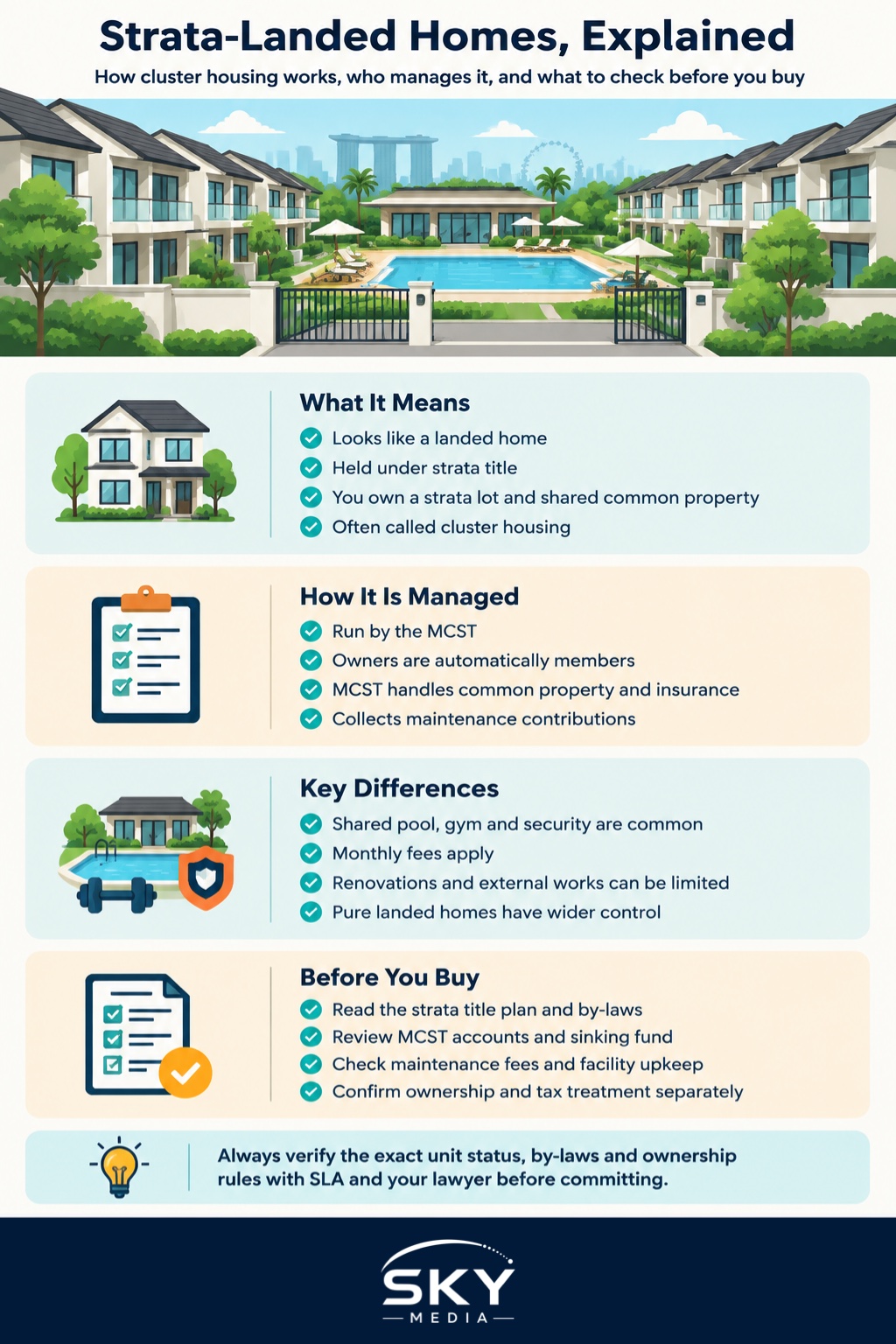
What Strata-Landed and Cluster Housing Actually Means
“Landed” property in Singapore normally means a house on its own plot of land held under a separate land title, such as a terrace, semi-detached or bungalow. A strata landed home looks like a landed house from the inside, but the whole development is held under a strata title, the same legal structure used for condominiums. Instead of owning a distinct plot, you own a strata lot within a larger parcel, plus a share of the common property.
Cluster housing is the term often used for these developments. A cluster estate groups several landed units together and adds shared amenities such as a swimming pool, a clubhouse, landscaped grounds, visitor parking and a guardhouse. The units can be terraces, semi-detached houses or even townhouses stacked over a few storeys.
The trade-off is the appeal. You get the space and privacy of a house, often over three levels with a private enclosed space or a small garden, alongside facilities and security you would usually only find in a condo. In return, you accept shared ownership of common areas and the rules that come with it.
How Ownership and the MCST Work
Because a cluster development is held under strata title, it is run by a Management Corporation Strata Title, usually called the MCST. Every owner is automatically a member. The MCST maintains the common property, arranges insurance for the shared structures, collects maintenance contributions and enforces the estate by-laws. If you want to understand this governing body in depth, read our guide on what an MCST does.
A few practical consequences follow from strata ownership:
- You pay monthly maintenance contributions for the upkeep of shared facilities and grounds, similar to condo owners. This is separate from the price of the home itself.
- By-laws apply to you. These can cover renovations, external appearance, pets, noise and use of the facilities. A house that looks fully private may still have rules about what you can change on the exterior.
- Major external works may need approval. Because parts of the structure or grounds can be common property, you may not have the free hand a pure landed owner would have to rebuild or extend.
The exact split between what you own privately and what is common property is set out in the strata title plan and the by-laws. Ask to see these documents, and have a conveyancing lawyer explain them for your specific unit.
Strata-Landed Versus Pure Landed Property
Buyers often weigh a cluster home against a conventional landed house. They feel similar to live in but differ in law and lifestyle. The table below sets out the main contrasts. Treat it as a general comparison, not a rule for every development.
| Feature | Strata-landed / cluster | Pure landed (own plot) |
|---|---|---|
| Land title | Strata title, share of a larger parcel | Individual land title for the plot |
| Facilities | Shared pool, gym, security, grounds | None unless you build your own |
| Managing body | MCST manages common property | Owner manages everything |
| Monthly cost | Maintenance contributions payable | No estate maintenance fee |
| Rebuild / extend | Constrained by strata rules and approvals | Wider freedom, subject to URA and BCA rules |
| Security | Estate-wide gated security common | Owner arranges own security |
Neither option is simply better. A cluster home suits owners who want house living with less personal responsibility for security and grounds. A standalone landed home suits those who want maximum control over their plot and no shared fees. Your priorities, budget and how you plan to use the home should drive the choice, so consider both carefully rather than assuming one is superior.
Foreigner and Permanent Resident Ownership Rules
This is where strata landed homes get genuinely complicated, and where you must not rely on assumptions. In general, landed residential property in Singapore is treated as restricted property under the Residential Property Act, and non-citizens usually need approval to buy it. Approval is assessed by the Land Dealings Approval Unit under the Singapore Land Authority (SLA).
Strata landed housing sits in a nuanced position. Some strata landed units in developments that are approved condominium projects may be treated differently from landed homes on individual titles, while others are still classified as restricted landed property. The classification is not something you can safely guess from the listing photos.
Because the treatment of citizens, permanent residents and foreigners differs, and because the rules can change, you should:
- Confirm the exact status of the specific unit with SLA before making any commitment.
- Ask your conveyancing lawyer to verify whether approval is required for your buyer profile.
- Check tax treatment separately, since stamp duties, including any Additional Buyer’s Stamp Duty, differ by residency and are set by IRAS. Do not assume a figure; confirm the current rate.
This article cannot tell you whether you personally are eligible, and no honest guide should. Get it confirmed in writing by SLA and your lawyer.
What to Check Before You Buy a Cluster Home
Once you understand the structure, a short due-diligence list helps you compare developments on a like-for-like basis:
- Read the by-laws and the strata title plan so you know what you own and what rules bind you.
- Review the MCST accounts and the state of the sinking fund to gauge whether the estate is well run and adequately funded for future repairs.
- Ask about the monthly maintenance contribution and its recent history, so there are no surprises.
- Inspect the shared facilities and grounds for condition and upkeep, since your fees pay for them.
- Clarify renovation and extension limits in writing if you plan to change the home.
- Engage a CEA-registered agent and a conveyancing lawyer to guide the purchase and the paperwork.
Explore More
Cluster living leans heavily on the managing body, so it helps to understand what an MCST does and how its by-laws shape daily life. If you are weighing older low-rise homes as an alternative, our guide to walk-up apartments in Singapore covers a very different low-density option. When you reach the paperwork stage, read up on the sale and purchase agreement for private property.
Frequently Asked Questions
Can I extend or add a floor to a strata-landed cluster house? Probably not freely. Because parts of the structure or grounds may be common property, major external works can need MCST and authority approval, and by-laws may restrict changes. Clarify renovation and extension limits in writing with your lawyer before buying.
How much are the monthly maintenance contributions for cluster housing? They vary by development, facilities and size of the unit, so no general figure applies. Ask for the current amount and its recent history, along with the MCST accounts and sinking fund, so you can judge whether the estate is well run and adequately funded.
Is a cluster house better than a condo for a family? It depends on what you value. A cluster home gives you a house layout with several levels and a small private space, plus shared facilities and security. A condo may offer more facilities or lower cost. Compare floor area, fees and by-laws for the specific developments.
Do cluster houses come with a freehold or leasehold title? Tenure varies by development, so check the title of the specific unit rather than assuming. Freehold or leasehold affects financing, CPF usage and long-term plans. Your conveyancing lawyer can confirm the tenure and explain what the strata title plan covers.
Can pets be kept in a strata-landed cluster home? That is set by the estate by-laws, which can cover pets, noise, exterior appearance and facility use. Ask to read the by-laws before you buy, and check with the MCST if you have specific animals in mind. Government rules on pet ownership also apply on top.
Official sources: URA