
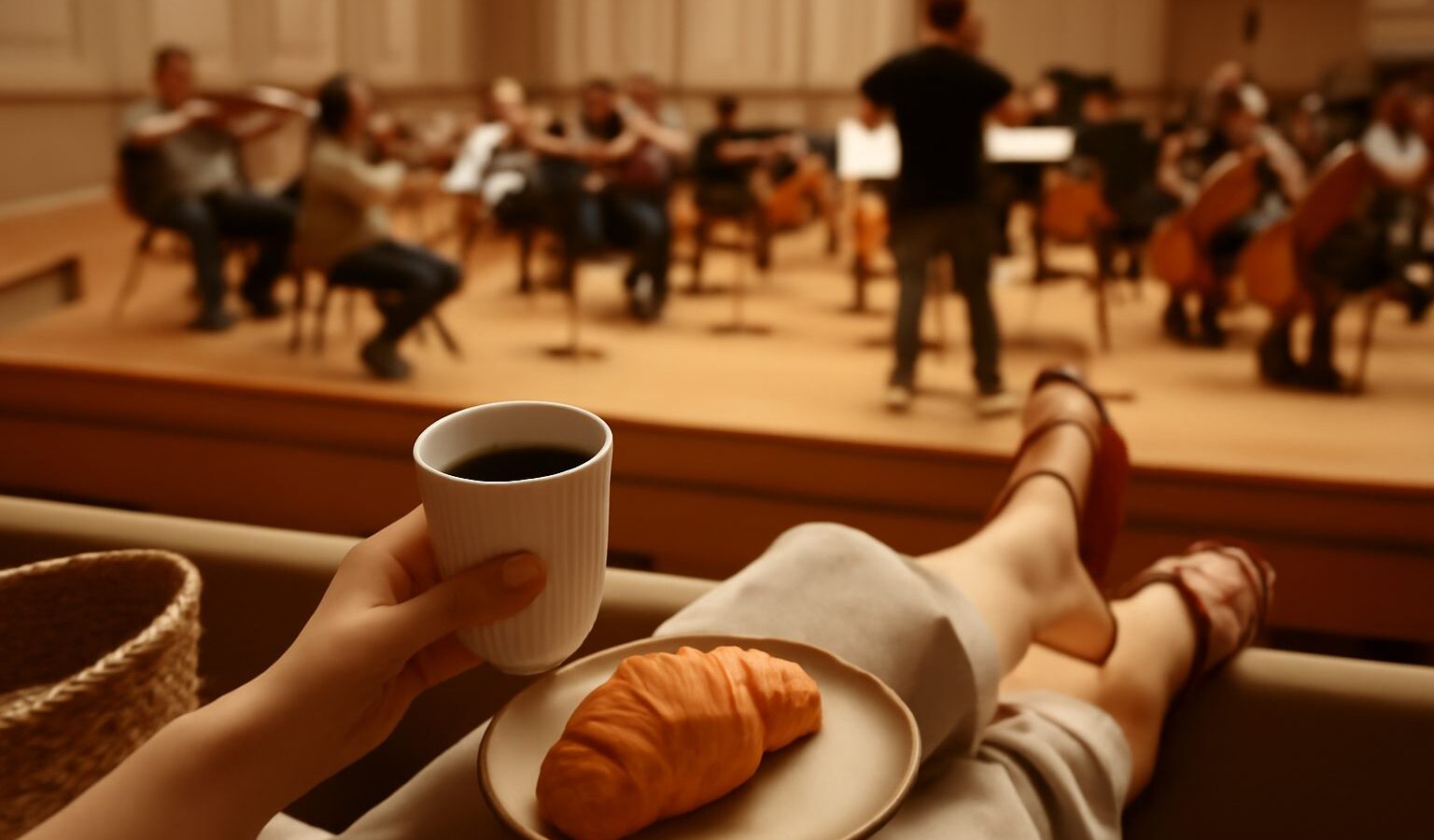
Most people’s picture of classical music is a formal concert: everyone seated in silence, the orchestra in black, applause only at the right moments. An open symphony rehearsal in Singapore offers something quite different. You get to watch the musicians and conductor at work, hear a passage stopped and played again, and see how a performance is actually built. For newcomers who are curious about classical music but unsure about the rules, it is one of the most relaxed and revealing ways in.
This guide explains what an open rehearsal is, how it differs from a concert, how to find one, and how to get the most from the experience.
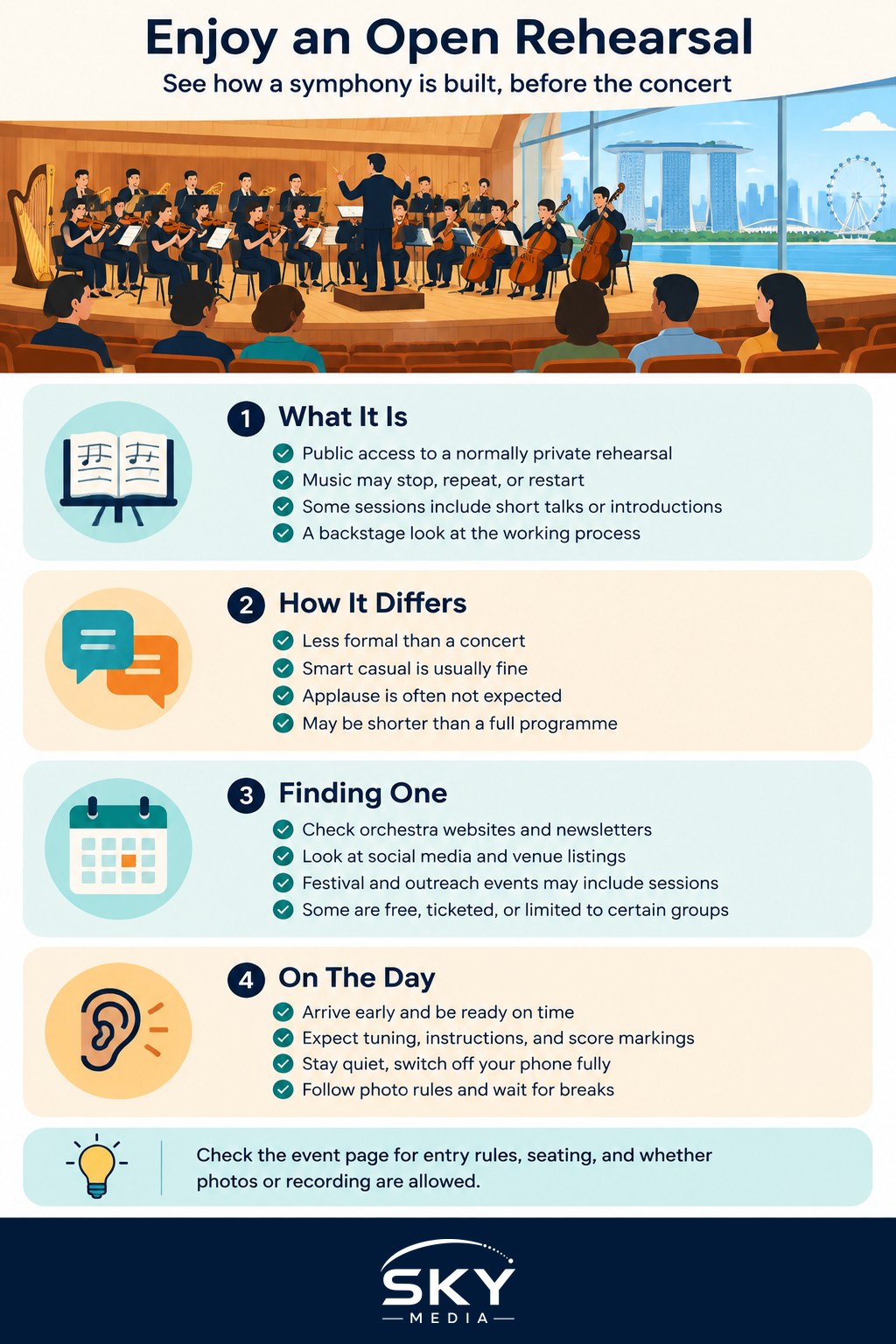
What an Open Rehearsal Actually Is
Orchestras rehearse several times before each concert. Most of those sessions are private. Occasionally, an orchestra opens a rehearsal to the public, usually close to the concert date when the programme is already in good shape. These may be called open rehearsals, public rehearsals or community rehearsals.
What you see depends on the orchestra and the stage of preparation:
- Run-throughs. The orchestra may play a whole work or movement with few interruptions.
- Working sessions. The conductor stops often to fine-tune balance, tempo or a tricky transition, and the musicians repeat short sections.
- Talks or introductions. Some open rehearsals begin with a short explanation of the music or a chance to hear from a musician.
Think of it as being allowed backstage in the workshop rather than in the showroom. You may not hear every piece from start to finish, and that is part of the appeal.
How a Rehearsal Differs From a Formal Concert
If you have never been to either, the differences are worth knowing so you arrive with the right expectations.
| Aspect | Open rehearsal | Formal concert |
|---|---|---|
| Music | May stop, restart and repeat sections | Each work usually played straight through |
| Dress for musicians | Often casual everyday clothes | Formal concert attire |
| Audience dress | Smart casual is fine | Smart casual to formal, depending on the event |
| Talking from the stage | Conductor speaks to the orchestra, sometimes to the audience | Usually limited to short announcements |
| Seating | Sometimes free seating or a limited section | Assigned seats from a ticket |
| Applause | Often not expected during the session | At the end of complete works |
| Length | Can be shorter, ending when the session ends | A full programme with an interval |
The relaxed feel is a big part of why rehearsals suit beginners. There is less pressure to “do it right”, and you can focus on watching and listening.
How to Find Open Rehearsals in Singapore
Open rehearsals are not held for every concert, and when they are, places can be limited. Here is where to look.
- Orchestra websites and newsletters. Singapore’s professional orchestras and many community orchestras announce special events on their official websites. Signing up for their mailing lists is the most reliable way to hear early.
- Social media pages. Orchestras often post rehearsal events, behind-the-scenes clips and last-minute openings.
- Arts venues’ event listings. Major performing arts centres list upcoming programmes, including talks and open sessions.
- Festivals and outreach programmes. Arts festivals and community events sometimes include open rehearsals or “meet the orchestra” sessions.
- Schools and youth orchestras. Youth and student ensembles occasionally invite the public to final rehearsals before a concert.
Some open rehearsals are free with registration, others need a ticket, and some are reserved for concert ticket holders or specific groups. Details change, so read the event page carefully and check the orchestra’s official channels for current arrangements.
What to Expect on the Day
Arrive early. Rehearsals usually start on time because orchestras are working to a tight schedule, and late entry may only be allowed at a suitable break or not at all.
Inside, you might notice:
- Musicians tuning and warming up, which sounds chaotic but is a normal part of the process.
- The conductor giving instructions with words, gestures or singing a phrase to show what they want.
- Section leaders such as the concertmaster, the lead first violinist, communicating with the conductor and their section.
- Pencils and score markings. Musicians often write changes into their parts during the session.
- Breaks. Orchestras take scheduled breaks. Stay seated or step out quietly as instructed.
Do not worry if you cannot follow every technical comment. Listen for how a passage changes after the conductor’s feedback. That before-and-after is the real treasure of a rehearsal.
Etiquette for Rehearsal Audiences
Rehearsals are relaxed, but the musicians are still working. Treat it like visiting someone’s workplace as a welcomed guest.
- Stay quiet while music is playing and while the conductor is speaking. Whispered comments carry surprisingly far in a concert hall.
- Silence your phone completely, including vibration.
- Follow the photo and video rules. Many orchestras do not allow recording during rehearsals. If photos are permitted, turn off flash and sound.
- Do not interrupt musicians during breaks unless the organisers have invited interaction.
- Stay in the audience area. Do not approach the stage.
- Hold your applause unless the conductor or host signals it is welcome.
- Bring children who can sit quietly and check whether the event has an age guideline.
Getting More Out of the Experience
A little preparation makes a rehearsal far more rewarding, especially if classical music is new to you.
- Listen to the programme beforehand. Find a recording of the main work and listen once or twice. Recognising a theme when it returns is very satisfying.
- Read a short introduction to the piece. The orchestra’s programme notes, often on their website, explain what to listen for.
- Choose your seat thoughtfully. If seating is free, sitting where you can see the conductor’s face and gestures can be fascinating.
- Watch one section at a time. Try following only the cellos for a few minutes, then the brass. You will start to hear how the parts fit together.
- Bring a small notebook. Jot down moments you liked or things you want to look up later.
- Book the concert too. Hearing the finished performance after seeing it built is a lovely way to complete the experience.
If you enjoy learning how culture is made, the same approach works for other outings. Our tips on how to enjoy a museum visit and actually remember it and how to enjoy a music festival apply similar ideas to different settings. Newcomers who also enjoy literature may like how China newcomers can enjoy SingLit events.
Tips for Newcomers to Singapore
If you have recently moved here, open rehearsals are also a good way to meet the local arts scene in a low-pressure setting.
- English is the usual language of rehearsals and talks, though music needs no translation.
- Dress comfortably and bring a light layer. Concert halls are air-conditioned and can feel cool after the heat outside.
- Plan your journey. Many performing arts venues are close to MRT stations, but check the route and allow time for finding the right entrance.
- Explore other free or low-cost classical events. Lunchtime concerts, outdoor performances and community orchestra shows are common and welcoming.
An open rehearsal strips away the formality and lets you see the craft, effort and humour behind a polished concert. Go with curiosity, stay quiet, and enjoy being one of the few people who get to hear the music before it is finished.
Frequently Asked Questions
Do I need to know classical music to enjoy a symphony rehearsal? Not at all. Rehearsals are one of the easiest ways to start, because you see how the music is shaped and nobody expects you to know the pieces. Listening to a recording of the main work beforehand helps, but curiosity is enough.
What does a conductor actually do in a rehearsal? The conductor shapes the performance by setting the tempo, balancing the sections and shaping how phrases are played. In rehearsal this means stopping the orchestra, giving instructions and asking for passages to be repeated. Watching their gestures and the orchestra’s response shows how the interpretation develops.
Is it okay to leave halfway through an open rehearsal? Usually yes, as long as you do so quietly and ideally during a break or between sections. Follow any instructions from the organisers about entering and leaving. If you have small children who may need to step out, sit near an aisle.
What is the difference between a symphony orchestra and a chamber orchestra? A symphony orchestra is larger and has a full range of strings, woodwinds, brass and percussion. A chamber orchestra is smaller, with fewer players, and often has a lighter, more intimate sound. Both can play the classics, and the size shapes the repertoire.
Can I join a community orchestra or choir as an amateur? Many community groups welcome amateur players and singers, though each has its own standards and may hold an audition or trial session. Check the group’s website for rehearsal times and skill level. Starting with a beginner-friendly ensemble helps if you are new.