

Few conversations feel as awkward as asking your mother or father what should happen when they can no longer decide for themselves, or after they pass away. Many families in Singapore avoid it entirely, sometimes because death is considered an unlucky topic, sometimes because no one wants to seem interested in an inheritance. Yet when the time comes, adult children who never had the talk are often left guessing. Learning how to talk to parents about will planning, a Lasting Power of Attorney and their care wishes is one of the kindest things you can do for them and for your siblings.
This article is about starting and guiding that conversation. It is general information, not legal advice. For the documents themselves, speak to a lawyer and use the official sources mentioned below.
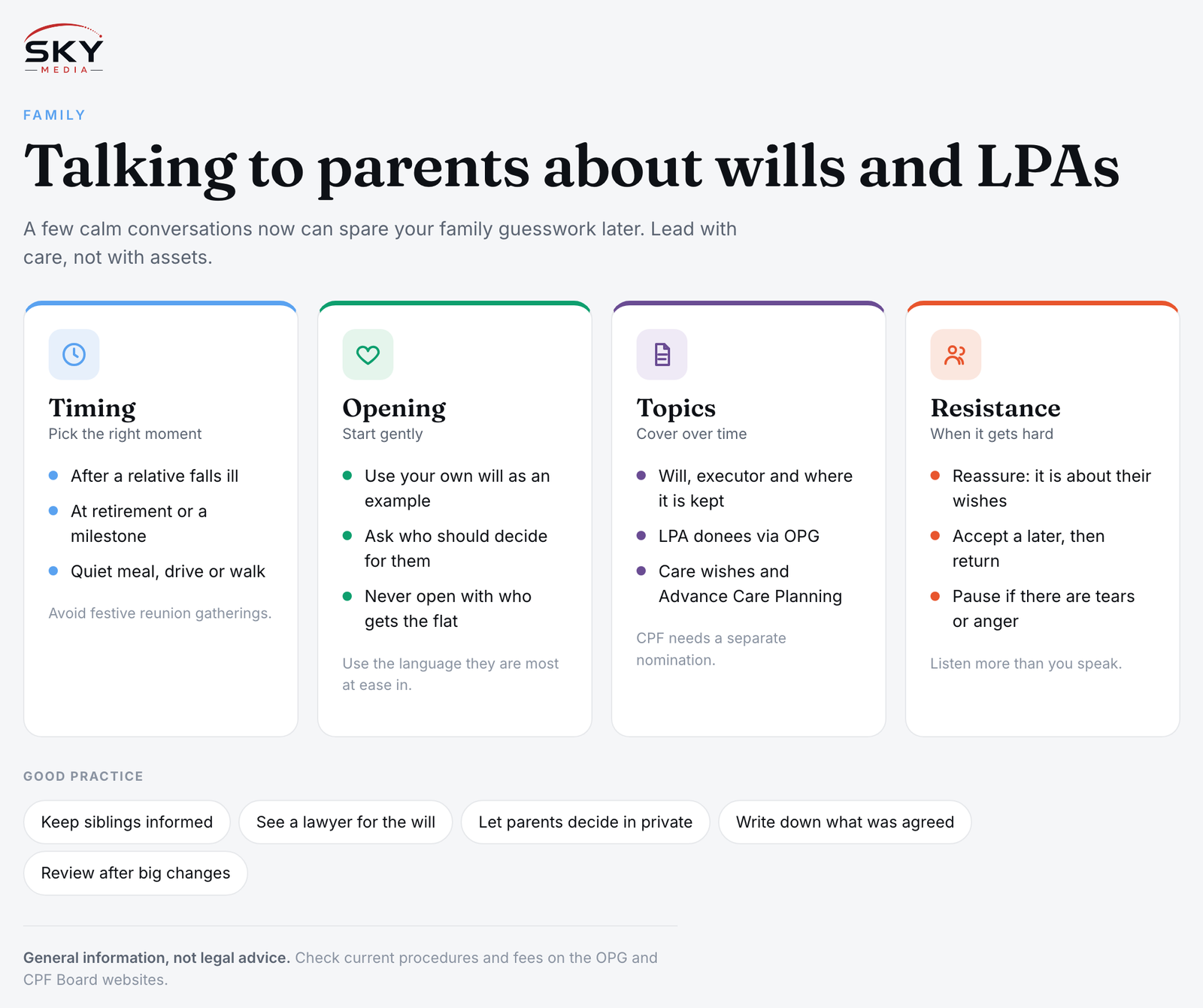
Why the Conversation Matters More Than the Paperwork
Documents are important, but the conversation is what makes them reflect what your parents actually want. Talking early helps in several ways:
- It respects their choices while they can still clearly make them.
- It reduces family conflict later, because siblings hear the same wishes at the same time.
- It avoids slow, costly processes. If a parent loses mental capacity without a Lasting Power of Attorney (LPA), the family may need to apply to court for a deputyship, which takes longer and involves more steps. Our guide on applying for a deputyship when there is no LPA explains what that involves.
- It gives your parents peace of mind that their affairs and care are in order.
Choosing the Right Moment and Setting
Timing makes a big difference. Natural openings include:
- After a relative or family friend has fallen ill or passed away, and someone remarks how hard it was for the family.
- When a parent retires, sells a property or reaches a milestone birthday.
- When you are doing your own estate planning, such as writing a will after buying a home or having children.
- After a health scare or hospital stay, once things have settled.
Choose a quiet, private setting with time to spare: a home meal, a drive, or a walk. Avoid festive gatherings such as Chinese New Year reunion dinners, Hari Raya or Deepavali, when the mood is meant to be celebratory and other relatives are present. Some families also prefer to avoid the topic during the Hungry Ghost month or around festivals, so take your parents’ beliefs into account.
Ways to Open the Topic Gently
How you start often decides how the rest goes. Lead with care, not with assets.
- Use yourself as the example: “I have just made my own will and LPA, and it made me wonder if you have thought about yours.”
- Focus on their wishes: “If you were ever unwell and could not tell the doctors what you want, who would you like to decide for you?”
- Mention a story: “Auntie’s family had a hard time when Uncle fell sick. I would not want that for you.”
- Make it about helping: “I want to make sure we do things the way you would want. Can you tell me what matters to you?”
Avoid opening with questions about who gets the flat or how much money there is. That can make parents feel their children are waiting for an inheritance.
If your parents are more comfortable in Mandarin, Malay, Tamil or a dialect, use it. Simple, warm phrasing works better than legal terms.
What to Cover Over Several Conversations
You do not need to settle everything in one sitting. Spread it out and let your parents lead.
- Will: do they have one, where is it kept and who is the executor? If not, would they like to make one?
- Lasting Power of Attorney: have they appointed donees to make personal welfare and property decisions if they lose mental capacity? The Office of the Public Guardian (OPG) website explains the forms and process. Our guide on becoming a donee under an LPA covers what the role involves.
- Care wishes: where would they prefer to be cared for, at home, with a caregiver or in a care facility? What matters most to them about quality of life?
- Medical wishes: Advance Care Planning (ACP) is a voluntary process in Singapore for discussing future healthcare preferences with loved ones and healthcare staff. Information is available through the Agency for Integrated Care and healthcare providers.
- CPF nominations: CPF savings are not distributed through a will, so a separate CPF nomination is needed. Your parents can check their nomination status on the CPF Board website.
- Practical details: where important documents, insurance policies and bank details are kept, and who to contact.
- Funeral and personal wishes: religious rites, burial or cremation, and any personal messages. Some parents like to write these in a letter of wishes to the family.
| Topic | What it covers | Where to learn more |
|---|---|---|
| Will | Distribution of assets after death and choice of executor | A lawyer, or a reputable will-writing service |
| Lasting Power of Attorney | Who decides on welfare and property if capacity is lost | Office of the Public Guardian (OPG) |
| Advance Care Planning | Preferences for future medical and end-of-life care | Agency for Integrated Care, healthcare providers |
| CPF nomination | Who receives CPF savings after death | CPF Board |
| Letter of wishes | Personal guidance and messages, not legally binding | Family discussion |
Handling Resistance and Strong Emotions
It is normal for parents to resist at first. Common reactions and how to respond:
- “Are you trying to curse me?” Reassure them it is about following their wishes, not about expecting the worst. Point out that many healthy people do this.
- “I will do it later.” Accept it, then return to the topic in a few weeks. Leave a brochure or link behind if they are curious.
- “Your brother will handle it.” Ask if they are comfortable involving all siblings so everyone hears the same thing.
- Tears or anger: pause. Say you love them and will come back to it another time.
Listen more than you speak. Your role is to understand, not to persuade them towards a particular arrangement. If they want to leave assets in a way you disagree with, that is their decision.
Involving Siblings and Professionals
Where possible, keep siblings informed so no one feels excluded or suspicious later. A family meeting, in person or by video for siblings overseas, can help once your parents are ready.
Encourage your parents to:
- See a lawyer for the will, especially if there is property, a business, assets overseas or a blended family.
- Make their own decisions in private with the professional, without children in the room, so their choices are clearly their own.
- Use official channels for the LPA and CPF nominations, and check current procedures and any fees on the OPG and CPF Board websites, as these can change.
After the Talk: Keeping Things Up to Date
Write down what was agreed and where documents are kept, and share it with the relevant family members. Encourage your parents to review their arrangements after major life changes such as selling a home, a death in the family or a change in health. A few calm conversations now can spare everyone confusion and stress later.
Explore more: General Power of Attorney vs LPA in Singapore
Official sources: Ministry of Social and Family Development (MSF)
Further reading: How Mental Capacity Is Assessed for a Will or LPA in Singapore