
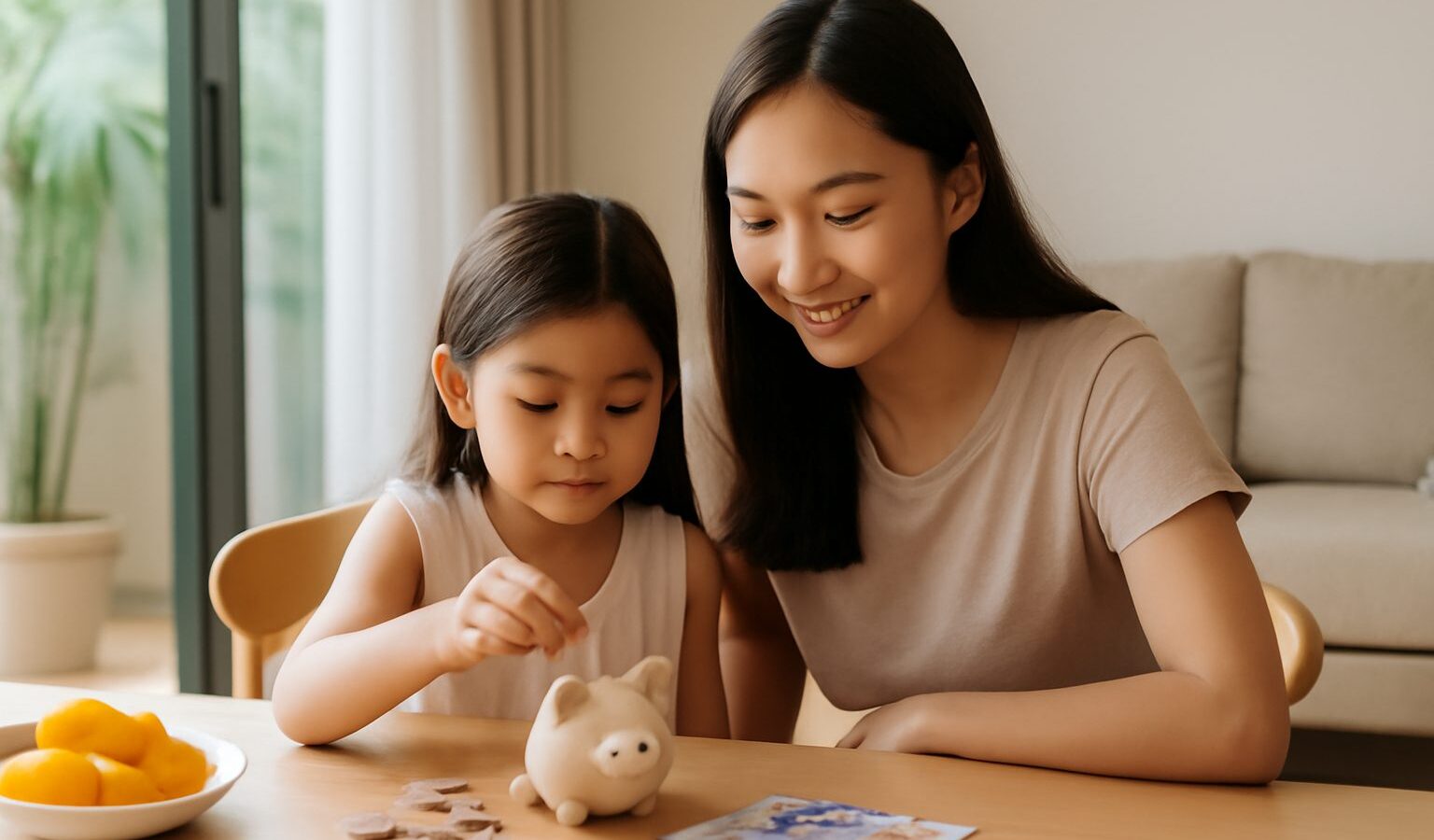
Money is one of the most useful subjects you will ever teach at home, and one of the easiest to put off. Teaching kids about money does not require a finance background or a perfect plan. It happens in small, everyday moments, at the hawker centre, the wet market and the school bookshop, where children watch how you decide and slowly learn to decide well themselves. In a fast, cashless city like Singapore, those lessons matter more than ever, because a tap of a card can hide the fact that money is being spent at all.
For families who have moved from the mainland, there is an added layer worth naming. Your children may be growing up between two money cultures, the one you knew and the one around them now, and helping them make sense of both is a gift. This guide offers gentle, age-aware ways to build that understanding, as general parenting ideas rather than financial advice.
Why Money Habits Start Early
Researchers who study financial behaviour often find that basic money attitudes take root in childhood, well before anyone opens a bank account. Children absorb how the adults around them talk about money, whether it is a source of stress, shame, secrecy or calm confidence. The tone you set matters as much as any lesson.
The good news is that you do not need to get every word right. What helps most is making money visible and ordinary, something the family talks about openly rather than a taboo whispered behind closed doors. When a child sees that money is a tool to be planned and shared, not a mystery or a fight, they carry that steadiness into their own adult choices. In a cashless society, part of your job is simply to make the invisible visible again, naming out loud when a payment happens so the abstract becomes real.
Age-Appropriate Money Lessons
Children can only hold ideas their stage is ready for, so match the lesson to the age. The table below offers a rough guide, to be adapted to your own child rather than followed to the letter.
| Age band | What to focus on | A simple everyday activity |
|---|---|---|
| Preschool (3 to 6) | Coins and notes are real, things cost money | Let them hand cash to the hawker uncle and take the change |
| Lower primary (7 to 9) | Saving, waiting, needs versus wants | A clear coin jar for a small goal they choose |
| Upper primary (10 to 12) | Budgeting a small allowance, comparing prices | Give a set canteen or book budget to manage themselves |
| Teens (13 and up) | Digital money, PayNow, part-time earnings, giving | Involve them in a real family purchase decision |
The thread running through every stage is responsibility that grows with age. A young child learns that the jar empties when you buy; a teenager learns that a PayNow transfer moves real money even though nothing physical changes hands. Let the lessons stretch as they do, and expect a few mistakes along the way, because a cheap mistake at ten is far better than an expensive one at twenty-five.
Everyday Ways to Teach in Singapore
You do not need special tools, only the ordinary rhythms of life here. Singapore is full of teachable moments if you slow down enough to point them out.
- At the hawker centre, let an older child order and settle the bill, working out whether the change is right.
- At the wet market, show how asking around and comparing stalls can find a better price than the first one quoted.
- On PayNow and cards, narrate the payment out loud, so your child understands that tapping still spends real money from a real account.
- At the supermarket, compare unit prices together and talk about why the bigger pack is sometimes, but not always, cheaper.
- With screens, treat in-app purchases and mobile games as a money lesson, since these are where many children first overspend.
Because Singapore is largely cashless, it is worth deliberately using physical cash sometimes with younger children. Coins and notes teach in a way that a card cannot, letting a small child feel the money leave their hand. As they grow, you can move the same lessons onto digital rails they will actually use.
Pocket Money, Ang Bao and Saving
Pocket money is the classic training ground, and how you structure it shapes what it teaches. Some families give a fixed weekly or monthly amount and let the child manage it, learning to stretch it and to live with running out. Others tie a portion to chores or effort. There is no single right answer, so choose the approach that fits your values and be consistent with it.
Festivals bring their own opportunity. The ang bao money that arrives at Chinese New Year is often a child’s largest windfall of the year, and it is a wonderful chance to teach saving rather than instant spending. A gentle rule that some families use is to split any windfall into three parts, one to spend, one to save and one to give, so generosity and patience grow alongside enjoyment. You might open a children’s savings account together so they can watch the balance rise, or simply keep a visible tally at home for younger ones.
Whatever you choose, resist the urge to rescue them from every empty wallet. The mild sting of spending too fast and having to wait is one of the most valuable lessons money can offer, and it costs almost nothing when the stakes are small.
Talking About Values, Not Just Numbers
Beyond the mechanics, children are watching what money means to your family. They notice whether you buy to impress or to suit your needs, whether you give quietly to those who have less, and whether you can enjoy simple things without a price tag. These lessons in contentment and generosity often outlast any budgeting skill.
If your family straddles two cultures, talk openly about the differences your children will notice, from how relatives give money to how peers spend it. There is no need to rank one way above another. What helps is giving your child the language to think for themselves, so they grow into adults who use money on purpose rather than out of habit or pressure. That, in the end, is the whole point, raising someone who is calm, capable and kind with money, wherever life takes them.
Explore more
Modelling good habits starts with your own plan, so our guide on budgeting for your first year in Singapore is a natural companion. To help older children understand everyday costs, see understanding GST and your spending, and for families thinking about passing on assets one day, read setting up a family trust in Singapore.