

Singapore is one of the most religiously diverse societies in the world, and its laws reflect a long-standing view that religious peace cannot be left to chance. The Maintenance of Religious Harmony Act, often shortened to the MRHA, is a central part of that framework. This guide explains, in plain terms, what the law is meant to do, the kinds of conduct it addresses, and the tools it gives the authorities to respond. It is general information about how the law works, not legal advice, and the actual text should be read on Singapore Statutes Online.
The Act sits alongside other laws and constitutional provisions that protect the freedom to practise religion. Its focus is narrower: preserving harmony between religious groups and keeping religion and hostile or subversive activity separate. Understanding that focus helps explain why the law is drafted the way it is.
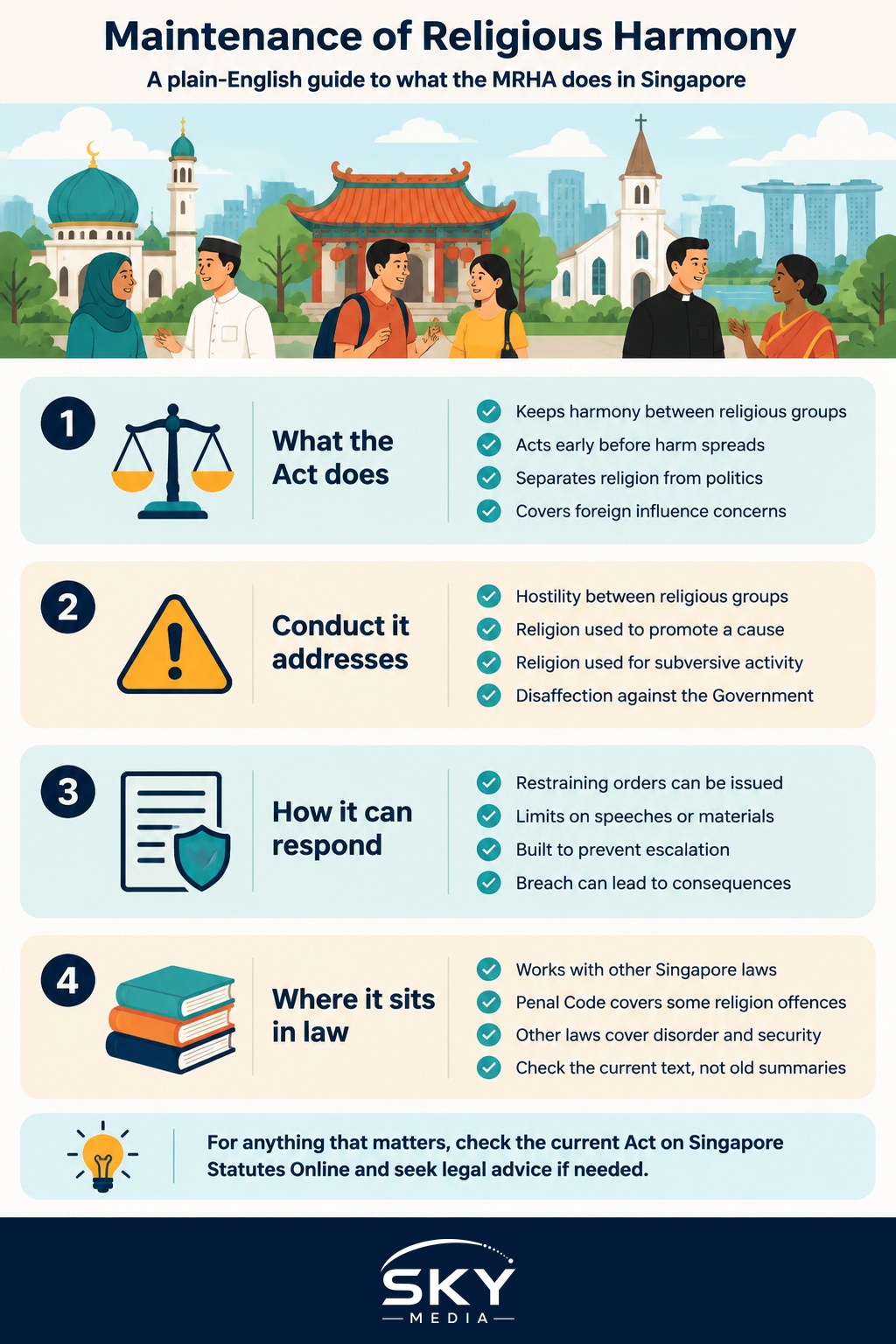
What the MRHA Is Meant to Do
The MRHA was first enacted to give the Government a calibrated way to respond when the conduct of a person, acting in the name of religion, threatens harmony between different religious communities. Rather than relying only on serious criminal charges, the law provides a means to step in early and stop harm before it spreads.
The Act reflects a few core ideas that the Ministry of Home Affairs and the Ministry of Law have set out publicly over the years:
- Religious freedom is protected, but it is exercised within limits when it affects others.
- Religion should not be mixed with efforts to promote a political cause, incite hostility, or carry out subversive activity.
- Foreign influence over religious matters is treated as a distinct concern.
- Everyday feelings of insult or offence are handled differently from organised conduct that endangers harmony.
The law has been updated since it was first passed. When Parliament amended it, the changes addressed newer concerns such as the speed of online communication and foreign interference. Because the details have changed over time, readers should confirm the current provisions through official sources rather than older summaries.
Conduct the Law Addresses
The MRHA is concerned with specific types of behaviour connected to religion. Broadly, and without reproducing the exact statutory wording, these include:
- Causing feelings of enmity, hatred, ill will or hostility between different religious groups.
- Carrying out activities to promote a political cause under the guise of practising or propagating a religion.
- Carrying out subversive activities under that same guise.
- Exciting disaffection against the Government under the guise of religion.
The Act also deals with foreign involvement, allowing the authorities to address situations where a foreign person or entity seeks to influence how a religious group in Singapore conducts its affairs. The precise thresholds, definitions and defences are set out in the statute itself, which is why the law should be read directly rather than paraphrased for any real situation.
The Restraining Order and Other Responses
A distinctive feature of the MRHA is the restraining order. This is a directive that can require a person who holds a position of authority or influence in a religious group, or another specified person, to stop doing certain things for a defined period. Depending on the situation, that could include refraining from addressing a congregation on particular subjects, or from printing or distributing certain material.
The purpose of this mechanism is preventive. It is designed to lower the temperature and stop escalating conduct, rather than to punish in the first instance. The law also sets out consequences if a restraining order is breached, and it provides a process involving review. Historically, oversight has included the Presidential Council for Religious Harmony, an advisory body that considers such matters. The current procedures, timelines and the exact role of each body are governed by the Act and its rules, so anyone affected should check those official details.
Separately, the Act contains community and self-help measures introduced in later amendments, aimed at encouraging religious groups to manage certain issues internally where appropriate. As with the rest of the law, the specifics are defined in the legislation.
How It Fits With Other Laws
The MRHA is not the only law touching on religion, speech and public order in Singapore. It works alongside several others, each with a different scope. The table below gives a simplified overview to show how the pieces differ. It is a general orientation only, not a substitute for the actual statutes.
| Law or provision | Main concern | Typical response |
|---|---|---|
| Maintenance of Religious Harmony Act | Harmony between religious groups; religion mixed with politics or subversion | Restraining orders and related directions |
| Penal Code offences on religion | Deliberately wounding religious feelings; promoting enmity | Criminal charges and penalties |
| Sedition-related and public order laws | Hostility between groups; public disorder | Criminal charges and orders |
| Internal Security Act | Threats to national security | Detention and other security measures |
Because these laws overlap in places and are periodically revised, which one applies in a given case is a matter for the authorities and the courts, guided by the facts and the current text of each law.
Why Singapore Takes This Approach
Officials have long framed religious harmony as a shared public good that underpins social stability. The stated rationale for a dedicated law is that harm involving religion can spread quickly and be difficult to reverse, so an early, targeted response is preferable to waiting for a serious breach of the peace. The MRHA is presented as one tool among many, including education, interfaith engagement and community networks, rather than a first resort.
This guide does not take a position on that approach. Its aim is to describe what the law is and how it is meant to operate, so that readers can understand the framework and then verify the specifics for themselves.
Where to Check the Current Law
For anything that matters, go to the primary sources. The full and current text of the maintenance religious harmony act is published on Singapore Statutes Online, and the Ministry of Law and the Ministry of Home Affairs provide official explanations and updates. If you face a real situation that could involve the Act, seek qualified legal advice rather than relying on a general summary, because the details, defences and procedures are what determine outcomes.
Explore more
To understand another law that protects individuals from targeted conduct, read our guide to the Protection from Harassment Act (POHA). For a look at how a specialised court examines certain deaths, see the Coroner’s Court explained.
Frequently Asked Questions
Does the Maintenance of Religious Harmony Act limit who can practise a religion? No, the article says religious freedom is protected, but it is exercised within limits when it affects others. The Act targets conduct such as causing hostility between groups or mixing religion with political or subversive activity, not the practice of faith itself.
What is a restraining order under this Act? It is a preventive directive that can require a person in a position of influence in a religious group, or another specified person, to stop certain activities for a defined period, such as addressing a congregation on particular subjects. It is meant to lower the temperature, not punish first.
Can a restraining order be challenged? The article says the law provides a process involving review, and oversight has historically included the Presidential Council for Religious Harmony. Procedures and timelines are set in the Act, so anyone affected should check them and get legal advice.
How is this different from the Penal Code offences on religion? The Act is a preventive tool that allows an early response, while Penal Code offences lead to criminal charges and penalties for conduct such as deliberately wounding religious feelings. Which applies depends on the facts, and that is for the authorities and courts to decide.
Why does the Act deal with foreign influence over religious groups? Foreign influence over religious matters is treated as a distinct concern, so the Act lets the authorities address cases where a foreign person or entity seeks to influence how a religious group in Singapore conducts its affairs. Details are in the statute.
Further reading: The Official Secrets Act Explained (Singapore)