
Few figures in Chinese folk belief are as beloved as the Monkey God, known formally as Qi Tian Da Sheng, the Great Sage Equal to Heaven. Drawn from the classic novel Journey to the West and from centuries of popular worship, he is celebrated across Singapore’s Taoist and folk temples with lively processions, offerings and time honoured spirit medium traditions. The monkey god birthday singapore observances remain one of the most colourful expressions of the island’s Chinese religious heritage, drawing devotees, families and curious onlookers alike.
Who the Monkey God Is and What He Means
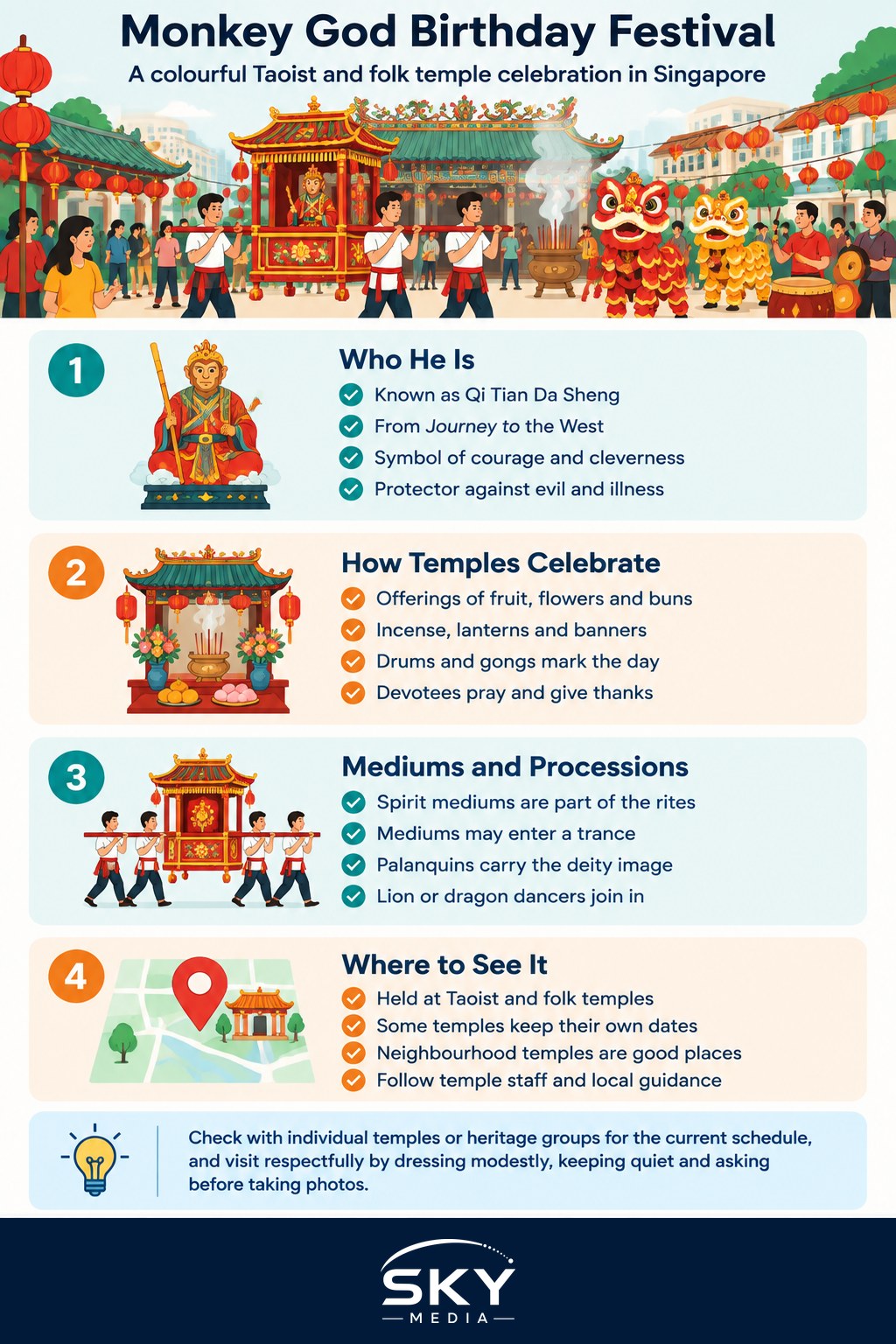
The Monkey God is a deity of remarkable character. In legend he is born from stone, masters supernatural powers, and after a rebellious youth becomes a disciple who helps a monk retrieve sacred scriptures. Over generations of retelling, he came to represent courage, cleverness, loyalty and the triumph of the underdog over powerful odds. For many devotees he is a protector who wards off evil, heals the sick and offers guidance to those facing difficulty.
Because his story is so widely known, the Monkey God occupies a special place in the affections of ordinary worshippers. He is approachable and playful, yet also righteous and powerful. Temples dedicated to him, or that house him among other deities, honour these qualities through their rituals. Devotees may seek his blessing for health, for protection of children, or for the resolve to overcome personal struggles. The birthday celebration is the moment when this devotion is expressed most vividly.
In the wider landscape of Chinese folk religion, the Monkey God sits alongside many other revered figures. Those interested in the broader tradition may wish to read about Taoist deities and their festivals in Singapore, which places his worship within the fuller pantheon honoured across the island.
How the Birthday Is Observed
The Monkey God’s birthday is marked more than once in the traditional calendar, and different temples may observe it on the dates their lineage keeps. Because these dates follow the lunar calendar and vary between temples, it is best to check with individual temples or heritage groups for the current schedule rather than relying on a fixed day.
On the celebration itself, temples come alive. Altars are laden with offerings of fruit, flowers, sweet buns, peaches and other foods that carry symbolic meaning. Incense fills the air, red lanterns and banners brighten the halls, and the rhythmic beat of drums and gongs signals that the festivities are under way. Devotees arrive throughout the day to make offerings, to pray and to give thanks for blessings received during the year.
One of the most distinctive features of the celebration is the tradition of spirit mediums, known in Hokkien as tang ki. A medium is believed to enter a trance and allow the deity to communicate through him. During Monkey God observances a medium may take on the character of the Great Sage, moving with agility and expression that echo the deity’s legendary nature. These practices are approached with deep seriousness and reverence by the communities that keep them, and visitors should observe respectfully and follow the guidance of temple staff.
Processions are another highlight. A sedan chair or palanquin bearing the deity’s image may be carried through the streets around the temple, accompanied by musicians, banner bearers, lion or dragon dancers and rows of devotees. These deity birthday processions are a shared feature of many folk celebrations, and readers can learn more about the wider custom in this overview of deity birthdays and temple processions in Singapore.
Where and How to Experience It
The Monkey God is honoured at a number of Taoist and folk temples across Singapore, some dedicated primarily to him and others where he is enshrined alongside other deities. Neighbourhoods with long standing Chinese communities are often good places to find such temples, though visitors should look for current information from the temples themselves or from local heritage programmes, since practices and schedules differ from one place to another.
If you wish to attend, arrive with a respectful and open attitude. Dress modestly, keep your voice low inside the prayer halls, and always ask before taking photographs, especially during rituals involving mediums. Many temples welcome visitors and are happy to explain the meaning behind the offerings and ceremonies, and observing quietly is often the best way to appreciate the depth of the tradition.
The Monkey God’s enduring popularity reflects something universal in his story. He is flawed yet redeemed, mischievous yet devoted, weak in origin yet mighty in the end. For those exploring Singapore’s living heritage, the birthday festival offers a window into a faith that is at once ancient, communal and full of life. The celebration also connects to the broader cycle of folk observances such as the Nine Emperor Gods Festival in Singapore, together forming a rich calendar of devotion.
Whether you come as a devotee or as a respectful observer, the birthday of the Great Sage is a reminder that heritage is not only preserved in museums but carried forward, year after year, by the communities who continue to light the incense and beat the drums in his honour.
Further reading: Thimithi: The Fire-Walking Festival