
If your calves feel like the one part of your body that refuses to change no matter what you do, you are not alone. Calves have a reputation for being stubborn, and plenty of gym-goers quietly give up on them. The good news is that smart, consistent calf training in Singapore does work, and it does not need fancy equipment or hours of your week. This guide walks through what your calves actually do, how to train them well, and how to stay comfortable and injury-free while you do it.
Before we start, a quick note. This is general fitness information, not medical or personalised training advice. Warm up first, use good form, start light and build up gradually, and stop if you feel actual pain rather than normal muscle effort. If you have a health condition or an injury, are pregnant, or are older, it is wise to check with a doctor before beginning a new programme, and to see a physiotherapist or a qualified coach for form or rehab.
Meet Your Calf Muscles
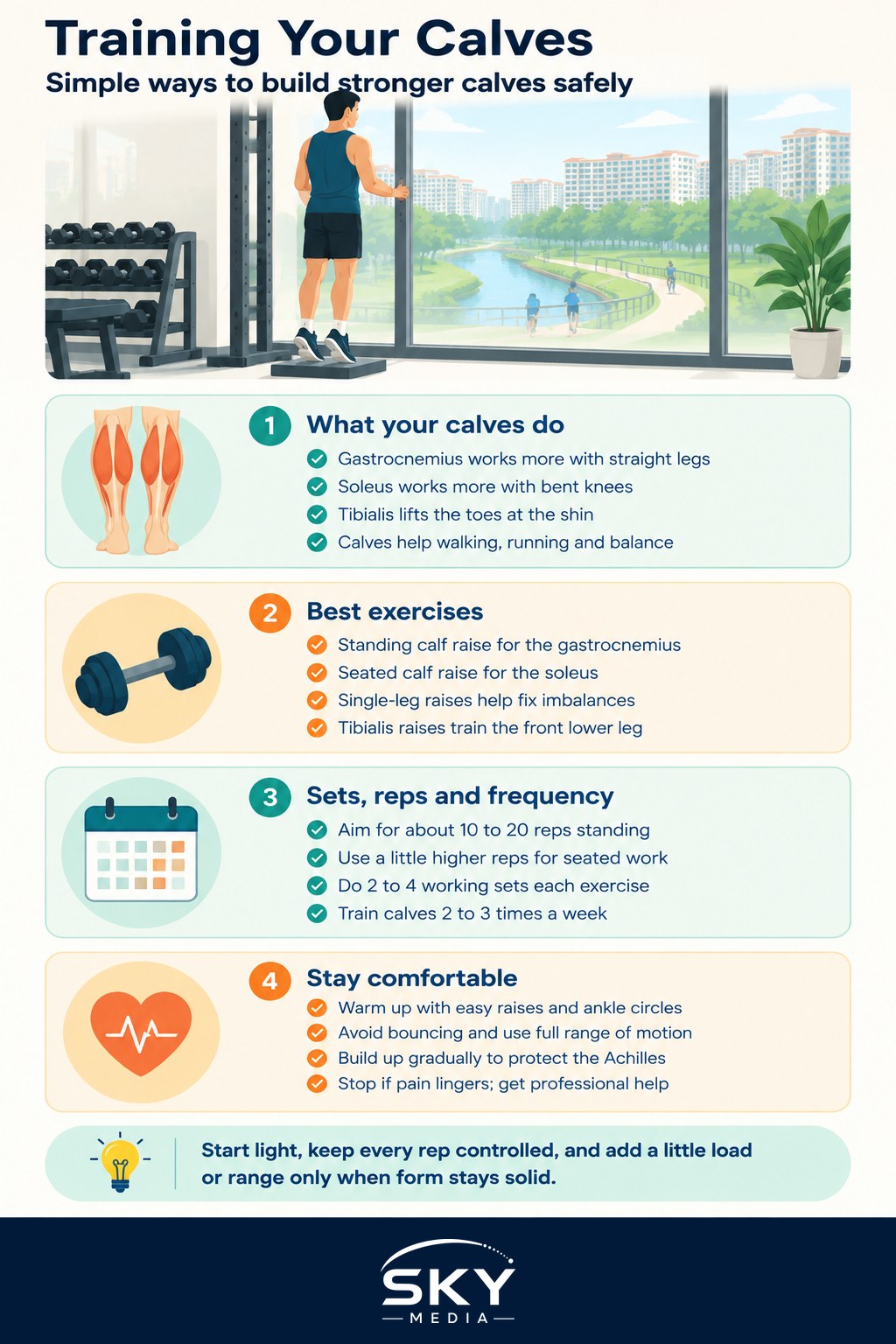
The calf is really two main muscles working together. The gastrocnemius is the larger, diamond-shaped muscle you can see, and it crosses both the knee and the ankle. The soleus sits underneath it and works mainly at the ankle. There is also the tibialis at the front of your shin, which lifts your toes and often gets forgotten.
Why does this matter for training? Because the gastrocnemius does more of its work when your leg is straight, while the soleus does more when your knee is bent. That single fact explains why a good calf plan usually includes both straight-leg and bent-leg work. Train only one position and you leave half the muscle behind.
Your calves also do a lot of quiet daily work. Every step, every stair at your HDB block, every push off the pavement along a park connector involves them. They help you walk, run, jump, and stay balanced. Strong calves support your ankles and knees and can make running feel smoother, which is one reason they are worth the effort.
The Best Calf Exercises
You do not need many movements. A handful done well, with real effort, covers almost everything.
- Standing calf raise. The classic straight-leg exercise, targeting the gastrocnemius. You can do it on a machine, holding dumbbells, or with a barbell. Rise up onto the balls of your feet, pause at the top, then lower slowly.
- Seated calf raise. Because your knee is bent, this shifts the work onto the soleus. A seated machine is ideal, but you can also rest a weight on your knees while seated.
- Single-leg calf raise. Doing one leg at a time, perhaps holding a wall or rail for balance, evens out any side-to-side differences and adds load without extra equipment.
- Tibialis raises. Standing with your back to a wall, lift your toes towards your shins. This trains the often-neglected front of the lower leg and can support ankle health.
The single biggest mistake in calf training is bouncing. People load up heavy, then bob up and down using momentum, barely moving the muscle. Instead, control the weight. Come up as high as you can, squeeze at the top for a beat, and lower all the way down until you feel a gentle stretch. That full range of motion is where the results live.
Sets, Reps and How Often
Calves respond well to a mix of rep ranges. A reasonable approach is somewhere between roughly 10 and 20 reps for standing work, and often a little higher for seated work, since the soleus tends to be endurance-oriented. Aim for two to four working sets per exercise and take each set close to the point where good form starts to slip.
Because calves recover quickly and you use them all day, you can train them more frequently than a big muscle like the back. Two or three short sessions a week, tacked onto the end of your usual workouts, is plenty for most people. This fits naturally into a well-planned routine, and it helps to understand how reps, sets and rest work together so your effort actually counts.
Progress is the engine of every muscle. Adding a little weight, a rep, or a better range of motion over the weeks is the principle of progressive overload, and it applies to calves just as much as to squats.
Staying Comfortable and Injury-Free
Calves and the connected Achilles tendon can get grumpy if you rush. Always begin with a proper warm-up so the tissue is ready to work; a few easy calf raises and some gentle ankle circles do the job. A short cool-down and some light stretching and mobility work afterwards can help you feel looser, especially in Singapore’s heat when you may already be doing a lot of walking.
Progress gradually. Sudden jumps in weight or volume are the quickest route to a strained calf or an irritated Achilles. If you feel sharp pain, pinching, or a tender spot that lingers, stop and let it settle rather than pushing through. Persistent lower-leg or Achilles pain is a good reason to see a physiotherapist or doctor, who can look at what is going on and guide your return.
A Simple Way to Start
Keep it uncomplicated. Pick one standing exercise and one seated exercise, do a couple of controlled sets of each two or three times a week, and focus on a full stretch and squeeze rather than heavy sloppy reps. Add a small amount of load or an extra rep when the sessions start to feel easy. Give it a couple of months of honest effort before you judge the results.
Calves may be stubborn, but they are not immovable. With patience, control, and steady progression, your calf training will pay off, and your ankles, knees, and running stride are likely to thank you for it too.
Further reading: Forearm Training