
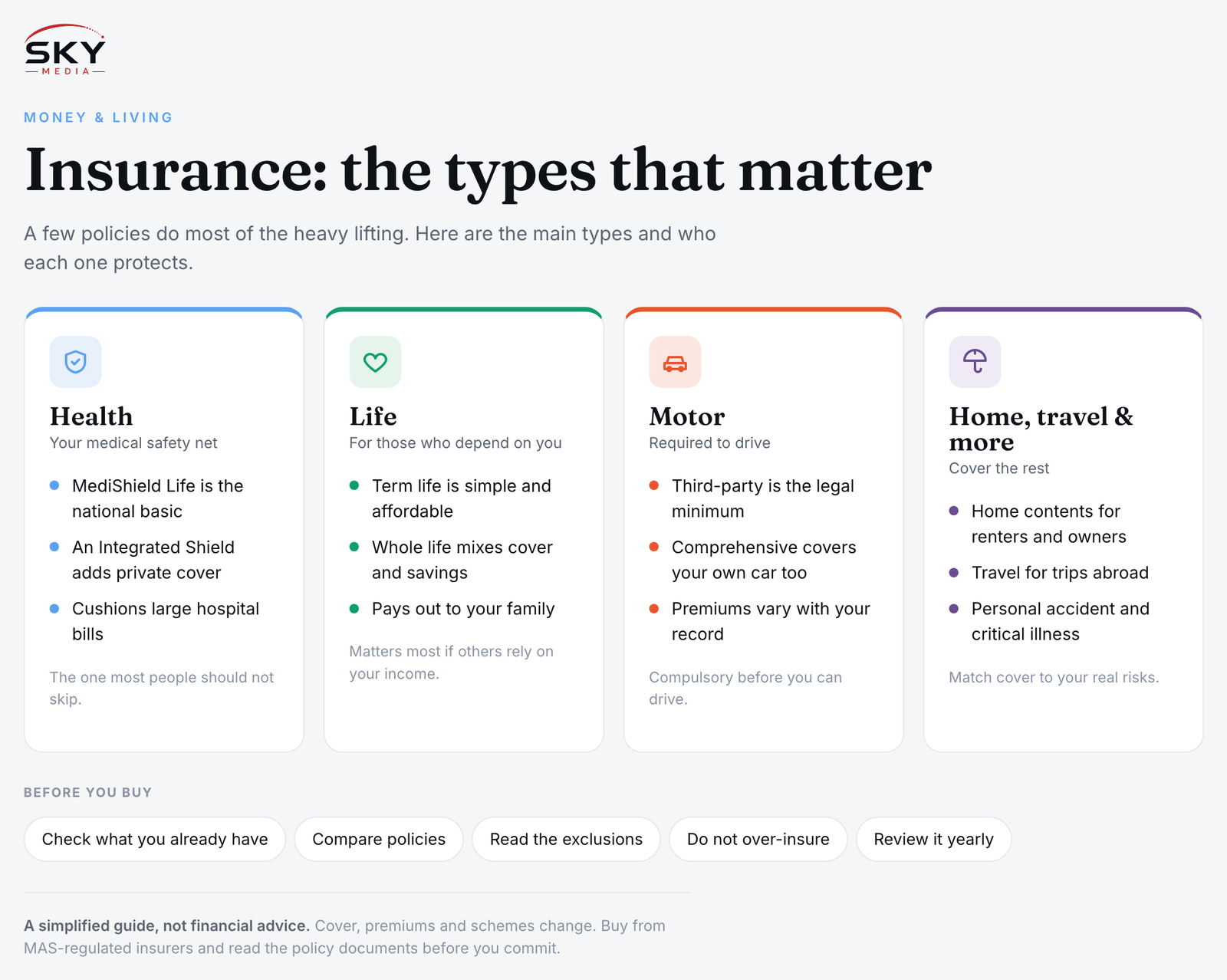
Insurance in Singapore can feel like an alphabet soup of plans, riders and acronyms, and it is easy to end up either over-insured, paying for cover you do not need, or under-insured, exposed to the risks that matter most. The purpose of insurance is simple: it transfers a financial shock you could not easily absorb, such as a serious illness or a major accident, to an insurer in exchange for a manageable premium. This guide breaks down the main types of insurance, explains how the national schemes fit in, and offers a plain framework for deciding what to prioritise at each stage of life.
Start with the national foundation
Every Singaporean and permanent resident is automatically covered by MediShield Life, a basic health insurance scheme run through CPF that helps pay large hospital bills and certain costly treatments. It is designed for subsidised care in public hospitals and covers you for life, regardless of age or health condition. Premiums can be paid using MediSave, the healthcare portion of your CPF.
Because MediShield Life is a foundation rather than a complete solution, many people add an Integrated Shield Plan (IP) on top, which can extend coverage to private hospitals or higher ward classes. If you buy an IP, be realistic about the ward or hospital type you would actually use, since higher tiers cost more. For the current scope and premiums, always check the official CPF Board and Ministry of Health information rather than older summaries.
The main types of insurance
Beyond the health foundation, most people will encounter these categories:
- Health and hospitalisation. MediShield Life plus any Integrated Shield Plan and riders. Covers hospital stays, surgery and some outpatient treatments.
- Life insurance. Pays out to your dependants if you die. Term life covers a set period at lower cost; whole life lasts your lifetime and includes a savings element, usually at a higher premium.
- Critical illness. Pays a lump sum on diagnosis of a covered serious condition, such as certain cancers or a heart attack, helping cover income loss and treatment beyond hospital bills.
- Disability income (income protection). Replaces part of your income if illness or injury stops you working. Often overlooked, yet vital for anyone who relies on a salary.
- Personal accident. Pays out for injuries, disability or death caused by accidents, typically at modest cost.
- Home and contents. Protects your belongings, and if you own property, the structure and renovations. Often required by mortgage lenders.
- Car insurance. Legally required to drive; ranges from third-party to comprehensive cover.
- Travel insurance. Covers trip disruptions, medical emergencies abroad and lost belongings.
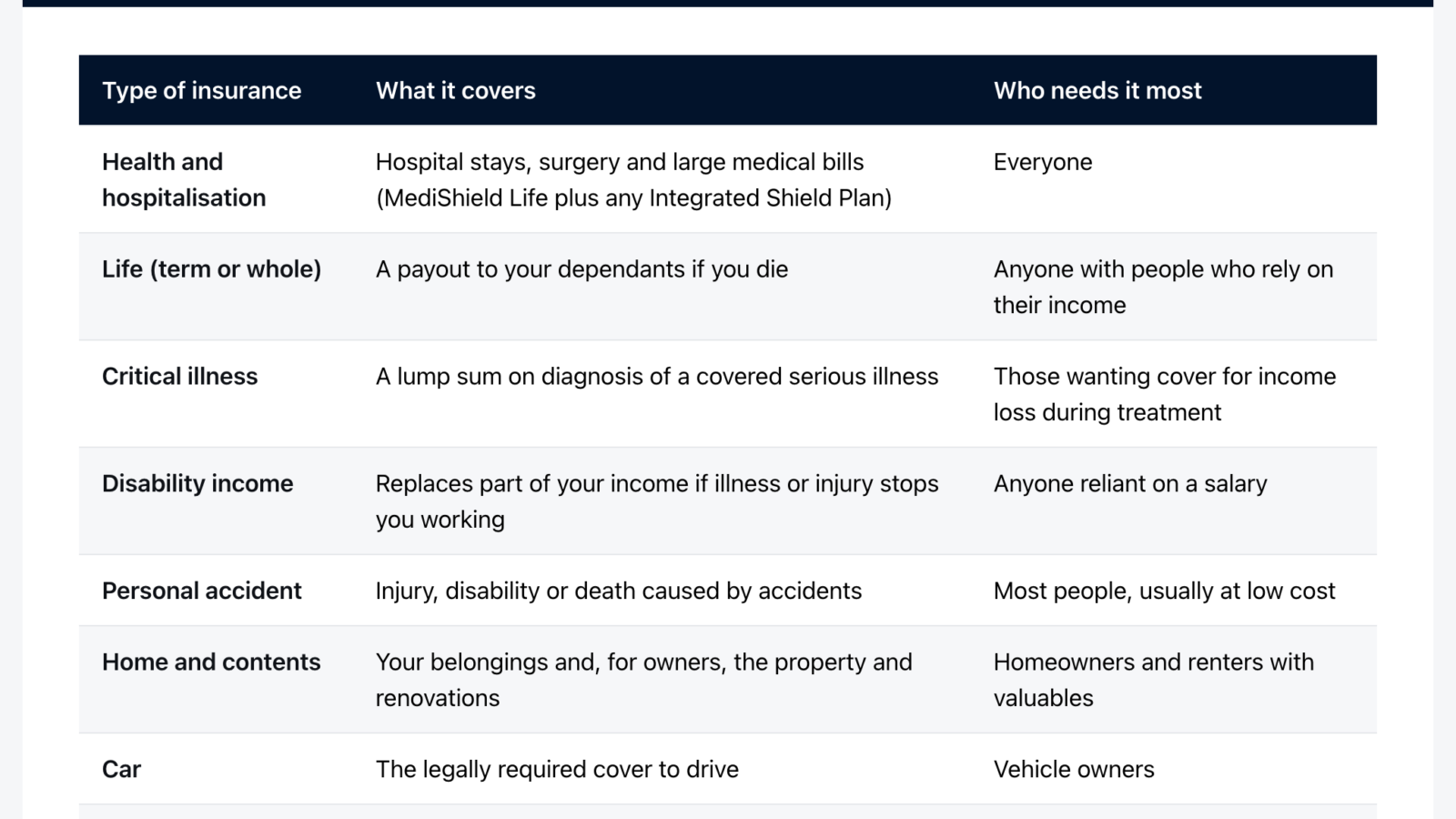
At a glance, here is what each main type does and who it matters most for:
| Type of insurance | What it covers | Who needs it most |
|---|---|---|
| Health and hospitalisation | Hospital stays, surgery and large medical bills (MediShield Life plus any Integrated Shield Plan) | Everyone |
| Life (term or whole) | A payout to your dependants if you die | Anyone with people who rely on their income |
| Critical illness | A lump sum on diagnosis of a covered serious illness | Those wanting cover for income loss during treatment |
| Disability income | Replaces part of your income if illness or injury stops you working | Anyone reliant on a salary |
| Personal accident | Injury, disability or death caused by accidents | Most people, usually at low cost |
| Home and contents | Your belongings and, for owners, the property and renovations | Homeowners and renters with valuables |
| Car | The legally required cover to drive | Vehicle owners |
| Travel | Trip disruptions, overseas medical care and lost belongings | Anyone travelling |
How to prioritise by life stage
You do not need everything at once. A useful way to think about it is to insure the biggest risks to your income and health first, then layer on the rest as your responsibilities grow.
- Young and single. Make sure your health cover is solid, consider personal accident and disability income, and keep life insurance modest if no one depends on your income yet.
- Married or with dependants. This is when life insurance and critical illness matter most, since others rely on you financially. Size the cover to your family’s needs, not a random round number.
- Homeowners. Add mortgage-related and home insurance, and revisit your life cover so it can clear the loan if something happens to you.
- Approaching retirement. Review whether you still need large life policies, and focus on health and hospitalisation cover for the years when you are most likely to use it.
A simple prioritisation rule
Insure first against the events that would be financially catastrophic and are hard to self-fund: serious illness, long-term disability, and death if others depend on you. Cover smaller, affordable risks only after those are handled.
Common mistakes to avoid
- Buying cover you do not understand. If you cannot explain what a policy pays out and when, ask until you can.
- Over-insuring. Paying for high private-hospital tiers or large whole-life policies you do not need drains money you could save or invest.
- Under-insuring the essentials. Skimping on disability income or critical illness to save a little each month can leave a big gap.
- Confusing insurance with investment. Products that bundle the two can be useful for some, but make sure you know what you are paying for protection versus savings.
- Forgetting to review. Your needs change with marriage, children, a home or a career shift. Revisit your cover after every major life event.
How CPF and schemes fit in
Your CPF does a lot of quiet work here. MediSave can pay MediShield Life and Integrated Shield Plan premiums within limits, and the national schemes provide a baseline of health protection that private cover builds upon. There are also schemes such as CareShield Life for long-term disability, which is worth understanding as part of the wider safety net. Because these government schemes evolve, treat the details as a rough guide and confirm specifics with the CPF Board and Ministry of Health.
A note for newcomers
If you have just moved here, your cover from back home may not travel with you, and the local system works differently. Permanent residents are brought under MediShield Life, while foreigners on work passes usually rely on employer-provided medical benefits plus their own private plans, so check exactly what your employer covers and where the gaps are. Do not assume a policy from another country pays out the same way in Singapore. It is worth reviewing your protection in the first few months rather than waiting until you need to claim, when it is too late to fix a shortfall.
Getting advice without the hard sell
Insurance is one area where independent, unbiased guidance pays off. If you consult an adviser, check that they are licensed with the Monetary Authority of Singapore, ask how they are paid, and never feel pressured into signing on the spot. A good adviser helps you match cover to your real needs and budget; a poor one sells you the plan that pays them best. Nothing here is professional financial advice, so use it as a map, then get tailored guidance and read the official sources before you commit.
Done well, insurance is not about fear. It is about buying yourself the freedom to face a bad year without it becoming a financial disaster.
Explore more: Health insurance in Singapore, Car insurance in Singapore, Travel insurance in Singapore