
A surname in Singapore can carry a whole history in a few letters. Look at the names Tan, Lim, Ong, Wong, Ng, Teo and Goh, and you are reading a quiet record of where families came from, which dialect they spoke, and how their forebears crossed the sea to settle here. Understanding Chinese surnames in Singapore means understanding dialect groups, migration and the clan associations that once anchored newcomers in an unfamiliar port. This is a story written into the identity of a large part of the population.
Chinese family names are among the oldest continuous surnames in the world, passed down the male line for many generations and shared by huge numbers of people. In China a single surname might be written in one standard way, but in Singapore the same character can appear in several spellings depending on the dialect a family spoke. That variety is one of the most distinctive features of Chinese names here, and it rewards a closer look.
Dialect Groups and the Spelling of Names
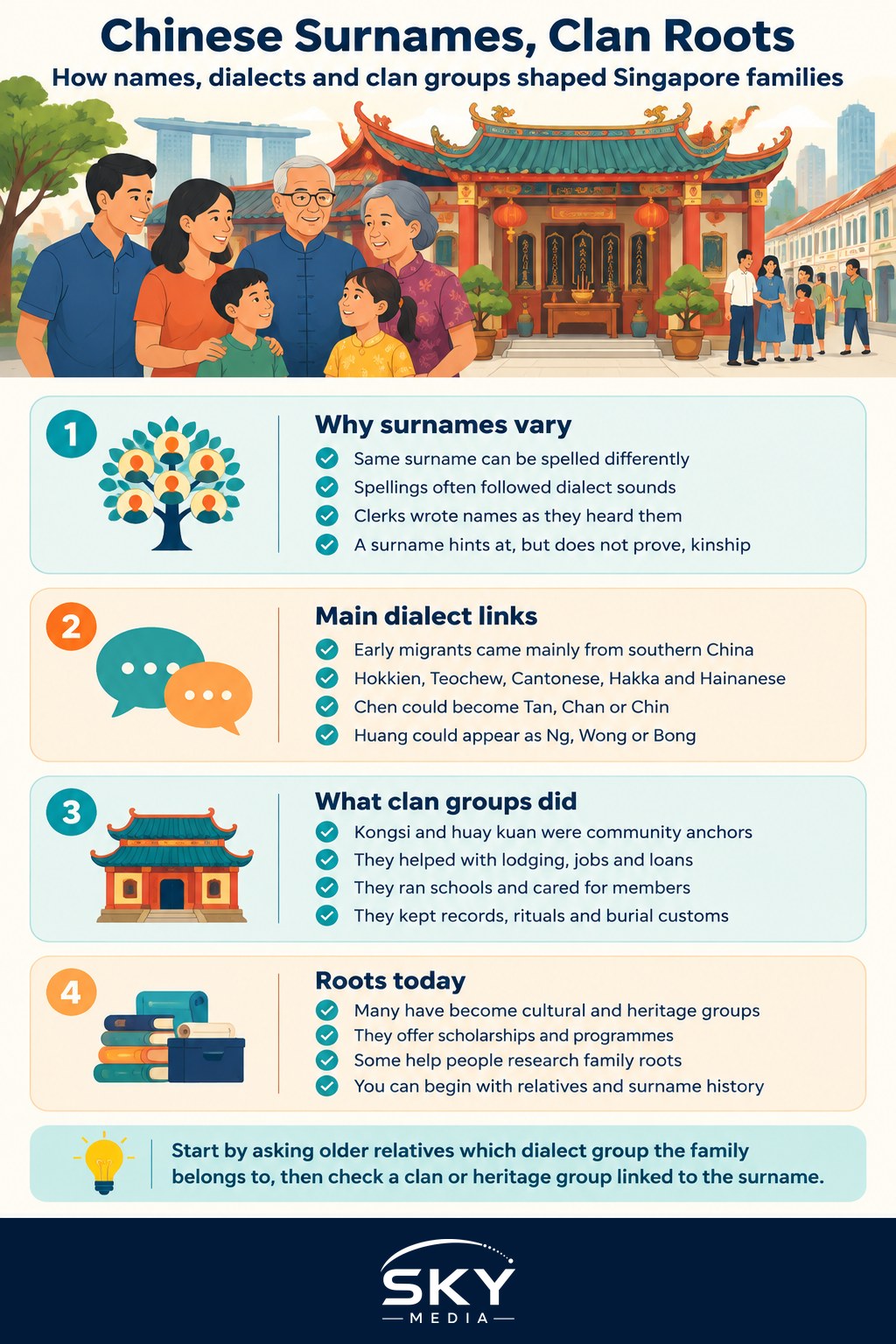
Most early Chinese migrants to Singapore came from the southern provinces, and they belonged to different dialect groups, chiefly the Hokkien, Teochew, Cantonese, Hakka and Hainanese communities. Each spoke its own tongue, and when their names were written down in English, usually by clerks recording them by ear, the spelling followed the sound of the dialect rather than a single standard. This is why the same Chinese surname can look so different from one family to the next.
A well-known example is the character often rendered in Mandarin as Chen. Among Hokkien and Teochew families it commonly became Tan, among Cantonese speakers Chan, and among Hakka speakers Chin. The name written Huang in Mandarin appears as Ng, Wong or Bong depending on the dialect and the person recording it. Lin becomes Lim or Lam, Wang becomes Ong or Heng in some readings, and so on. None of these spellings is more correct than another, as each simply reflects a different community’s pronunciation captured at a particular moment.
Because the spelling was often set by whoever filled in the papers, some families with a shared origin ended up with slightly different surnames, while unrelated families sometimes share a spelling by coincidence. A surname alone therefore hints at dialect background but does not prove a direct blood link between two people who carry it. To trace real kinship, families rely on genealogies, ancestral records and the memory of elders. Our overview of Singapore’s dialect groups explains how these communities differ in language, food and custom, and how those differences shaped everyday life.
It is worth adding that naming practices vary from family to family. Some households later standardised their spelling, some adopted Mandarin readings, and many Singaporeans today also carry an English given name alongside their Chinese one. Younger generations may be less familiar with the dialect roots of their own surnames, which is part of why heritage groups work to keep this knowledge alive.
Clan Associations and Keeping Roots Alive
When migrants arrived in Singapore, they often knew few people and spoke little of the local languages. Clan associations, known in various forms as kongsi or huay kuan, grew up to meet this need. Organised around a shared surname, a shared district of origin in China, or a shared dialect, these bodies offered newcomers a ready-made community, a network of trust in a strange city.
Their work was practical and wide-ranging. Clan associations helped members find lodging and jobs, lent money, settled disputes, and cared for the sick and the elderly. They ran schools so that children could be educated, maintained temples and ancestral halls, and organised proper burials and the keeping of records for those far from home. In an age before broad state welfare, they were a lifeline, and many of Singapore’s early schools and community institutions trace their beginnings to such groups. Our look at clan associations in Singapore explores this history in fuller detail.
The associations also guarded heritage. They preserved genealogies, honoured ancestors through rituals, and kept alive the customs, festivals and dialects of the home regions. For many families, the clan hall was where a child first understood which village their forebears had left, and why the family name was written as it was. In this way surname and clan were closely bound together, two halves of a single sense of belonging.
Today the practical need for clan associations has faded, since education, housing and welfare are provided in other ways, and many younger Singaporeans have never set foot in a clan hall. Yet the associations have not disappeared. Many have reinvented themselves as cultural and heritage bodies, offering scholarships, running cultural programmes, and helping people research their family roots. Some organise visits to ancestral villages or maintain archives that would otherwise be lost.
For anyone curious about their own name, a simple starting point is to ask older relatives which dialect group the family belongs to and how the surname was traditionally pronounced. From there, a clan association or heritage group tied to that surname or district can often help fill in the picture. Understanding a surname in this way connects a single person to the wider story of migration and settlement that shaped modern Singapore, a story woven through our multiracial society. A name, it turns out, is rarely just a name.
Frequently Asked Questions
Do people with the same surname spelling share the same ancestors? Not necessarily. Spelling was often set by whoever filled in the papers, so families with a shared origin can end up with slightly different surnames, while unrelated families sometimes share a spelling. To trace real kinship, rely on genealogies, ancestral records and elders’ memory.
How can I find out which dialect group my family belongs to? Start by asking older relatives which dialect group the family belongs to and how the surname was traditionally pronounced. From there, a clan association or heritage group tied to that surname or district can often help fill in the picture.
Why is the same Chinese surname spelt differently, like Tan, Chan and Chin? Early clerks recorded names by ear, so the spelling followed each dialect’s sound rather than a single standard. Chen, for example, commonly became Tan among Hokkien and Teochew families, Chan among Cantonese and Chin among Hakka. None is more correct than another.
What did clan associations do for new migrants? They gave newcomers a ready-made community. They helped members find lodging and jobs, lent money, settled disputes, cared for the sick and elderly, ran schools, maintained temples and ancestral halls, and arranged burials. In an age before broad state welfare they were a lifeline.
Do clan associations still exist today? Yes, though the practical need has faded. Many have reinvented themselves as cultural and heritage bodies, offering scholarships, running cultural programmes, helping people research family roots, and keeping archives. Some organise visits to ancestral villages.