

Most of us have wondered why we react the way we do. Why does one friend feel recharged after a big party while another quietly counts down the minutes until they can go home? Why do some people plan every detail of a trip and others happily wing it? Learning about personality types in Singapore, and the frameworks people use to describe them, can help you make sense of these differences. Used gently, this kind of self-reflection is a mirror, not a label. It helps you understand your natural tendencies so you can work with yourself instead of against yourself.
Before we go further, one honest note. The popular personality frameworks you have probably heard of are useful conversation starters and reflection tools, not science-grade tests that measure your fixed “type” with a score. People are complex, and we behave differently across situations and seasons of life. So treat everything below as prompts for thinking about yourself, not a diagnosis.
What we mean by personality and temperament
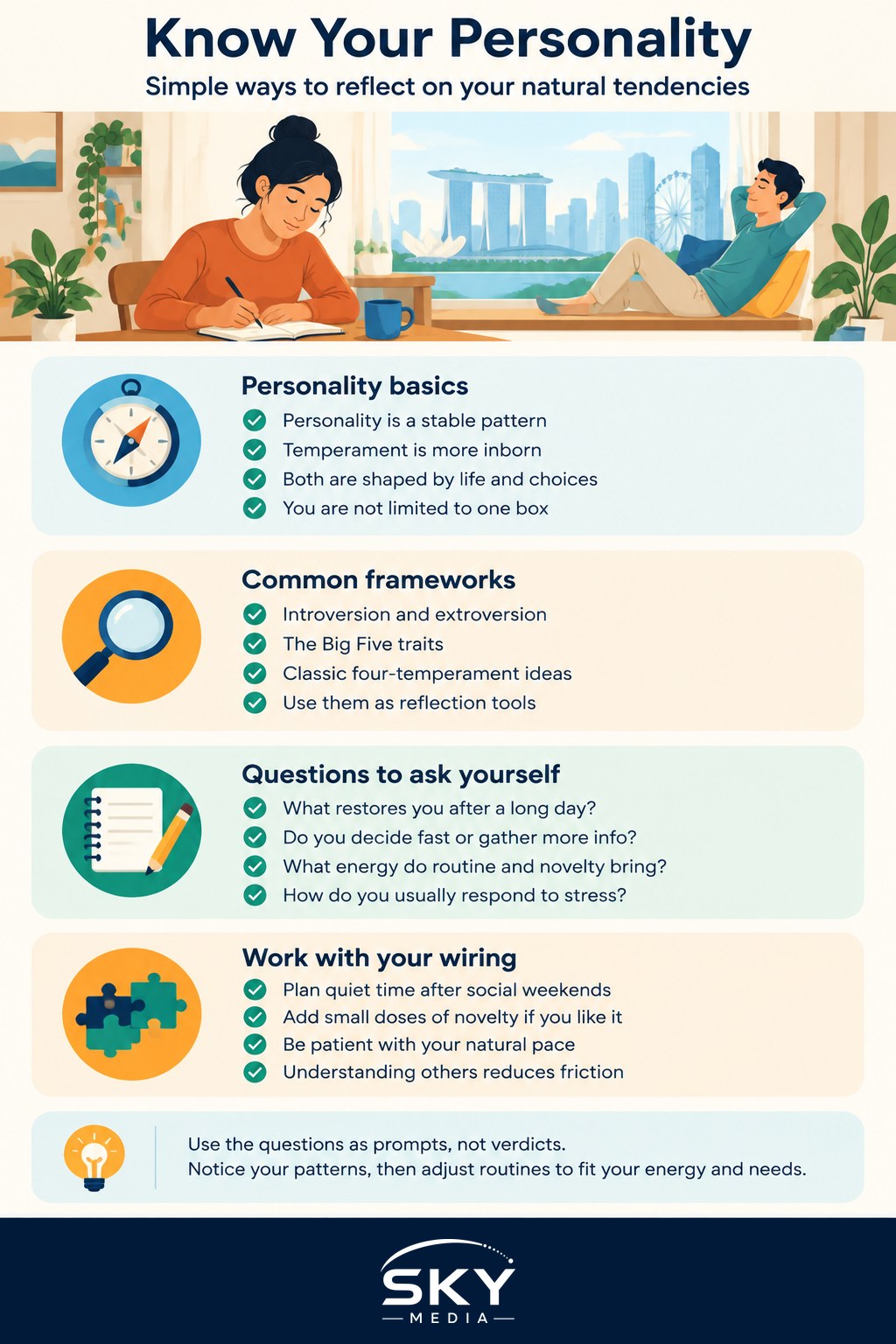
Personality is the fairly stable pattern of how you think, feel, and behave over time. Temperament is a related idea that usually points to the more inborn part of that pattern, the natural leanings you seem to have had since you were young. Neither is destiny. Your habits, upbringing, culture, and choices all shape how your temperament shows up day to day.
It helps to picture personality as tendencies on a sliding scale rather than boxes. You are rarely fully one thing. You might be mostly reflective but chatty with close friends, or usually organised but relaxed on holiday. Where you sit can also shift a little depending on stress, rest, and who you are with.
Well-known frameworks as reflection tools
A few frameworks come up again and again. Think of them as different lenses on the same person.
- Introversion and extroversion. This is really about where you get your energy. Do social gatherings top you up or drain you? Neither is better. In a busy, always-on city, many introverts simply need more quiet recovery time after a packed week.
- The Big Five traits. Researchers often describe personality across five broad dimensions: openness to new experiences, conscientiousness, extroversion, agreeableness, and how strongly you feel worry or calm. Instead of a “type”, it describes where you tend to land on each dimension.
- Classic four-temperament ideas. Older traditions grouped people into broad temperaments, such as lively and sociable, calm and steady, driven and decisive, or thoughtful and cautious. These are very simplified, but they can be a friendly starting point for noticing your defaults.
You do not need to take any formal quiz to benefit. You can simply ask yourself honest questions and notice the patterns.
Gentle questions to understand yourself
Set aside ten quiet minutes, perhaps with a cup of kopi, and reflect on these:
- After a long day, what actually restores you? People, solitude, movement, or rest?
- Do you make decisions quickly and adjust later, or do you like to gather information first?
- Are you energised by variety and new ideas, or by routine and the comfort of the familiar?
- How do you usually respond to stress? Do you speed up, go quiet, get organised, or seek reassurance?
- Which situations make you feel most like yourself, and which leave you feeling stretched?
Jotting your answers down helps. If you enjoy writing things out, you may find the benefits of journaling a natural companion to this kind of reflection. The aim is not to pin a label on yourself, but to notice your grain, the direction you naturally run in.
Working with your temperament, not against it
Once you see your tendencies clearly, you can design a life that fits them better. If crowds drain you, you might schedule quieter evenings after social weekends rather than forcing yourself to be constantly available. If you love novelty, you might build small doses of newness into an otherwise steady routine so you stay engaged.
Understanding your temperament also builds patience with yourself. Instead of scolding yourself for being “too sensitive” or “too slow to decide”, you can name it as a trait and manage it wisely. This is a big part of learning how to become more self-aware, which quietly improves your relationships, your work, and your peace of mind.
It works both ways. Knowing that others have different wiring makes you kinder. Your colleague who needs to think overnight is not being difficult. Your friend who cancels plans may simply be low on social energy. Reading temperament generously reduces a lot of friction.
Growth is still possible
Here is the encouraging part. Understanding your personality is not an excuse to stay stuck. You can be a natural introvert and still learn to speak up in meetings. You can be cautious by nature and still take brave steps. Your temperament sets your starting point and your comfort zone, but it does not cap your growth. In fact, real change tends to stick when it respects who you are, which is why a growth mindset and self-knowledge work so well together.
A warm wrap-up
Understanding personality types in Singapore, and your own temperament within them, is a quiet act of self-kindness. You stop comparing yourself to a template that was never yours and start building a life that suits your actual wiring. Go slowly. Notice your patterns without judgement. Use the frameworks lightly, as mirrors rather than verdicts. Over time, this gentle self-understanding makes everyday life feel a little less like a struggle and a lot more like your own.
Further reading: The Enneagram Explained: What Enneagram Types Can and Cannot Tell You · The Four Tendencies Explained: Upholder, Questioner, Obliger, Rebel