

Life in Singapore moves quickly. Between long commutes, demanding jobs, family obligations, and the endless admin of running a household, it is easy for couples to drift into autopilot. You share a flat, split the chores, and coordinate the calendar, yet weeks can pass without a real conversation about how you are both actually feeling. That is exactly the gap a weekly check-in is designed to close. Couple check-ins in Singapore are becoming a quietly popular habit precisely because they are simple, low pressure, and genuinely effective at keeping a relationship warm before small frustrations harden into big ones.
A check-in is not a performance review or a confrontation. It is a gentle, regular pause where the two of you sit down, put the phones aside, and talk honestly about your week, your worries, and your wins. Think of it as maintenance rather than repair. You service a car before it breaks down, and this is the emotional equivalent.
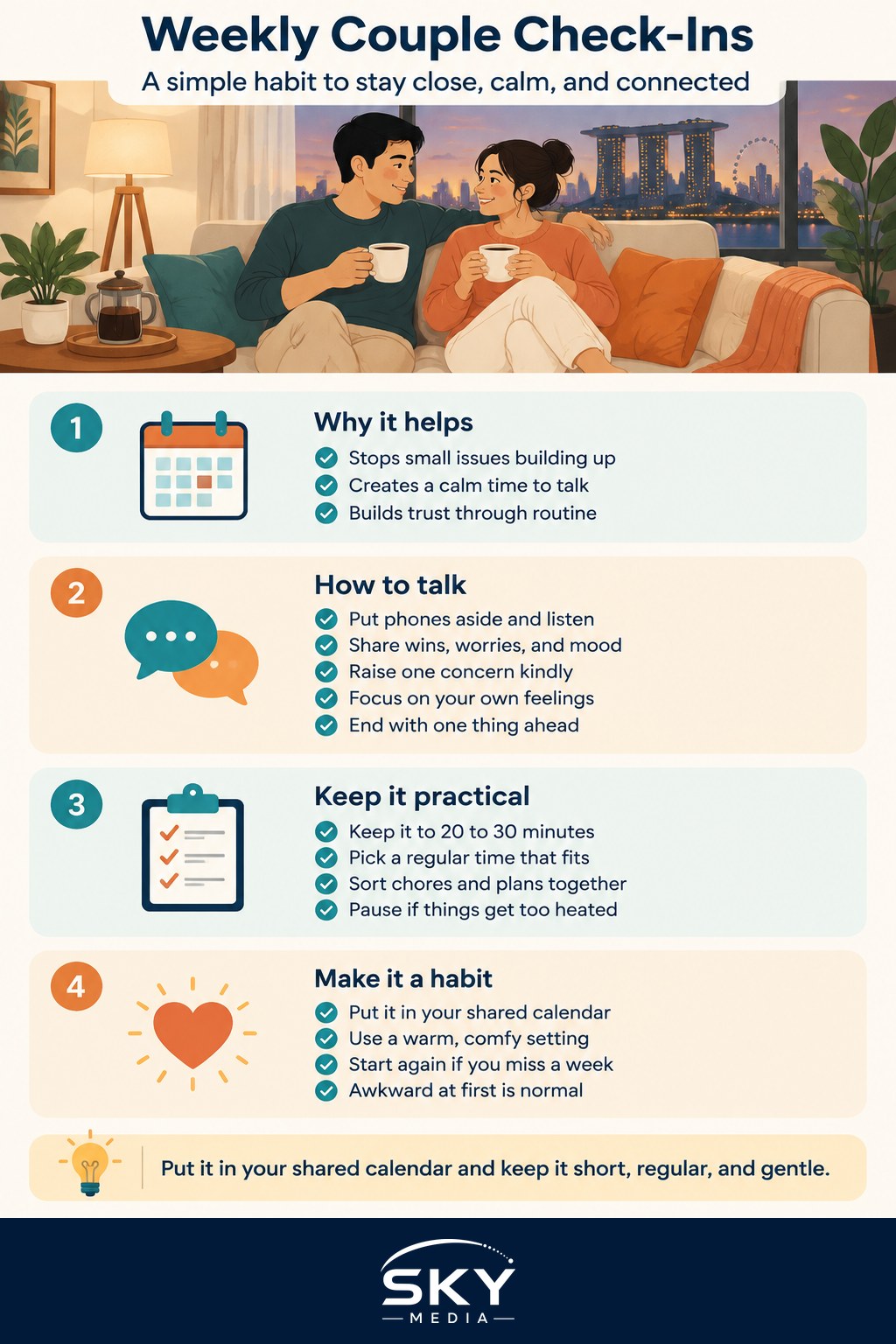
Why a Regular Ritual Helps
Most relationship strain does not arrive as one dramatic event. It builds slowly, from the unsaid comment, the forgotten promise, the small resentment that never got aired. When couples wait until they are already upset to talk, conversations tend to happen at the worst possible moment, often late at night when both people are tired and defensive.
A scheduled check-in changes the timing. Because you know a calm space is coming, you can hold on to a niggle rather than blurting it out in frustration, and you can raise it when you are both regulated. Over time this builds trust, because your partner learns that difficult things get discussed kindly rather than exploding unpredictably.
There is also a connection benefit that has nothing to do with problem solving. A weekly check-in is a standing appointment that says, you matter enough for me to make time. In a busy Singapore household, that signal is worth a great deal. If you want to go deeper on the everyday side of closeness, our piece on how to communicate better with your partner pairs nicely with this habit.
How to Run a Check-In
Keep it short and predictable. Twenty to thirty minutes is plenty. Pick a slot that suits your rhythm, perhaps a Sunday evening before the week begins, or a weekday lunch if your schedules clash. Consistency matters more than the exact day.
A simple structure keeps things safe and stops the conversation from wandering into old arguments. You might move through a few gentle rounds.
- Appreciation: Each of you shares one thing you were grateful for this week. Starting positive sets a warm tone.
- How I am doing: A short honest update on your mood, stress, and energy, so your partner understands your headspace.
- Something on my mind: Raise one worry or request, framed kindly. Speak about your own feelings rather than listing your partner’s faults.
- Logistics: Sort the practical week ahead, from who is cooking to which family visit is coming up.
- Looking forward: Name one thing you are excited about together, even something small like a hawker dinner or a weekend walk.
A few ground rules make this work. Listen to understand rather than to defend. Avoid the words always and never, which tend to escalate things. If a topic gets heated, it is completely fine to pause and return to it later when you are both calmer. The goal is closeness, not winning.
Making It Stick
New habits fade without a little scaffolding, so treat the check-in like any other commitment. Put it in your shared calendar, protect the time from other plans, and start again without guilt if you miss a week. Some couples like a warm setting, a favourite kopi or tea, a quiet corner of the flat, or a bench at the park. The ritual around it can make it something you look forward to rather than a chore.
Be patient with the early sessions. They can feel slightly awkward, a bit like a first date with someone you already know well. That awkwardness passes as trust grows. If you find that the same painful issues keep surfacing and you cannot move through them together, that is not a failure, it is useful information. Learning to raise hard topics is a skill in itself, and our guide on having difficult conversations with your partner can help. If deeper patterns keep resurfacing, speaking to a trained couples counsellor can give you tools that are hard to find on your own, and reaching out early is a sign of care, not weakness. You can read more about when to consider couples counselling if you are curious about that step.
A weekly check-in will not solve everything, and it is not meant to. What it offers is steadier, kinder communication and a reliable moment to feel seen by the person you love. Start small, stay gentle with each other, and let the habit grow at its own pace. The couples who last are rarely the ones who never struggle. They are the ones who keep turning towards each other, one honest conversation at a time.
Frequently Asked Questions
What day and time works best for a weekly check-in? Pick a regular slot when you are both relaxed and not rushed, such as a Sunday evening or a weekday lunch if schedules clash. Avoid late at night when you are tired. Being consistent matters more than the exact day.
What if one of us doesn’t want to do a check-in? Explain it as a way of keeping things warm, not a performance review. Offer to try a short version for a few weeks and see how it feels. If resistance continues, ask what is behind it and adjust the format together.
Can we do a check-in if we have young kids at home? Yes, it just needs a little planning. Wait until the children are asleep or occupied, or use a short window while they play. Even fifteen minutes can work, and a walk together can serve as the setting.
What should we do if a check-in turns into an argument? Pause, take a breath and agree to return to it when calmer. Avoid words like always and never. Focus on your own feelings and listen to understand. If the same topic keeps flaring up, consider a counsellor.
Do check-ins still help when things are going well? Yes, they act as maintenance. Sharing appreciation and small worries early stops resentments from building quietly. They also give you a regular moment to feel seen, even when nothing is wrong.
Further reading: A Couple’s Bucket List of Things to Do in Singapore