

The Work Permit is the pass that brings in most of the foreign workforce behind Singapore’s building sites, factories, shipyards, kitchens and cleaning teams. If you are about to start a job here, or you are hiring for one, this guide to the work permit Singapore system explains who qualifies, how the application works and the conditions that come with the card. It is general information, not legal advice. The Ministry of Manpower (MOM) sets and regularly updates the rules, so always confirm the current details on the MOM website before acting.
What the Work Permit Is and How It Differs From Other Passes
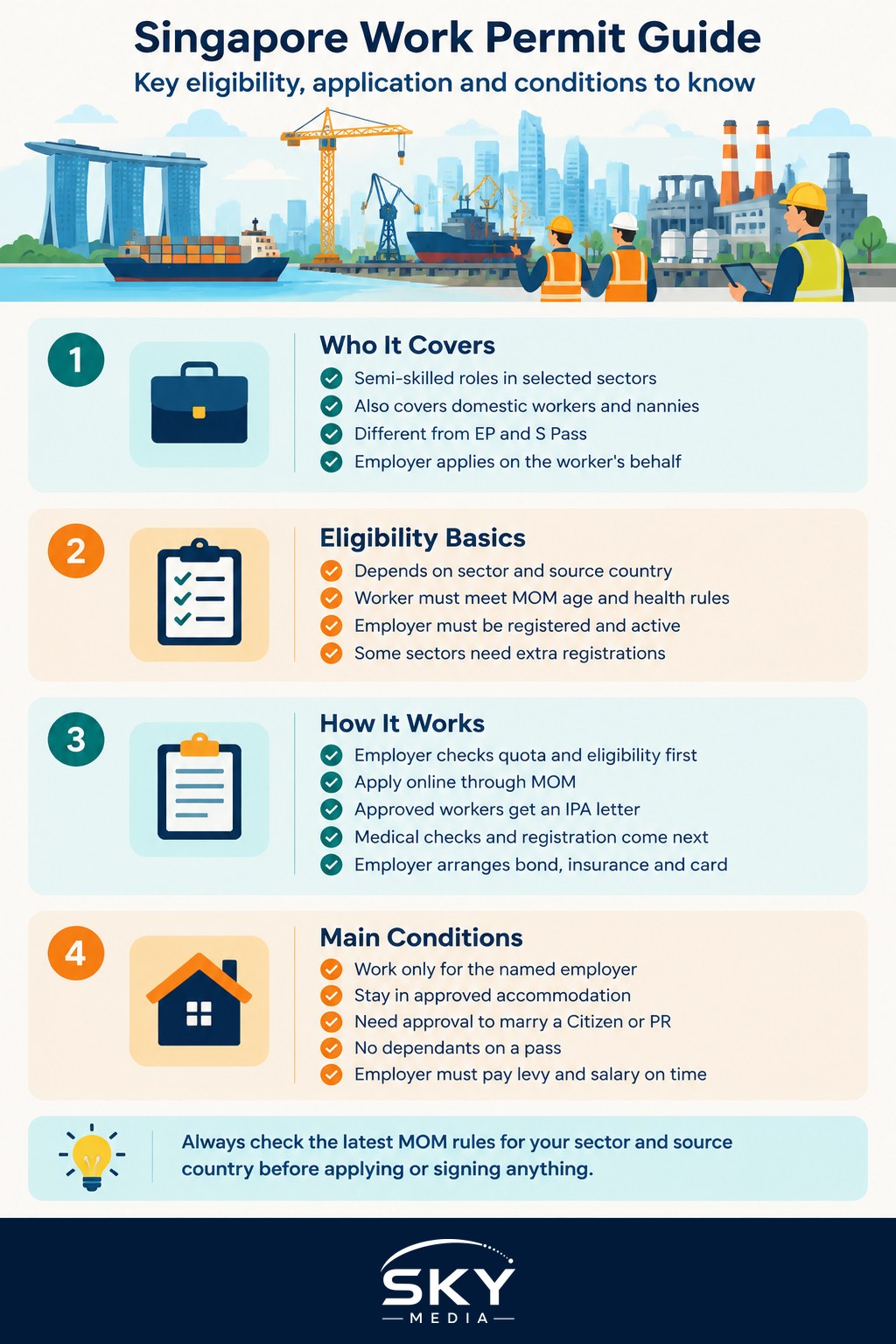
Singapore has several work passes. The Employment Pass (EP) is for professionals, managers and executives. The S Pass is for mid-level skilled staff. The Work Permit sits below both and covers semi-skilled and lower-wage roles in specific sectors. It also has its own track for migrant domestic workers and confinement nannies, which follows separate rules.
A few features set the Work Permit apart:
- The employer applies, not the worker. You cannot apply for a Work Permit on your own. Your employer, or an employment agency acting for them, submits the application to MOM.
- It is tied to one employer and one job. You may only work for the employer named on your permit, in the occupation approved.
- Employers pay a monthly levy and must stay within a quota. These two tools control how many foreign workers a company can hire.
- Family and personal conditions are stricter. Holders generally cannot bring family members on a dependant pass, and there are rules on marriage and pregnancy.
Here is how the three main passes compare at a glance.
| Feature | Work Permit | S Pass | Employment Pass |
|---|---|---|---|
| Typical roles | Semi-skilled work in set sectors | Mid-level skilled and technical roles | Professional, managerial and executive roles |
| Who applies | Employer or appointed agent | Employer or appointed agent | Employer or appointed agent |
| Levy and quota | Yes, both apply | Yes, both apply | No levy or quota |
| Can bring family on a pass | Generally no | Possible if salary criteria are met | Possible if salary criteria are met |
| Source country limits | Yes, depends on sector | No | No |
Who Is Eligible: Sectors, Source Countries and Basic Criteria
Eligibility depends on three things: the sector the employer is in, the country the worker comes from, and the worker’s own profile.
Sectors. Work Permits for non-domestic workers are issued for a defined list of sectors. These have traditionally included construction, manufacturing, marine shipyard, process (for example petrochemical plants) and services. Each sector has its own quota, levy rates and rules on which nationalities can be hired.
Source countries and regions. MOM groups workers by where they come from. Broadly, workers may come from Malaysia, from the People’s Republic of China, or from a list of approved non-traditional and North Asian sources. Not every sector accepts every source. Services, for example, has historically been more restrictive on source countries than construction. MOM has also been updating these lists and introducing new occupation lists for certain sources, so check the current table for your sector.
Worker criteria. MOM sets age limits, health requirements and, in some sectors, skills or test requirements. Rules on minimum and maximum age and on how long a worker can stay on a Work Permit have been revised in recent years, so rely on MOM’s current eligibility pages rather than older figures.
Employer criteria. The company must be registered with ACRA (the Accounting and Corporate Regulatory Authority), be active in an eligible sector, and have enough quota to hire. Some sectors require extra registration, for example with the Building and Construction Authority for construction firms.
How the Application Works, Step by Step
The process looks roughly like this, though details vary by sector and source country:
- Employer checks quota and eligibility. The employer confirms the role, the worker’s nationality and the sector all fit MOM’s rules.
- Online application. The employer or agent applies through MOM’s online system with the worker’s details and the job offer.
- In-Principle Approval (IPA). If approved, MOM issues an IPA letter. This lets the worker enter Singapore for the job.
- Security bond and insurance. For most non-Malaysian workers, the employer must buy a security bond before the worker arrives. Employers must also buy medical insurance and work injury compensation insurance as required. Our guide to the Work Permit security bond explains how the bond works from the employer’s side.
- Arrival and medical examination. The worker usually completes a medical check-up at a Singapore clinic within the stated time after arrival.
- Issuance and registration. The employer requests issuance of the permit. The worker may need to register fingerprints and a photo before the card is printed and delivered.
- Settling-in requirements. Some first-time workers, depending on sector, attend a settling-in or orientation programme that covers rights, safety and local norms.
Throughout this process, it is the employer who carries most of the obligations. Workers should never pay an employer for a Work Permit, and should keep copies of their IPA and contract.
Conditions Holders Must Follow
Once the permit is issued, the holder must follow conditions that MOM lists on the permit and on its website. The main ones are:
- Work only for the named employer and in the approved job. Doing side work, freelancing or working for another company is not allowed.
- Live in the approved accommodation. Employers must provide acceptable housing, and in some sectors this means a registered dormitory. Workers should report their address as required.
- Marriage rules. Work Permit holders need MOM’s approval before marrying a Singapore Citizen or Permanent Resident, both while holding the permit and in some cases after. Check MOM’s latest guidance before planning a wedding.
- Pregnancy rules. For migrant domestic workers in particular, there are conditions on pregnancy and delivery in Singapore. Read the conditions of your specific pass.
- No dependants on a pass. The Work Permit generally does not allow family members to join on a Dependant’s Pass or Long-Term Visit Pass sponsored by the worker.
Buying an HDB flat requires citizenship or PR status, so it is not an option on a Work Permit. If you hope to settle long term, our explainer on HDB eligibility schemes shows what each buyer group can do.
Employer Duties: Levy, Quota, Salary and Wellbeing
Employers take on real responsibilities when they hire on a Work Permit:
- Pay the foreign worker levy every month, on time. The rate depends on sector, skill level and how close the company is to its quota.
- Pay salary as declared in the IPA, on time, and keep proper records. Itemised payslips and key employment terms in writing are expected under the Employment Act.
- Provide medical care and insurance as required by MOM.
- Give adequate rest days and safe working conditions, following workplace safety and health rules.
- Cancel the permit properly when employment ends, and arrange the worker’s return home where required.
Workers who face salary problems, unsafe conditions or other disputes can approach MOM, and for salary claims the Tripartite Alliance for Dispute Management (TADM). Migrant worker support organisations can also help with advice.
Changing Jobs, Renewal and Leaving
A Work Permit is not portable. To change employers, the new employer must apply for a fresh permit, and whether a transfer is allowed depends on the sector and current MOM rules. Renewal is done by the employer before the permit expires, subject to the worker still meeting the criteria.
When the job ends, the employer cancels the permit and the worker usually needs to leave Singapore within the time allowed, unless a new pass is approved. Overstaying carries serious penalties, so plan ahead and ask your employer or MOM if anything is unclear.
Rules on the Work Permit change from time to time. Keep copies of your IPA, contract and permit card, and check MOM’s current requirements for your sector and source country before you sign anything.
Official sources: Ministry of Manpower (MOM)