

Entering a writing competition is one of the best ways to set a deadline, get your work read by experienced judges and build a track record before you approach publishers. Singapore has a small but active literary scene, with prizes for published books, contests for unpublished manuscripts, and many smaller competitions for short stories, poetry and young writers. This guide explains the kinds of writing competition Singapore writers can enter, how to find the current ones, and how to give your entry the best chance.
Competitions come and go, and organisers change formats, eligibility and deadlines from year to year. Treat the names below as starting points, and always check the organiser’s official page for the current rules.
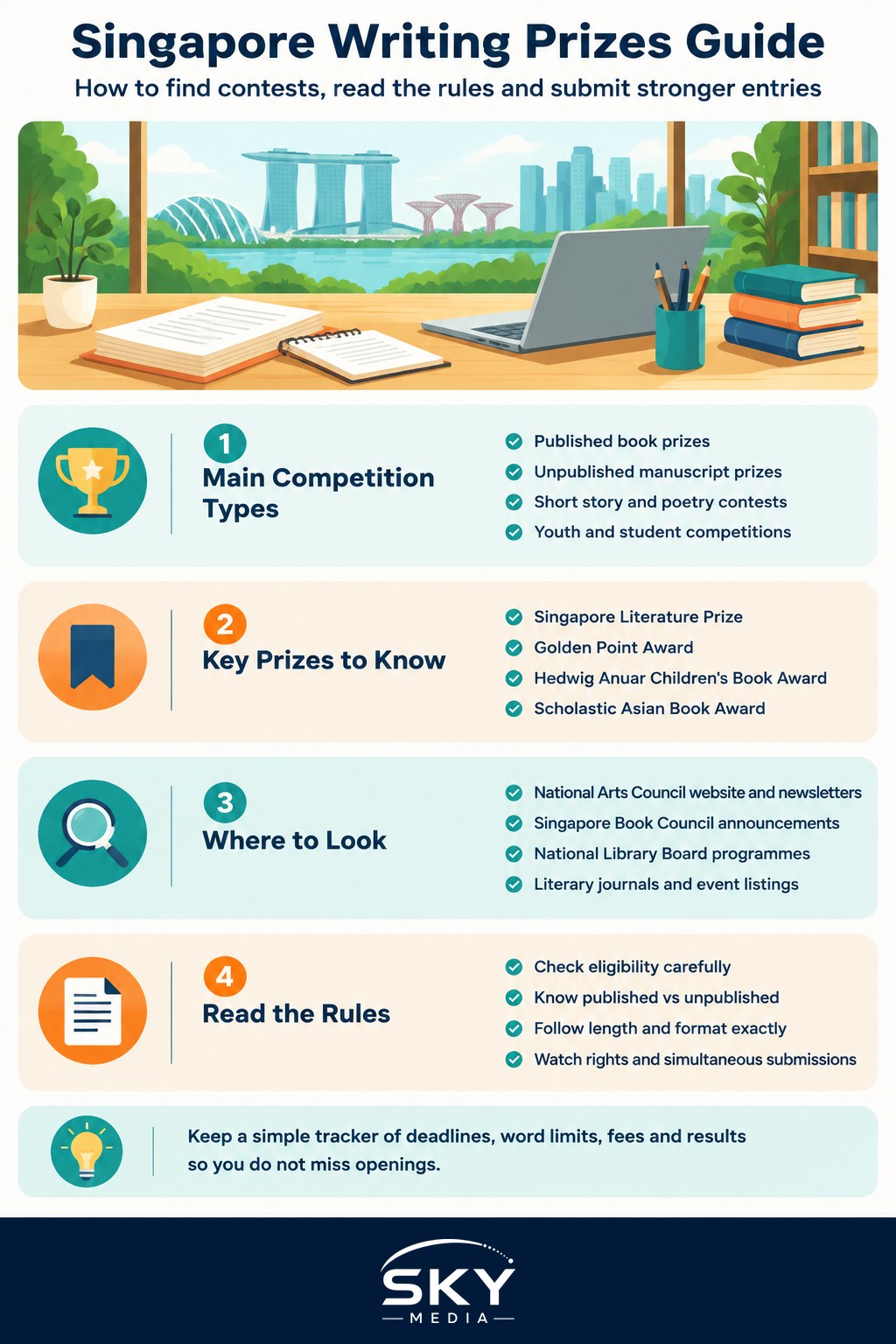
The Main Types of Writing Competitions
It helps to know what kind of contest you are looking at before you start writing for it.
| Type | Who it suits | What you usually submit |
|---|---|---|
| Prizes for published books | Authors with a book already out | The published book, often nominated by a publisher |
| Unpublished manuscript prizes | Writers with a finished or near-finished book | A full manuscript or a substantial extract |
| Short story and poetry contests | Emerging writers building a track record | One or a few short pieces within a word or line limit |
| Youth and student competitions | Students and young writers | Short pieces, often on a theme, sometimes through school |
Knowing the category stops you from wasting effort. A short story contest is a good first step for a new writer, while a published book prize only becomes relevant after you have a book out.
Well-Known Prizes and Platforms to Watch
Several long-running names come up often in Singapore’s literary world. Check each one’s official site for whether it is running in a given year.
- The Singapore Literature Prize, organised by the Singapore Book Council, recognises published works in Singapore’s four official languages, English, Chinese, Malay and Tamil, across genres such as fiction, poetry and creative non-fiction. Submissions are usually for books published within a set period.
- The Golden Point Award, run by the National Arts Council (NAC) in past editions, has been one of the better-known competitions for unpublished short stories and poetry in the four official languages. Check NAC’s website for its current status.
- The Hedwig Anuar Children’s Book Award, also linked to the Singapore Book Council, focuses on children’s literature by Singapore authors.
- The Scholastic Asian Book Award, associated with the Singapore Book Council and Scholastic, has recognised unpublished manuscripts for children and young people with Asian themes.
Beyond these, publishers, universities, libraries, literary journals and community groups run their own competitions from time to time. Some publishers have also run prizes for unpublished novels. These can be valuable because winning may come with a publishing opportunity.
Where to Find Current Competitions
Since calls for entries open and close throughout the year, it helps to build a habit of checking a few places regularly.
- National Arts Council website and newsletters. NAC lists literary arts programmes, grants and initiatives. It also runs funding schemes for writers that are not competitions but are worth knowing about.
- Singapore Book Council. Follow its announcements for book awards, workshops and calls for submissions.
- National Library Board (NLB). Libraries host writing programmes, talks and occasional competitions, and NLB promotes reading and writing initiatives such as its annual reading festival.
- Literary journals and independent presses. Local online journals publish calls for submissions and sometimes run themed contests.
- Schools, polytechnics and universities. Students often have access to internal competitions and inter-school contests.
- Literary events. The Singapore Writers Festival and smaller readings are good places to meet editors and hear about upcoming opportunities. Our guide to bookshops and literary events in Singapore suggests where to start.
Keep a simple spreadsheet of competitions, deadlines, word limits and fees so nothing slips past you.
How to Read the Rules Properly
Competition rules are not a formality. Many good entries are disqualified for small mistakes. Before you start, check:
- Eligibility. Some prizes are open only to Singapore citizens or permanent residents. Others accept anyone living in Singapore, or anyone worldwide. Age limits apply to youth contests.
- Published versus unpublished. Many contests define “unpublished” strictly. Posting a piece on a public blog or social media may count as publication.
- Language and length. Respect word or line limits exactly. Check whether translations are accepted.
- Anonymity. Many contests judge blind, so your name must not appear on the manuscript itself.
- Simultaneous submissions. Some organisers allow you to send the same piece elsewhere, while others do not.
- Rights. Read what rights you grant the organiser if you win or are shortlisted, such as anthology publication, and for how long.
- Format. Follow font, spacing, file type and naming instructions to the letter.
If a rule is unclear, email the organiser before the deadline rather than guessing.
Preparing an Entry That Stands Out
Judges often read a large number of entries, so clarity and craft matter more than ambition.
- Start strong. The opening lines decide whether a judge leans in. Cut slow warm-ups.
- Answer the theme thoughtfully. If there is a theme, an unexpected but clearly connected angle often works better than the most obvious interpretation.
- Write from what you know. Local settings, languages and textures can give your work a distinct voice. Singapore’s own literary heritage shows how much ground there is to draw on.
- Revise in stages. Put the draft away for a few days, then read it aloud. Cut repetition and tighten sentences.
- Get feedback. A writing group, class or trusted reader can catch problems you no longer see.
- Proofread last. Typos rarely sink a strong piece, but they do not help a borderline one.
If you are new to fiction, our guide to writing your first short story covers structure, character and endings in more depth.
Fees, Scams and Vanity Contests
Most reputable local competitions charge no fee or a modest one. Be cautious when a contest:
- Charges a high entry fee with vague prize details.
- Promises that every entrant will be “published” in an anthology, then asks you to pay to buy copies or for a “publishing package”.
- Claims broad, permanent rights to every submission, not just the winners.
- Has no named judges, past winners or clear organiser behind it.
Search for past results and the organiser’s track record. A legitimate competition is usually transparent about who runs it, who judges and what winners receive.
What to Do After You Enter
Once you submit, start the next piece. Results can take months, and most entries will not win, which is normal even for experienced writers. A shortlist or honourable mention is a genuine achievement and worth listing in your writer’s bio.
If you do not place, look again at the piece with fresh eyes, revise it, and check whether the rules let you submit it elsewhere. Over time, a portfolio of polished work, a few credits and the discipline of meeting deadlines will serve you well, whether your goal is a published book or simply better writing.
Frequently Asked Questions
Are there grants for writers apart from competitions? Yes, the National Arts Council runs funding schemes for writers and literary projects that are not competitions. Eligibility, amounts and deadlines change, so check the NAC website for current schemes and what documents you need. Publishers and literary organisations occasionally offer mentorships and residencies too.
Where can I find a writing group or class in Singapore? Try libraries, community clubs, literary organisations, universities, and independent writing workshops. Literary events and festivals are good places to meet other writers. Check current listings since offerings change, and attend a trial session to see whether the group’s feedback style suits you.
Can I use AI tools to write my competition entry? Check each competition’s rules, because many organisers require entries to be original work and some have specific rules on AI-generated or AI-assisted writing. If the rules are unclear, email the organiser before the deadline. Entries that break the rules can be disqualified.
What should I put in the writer’s bio for an entry? Keep it short and factual, usually a sentence or two on who you are and any relevant writing credits, such as shortlists or publications. If the contest is judged blind, check whether the bio must go in a separate file. Follow the organiser’s word limit.
How many competitions should I enter at once? Enter as many as you can write well for, rather than rushing a piece for every deadline. Match each piece to the theme and rules, and check whether simultaneous submissions are allowed. A spreadsheet of deadlines and word limits keeps you organised and stops quality dropping.
Further reading: Finding Open Calls and Art Competitions in Singapore