

You switch off your laptop after a long day, but on the MRT ride home your brain keeps circling back to the email you did not send and the report you only half wrote. That nagging feeling has a name: the Zeigarnik effect. It describes our tendency to keep unfinished tasks active in our minds more than completed ones. Understood well, it is not just a source of stress. You can use these “open loops” deliberately to get started, stay focused and then close them properly so you can rest.
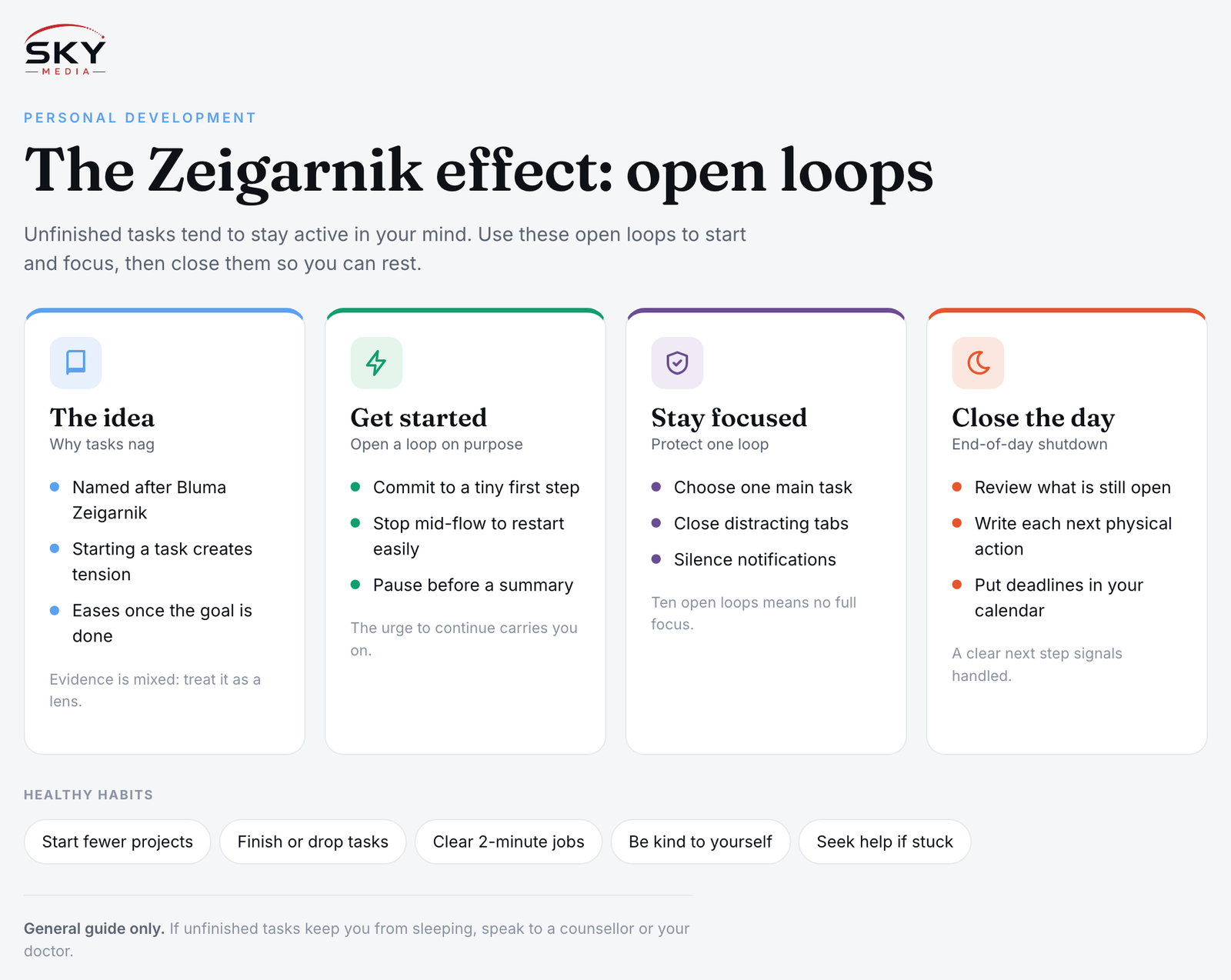
Where the Zeigarnik Effect Comes From
The effect is named after Bluma Zeigarnik, a psychologist who studied in Berlin in the 1920s. The story often told is that her supervisor, Kurt Lewin, noticed something odd at a restaurant: waiters could remember complicated orders while they were still unpaid, but seemed to forget them once the bill was settled.
Zeigarnik tested this in the lab. Participants were given a series of simple tasks, such as puzzles and small handicrafts, and some were interrupted before they could finish. Later, people tended to recall the interrupted tasks better than the completed ones.
The explanation drew on Lewin’s ideas: starting a task creates a kind of mental tension, and that tension only eases once the goal is completed. Until then, the mind keeps the task “switched on”.
A note on the evidence
Later studies have produced mixed results, and not every experiment has found the memory boost Zeigarnik reported. What does hold up more consistently is the related idea that unfinished goals keep pulling at our attention. A closely related finding, sometimes called the Ovsiankina effect after another of Lewin’s students, is that people feel a strong urge to go back and resume interrupted tasks. So treat the Zeigarnik effect as a useful lens on how attention works, not as an exact law.
How Open Loops Show Up in Everyday Life
Once you know about it, you will notice the effect everywhere.
- Intrusive work thoughts after office hours, because a project has no clear next step.
- Cliffhangers in drama series that make you click “next episode” at midnight.
- Half-done chores, such as a pile of folded laundry not yet put away, that keep catching your eye.
- Notification badges on apps, which feel like small unfinished tasks begging to be cleared.
- Students revising for exams who find their mind drifting back to a topic they left halfway.
Some of these work against you. Others can be harnessed, which is what the rest of this guide is about.
Using Open Loops to Get Started and Stay Focused
The Zeigarnik effect suggests that the hardest part of a task is often starting it. Once something is open, your mind wants to finish it.
Start small to create the pull
If you are procrastinating on a big job, commit to a tiny first step: write one paragraph, open the spreadsheet and fill in the headers, or read the first page of your notes. You are deliberately opening a loop. Often, the urge to continue carries you further than planned.
Stop mid-flow on purpose
Some writers stop their work for the day in the middle of a sentence or a section they know how to continue. The next morning, picking it up feels easy because the loop is already open and the next step is obvious. You can try this with study sessions too: end on a question you know how to answer, so returning feels natural.
Use cliffhangers for revision
When studying, break topics into chunks and pause just before a chapter summary or a worked example. Returning to it later can feel less like a chore and more like finishing a story. This pairs well with visual techniques such as mind mapping for studying, where an incomplete branch can act as a prompt for your next session.
Protect the loop you are working on
Open loops compete for attention. If you have ten tasks half done, all of them will pull at you, and none gets full focus. Choose one main task, close distracting tabs and silence notifications while you work on it. Our guide on how to prioritise your tasks can help you decide which loop deserves your focus first.
Closing Loops So Your Mind Can Rest
The same effect that keeps you engaged can also keep you awake at night. The good news is that research on goals suggests you do not always have to finish a task to quieten it. Making a concrete plan for when and how you will finish can reduce the mental pull, because your mind trusts that the task is handled.
Here is how that looks in practice, compared with what usually happens.
| Situation | What usually happens | A better way to close the loop |
|---|---|---|
| Leaving work with a report half done | You replay it all evening | Write the exact next step and when you will do it tomorrow |
| Many small chores pending at home | Each one keeps catching your eye | List them, pick a time slot, and do quick ones immediately |
| Unanswered messages piling up | You feel low-level guilt all day | Reply briefly now or schedule a time to reply properly |
| Revision topic only partly covered | It surfaces at bedtime | Note where you stopped and which page to start from next |
| A big goal with no clear start | Vague anxiety without action | Define one small, specific first action and when you will do it |
A simple end-of-day shutdown
- Spend five to ten minutes reviewing what is still open.
- For each item, write the very next physical action, not just the task name.
- Put time-sensitive items into your calendar.
- Say, out loud or in writing, that work is done for the day.
This is different from simply dumping everything onto paper. The key is that each loop gets a concrete next step and a time, which is what signals “handled” to your brain.
When Unfinished Tasks Become Overwhelming
For some people, open loops turn into constant rumination. If thoughts about unfinished tasks keep you from sleeping, relaxing or enjoying time with family, it may be a sign of stress overload rather than a productivity problem. Strategies in how to stop overthinking may help, and if the feeling persists, speaking to a counsellor or your doctor is a sensible step.
A few habits keep the effect in a healthy range:
- Limit how many projects you start at once.
- Finish or deliberately drop tasks, rather than leaving them hanging indefinitely.
- Clear small, two-minute tasks straight away.
- Be kind to yourself. An unfinished list is normal, not a personal failing.
Making the Zeigarnik Effect Work for You
The Zeigarnik effect is a reminder that your mind is wired to care about unfinished business. Instead of fighting it, use it in two directions: open a loop deliberately when you need momentum, and close loops with clear next steps when you need rest. Start small, focus on one thing at a time, and end each day by giving every open task a plan. Over time, you may find that you get more done and switch off more easily too.
Further reading: The Spotlight Effect: Why People Notice You Less Than You Think