
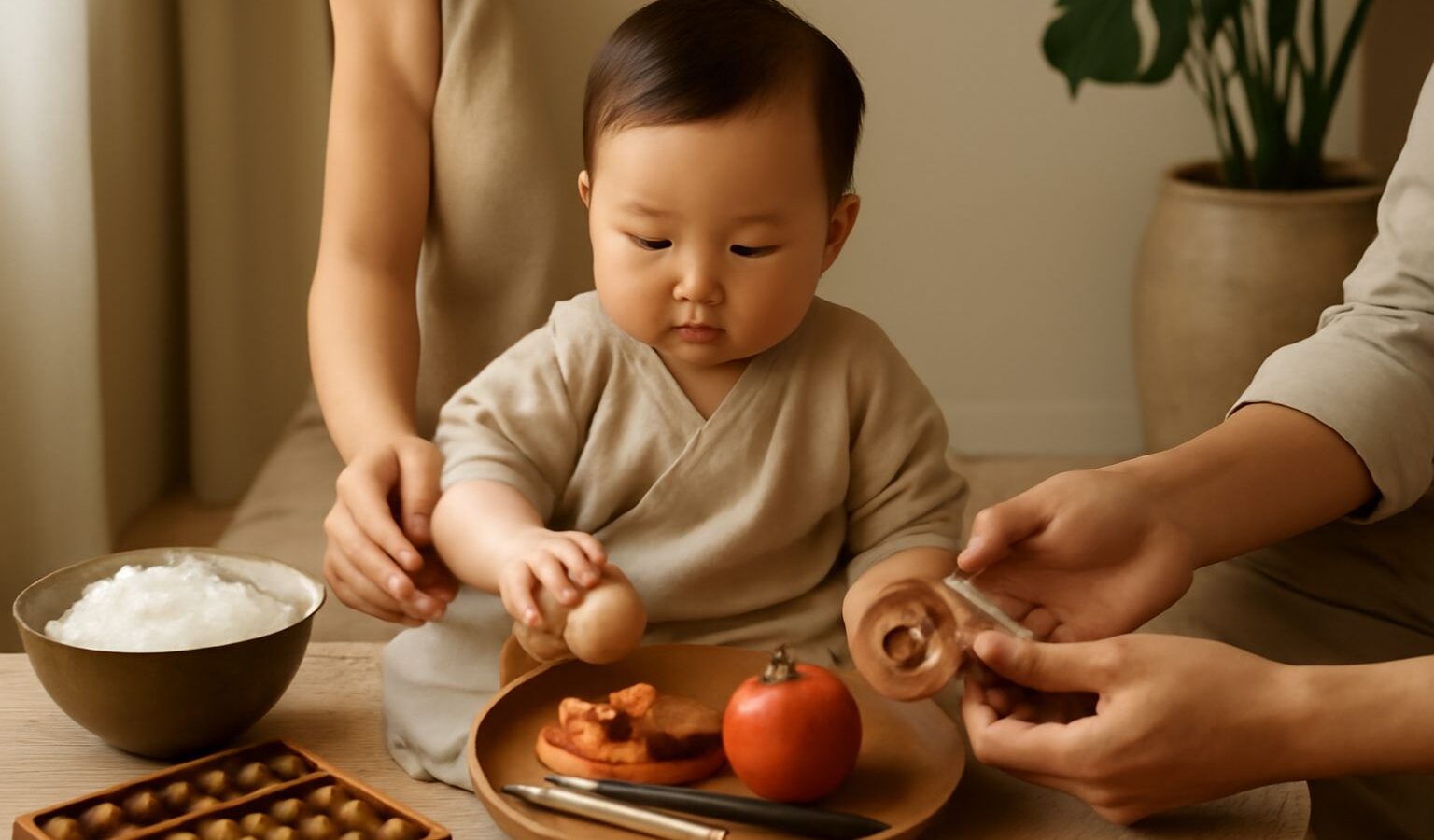
The baby sits on a red cloth, surrounded by a book, a calculator, a toy stethoscope and a few coins. The whole family leans in, phones raised, as tiny hands reach out. Whatever gets grabbed first is greeted with cheers and plenty of good-natured predictions. This is zhua zhou (抓周), the Chinese first birthday grab custom, and it remains one of the most photographed moments of a child’s first year in many Singapore families.
This guide explains where zhua zhou comes from, what the items traditionally mean and how families stage it today. It focuses on the grabbing ritual itself. For wider traditions around birthdays and old age, see our guide to Chinese birthday and longevity customs.
What Zhua Zhou Means
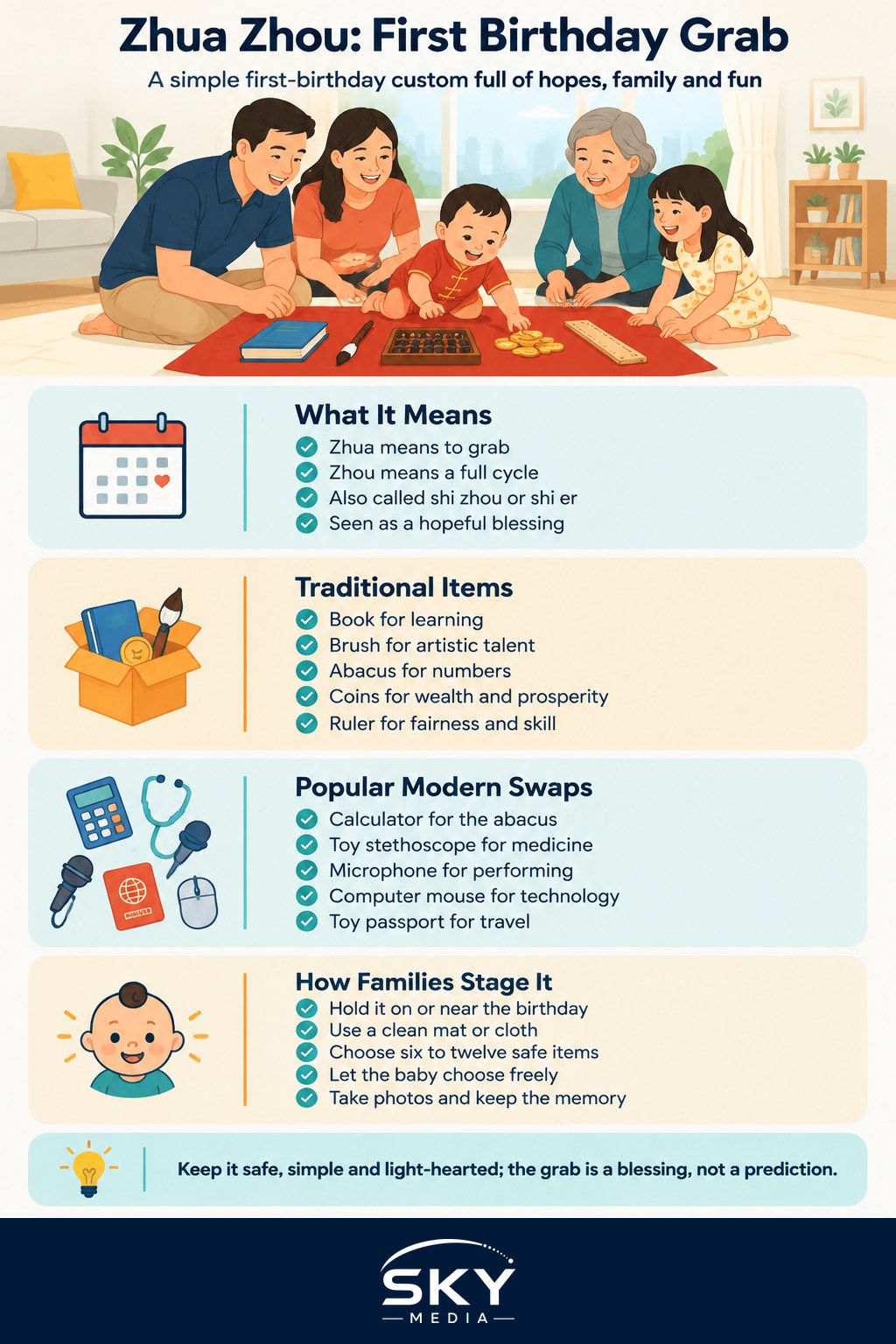
The name combines two words. “Zhua” (抓) means to grab, and “zhou” (周) refers to a full cycle, here the completion of the baby’s first year. The custom is also known by older names such as “shi zhou” (试周, testing at one year) and “shi er” (试儿, testing the child).
The idea is simple. On or around the first birthday, a selection of symbolic objects is laid out in front of the baby, who is encouraged to pick one. The chosen item is said to hint at the child’s future interests, personality or career.
Today, very few families treat the result as a real prediction. It is a light-hearted blessing, a way of expressing hopes for the child and a joyful activity that brings the generations together.
A Custom With a Long History
Zhua zhou has deep roots in Chinese culture. The scholar Yan Zhitui, writing during the Northern and Southern Dynasties period, described a version of the practice in his “Family Instructions of the Yan Clan” (颜氏家训), where boys and girls were presented with different sets of objects on their first birthday.
The custom also appears in the classic novel “Dream of the Red Chamber” (红楼梦). The young Jia Baoyu famously ignores everything else at his zhua zhou and grabs rouge and hairpins, to his father’s great displeasure. The scene is often recalled because it foreshadows the character’s later life, and because it shows how seriously some families once took the result.
Practices varied by region and family, and they continue to vary today. Similar first birthday traditions exist in other East Asian cultures too, such as the Korean doljabi, which shows how widely the idea has travelled.
Traditional Items and Modern Swaps
Families choose items that reflect their hopes and values. The table below shows common traditional objects, the meanings often associated with them and the modern alternatives many parents use. Meanings can differ between families and dialect groups, so treat this as a general guide.
| Traditional item | Common meaning | Modern alternative |
|---|---|---|
| Book | Scholarship, a love of learning | Picture book or e-reader toy |
| Calligraphy brush | Literary or artistic talent | Paintbrush, crayons or a pencil |
| Abacus | Business sense, skill with numbers | Calculator |
| Coins or money | Wealth and prosperity | Notes in a red packet, or a toy credit card |
| Seal or chop | Authority, a respected official role | Toy gavel or a name stamp |
| Ruler | Fairness, practical skill | Measuring tape or toy tools |
| Food, such as a cake | A good appetite, a comfortable life | A small snack or teething biscuit |
Many parents also add items tied to modern careers, such as a toy stethoscope for medicine, a microphone for performing, a computer mouse for technology, a football for sport, a toy passport for travel, or a toy plane. Some families include a spring onion, as the word for it (葱, cong) sounds like the word for clever (聪, cong).
How to Stage a Zhua Zhou at Home
You do not need anything elaborate. A simple, well-prepared set-up works best for a one-year-old.
Choosing the Date
Families hold zhua zhou on the first birthday itself or on a convenient day close to it, often the weekend of the birthday party. Some families follow the lunar calendar birthday, while others use the Gregorian date. If grandparents have strong preferences, it is worth asking them early.
Setting the Scene
- Lay down a mat or cloth. Red is popular as it symbolises luck and celebration, but any clean, soft mat works.
- Arrange the items in a circle or arc around where the baby will sit, all within reach.
- Pick six to twelve items. Too many can overwhelm a toddler; too few makes the moment brief.
- Space them out evenly so no item is closer or more eye-catching than the rest, unless you want to stack the odds.
- Check every item for safety. Avoid small parts, sharp edges, real coins that can be swallowed, and anything breakable. Supervise closely throughout.
Running the Ritual
- Place the baby in the centre, facing the items.
- Let them look around without pressure. Gentle encouragement is fine, but avoid pushing an item towards them.
- Watch for the first grab. Some families count only the first item; others count the first two or three.
- Celebrate whatever is chosen, and announce the meaning with good wishes.
- Take photos and short videos. Many families frame the photo or add it to the baby’s album.
Babies are unpredictable. Some grab instantly, others crawl away, cry, or chew on the mat. All of these are perfectly normal and make for good stories later.
Making It Meaningful for Your Family
Zhua zhou adapts easily to modern and mixed families. Ideas many parents like:
- Include family heirlooms, such as a grandparent’s pen or a small keepsake, for added sentimental value.
- Let relatives each contribute one item with a short explanation of their wish for the child.
- Mix cultures. In multicultural households, items can reflect both sides of the family, and the ritual can be explained to guests who have not seen it before.
- Keep it inclusive. Older practices sometimes offered different items to boys and girls. Many families today offer the same range to any child.
- Write it down. A short note of what was chosen and who attended makes a lovely keepsake to share when the child is older.
Zhua zhou often sits within a larger first birthday celebration. If you are still planning the party itself, our round-up of birthday celebration ideas in Singapore offers venues and formats, and our guide to traditional Chinese customs in Singapore gives context for other family rituals across the year.
Keeping the Spirit Light
The heart of zhua zhou is not fortune-telling. It is a family gathering around a child who has reached an important milestone, with every item on the mat representing a hope that they will grow up healthy, curious and loved. Whatever your baby grabs, the photo will be treasured.