

Academic integrity is a simple idea underneath all the rules: your work should honestly be your own, and the ideas you borrow should be clearly credited. It sounds obvious, yet in a busy Singapore school year, with deadlines stacking up and a dozen tabs open, the line between “using a source” and “copying it” can blur without you meaning any harm. This guide walks through what academic integrity really means, how plagiarism happens (often by accident), and the practical habits that keep you on the right side of it, whether you are a secondary student, a junior college or polytechnic student, or an adult learner returning to study.
None of this is about fear. Getting integrity right actually makes your work easier to produce and stronger to read, because you stop pretending and start thinking. Let us make it concrete.
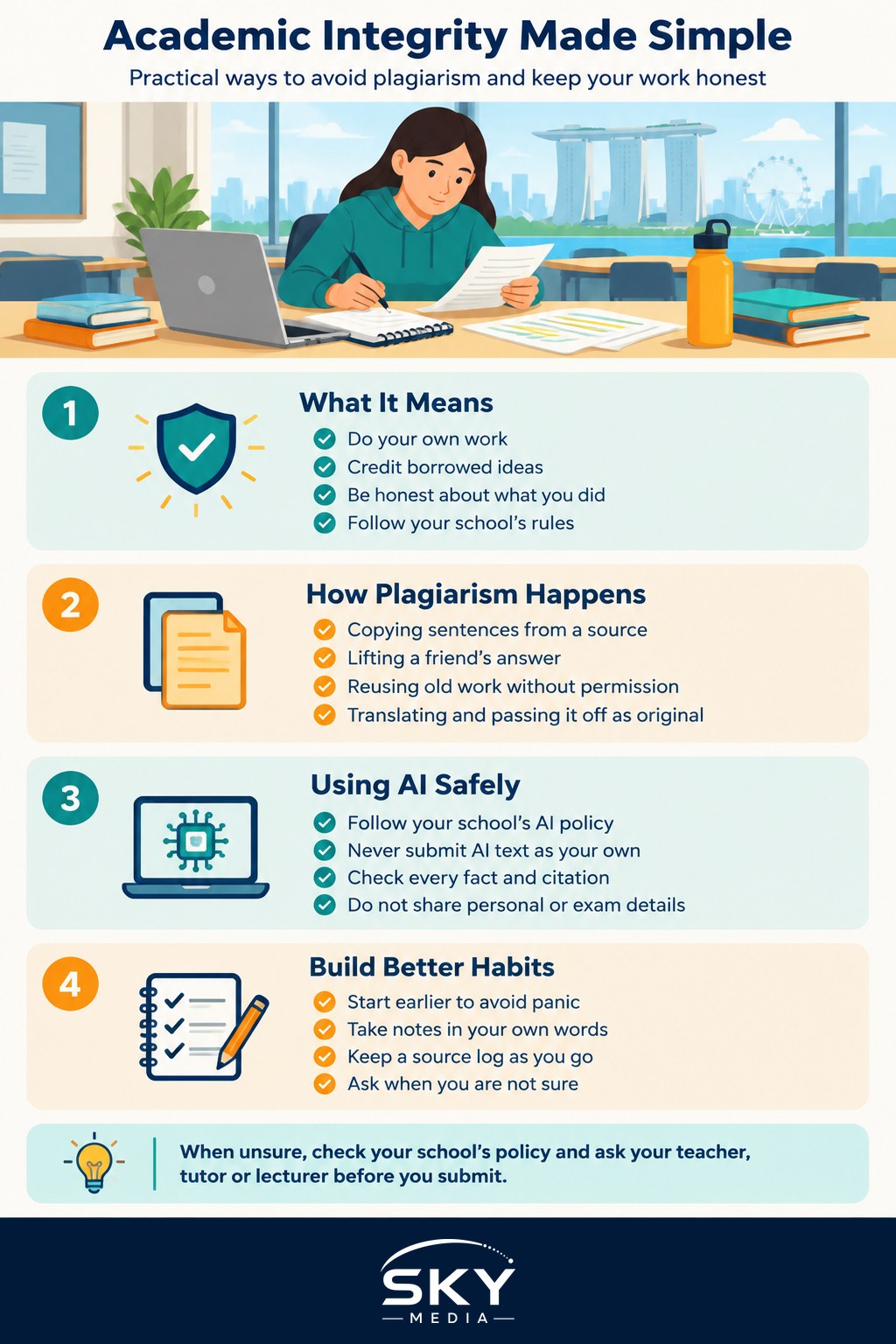
What Academic Integrity Actually Means
Academic integrity is the commitment to honest, fair and responsible learning. In practice it covers a handful of everyday behaviours:
- Doing your own work, or clearly acknowledging when a task is collaborative.
- Giving credit whenever you use someone else’s words, data, images or ideas.
- Not misrepresenting what you did, such as claiming you read a source you only skimmed, or inventing results.
- Following the rules your school or institution sets for each assignment.
Plagiarism is the most common breach: presenting another person’s work or ideas as your own. It can be copying sentences from a website, lifting a friend’s answer, translating a foreign-language article and passing it off as original, or reusing your own past assignment without permission (yes, “self-plagiarism” is a thing at university). Most plagiarism at the school level is not scheming; it is a rushed student who copied a paragraph “just to get started” and forgot to rewrite it.
Every institution here sets its own standards, so treat this article as general guidance and always check the specific policy that applies to you. MOE schools, the polytechnics, the ITE and the universities each publish their own academic honesty rules, and they do change. When in doubt, ask your teacher, tutor or lecturer directly. They would far rather answer a question early than mark a problem later.
Why It Matters More Than the Grade
It is tempting to see integrity as a hoop to jump through. The deeper reasons are more useful to remember when you are tired at 1am.
First, the skills are the point. When you paraphrase properly, you have to understand the idea well enough to say it in your own words. That act of rewording is where real learning happens, which is exactly what the Feynman technique for understanding trains you to do. Copying skips the learning and leaves you exposed the moment an exam asks you to explain the idea unaided.
Second, trust compounds. A reputation for honest work follows you into your CCA leadership, your internship, your first job. Employers and universities in Singapore take academic misconduct seriously, and a proven case can sit on your record.
Third, the consequences are real and rising. As detection tools improve, the odds of copied work going unnoticed keep falling. It is simply a poor bet.
How Plagiarism Sneaks In (and How to Stop It)
Most honest students get caught out by process, not intent. Here are the usual traps and the fix for each.
- Copy-pasting to “save time”. You paste a chunk into your draft meaning to reword it later, then run out of time. Fix: never paste source text straight into your document. Read the source, close the tab, then write from memory in your own words.
- Patchwriting. You change a few words and swap the sentence order, but the structure and phrasing are still the author’s. That still counts as plagiarism. Fix: paraphrase the idea, not the sentence. If you truly want the author’s exact words, quote them and cite them.
- Losing track of sources. Halfway through, you cannot remember which fact came from where. Fix: keep a running list of every source as you go, with the link and page number, so citing later is mechanical.
- Misusing group work. Collaborating is fine when allowed, but submitting near-identical answers is not. Fix: discuss ideas together, then write alone.
Paraphrasing well is the core skill, so here is a comparison that separates true paraphrasing from the patchwriting that trips people up.
| Situation | Patchwriting (not acceptable) | Genuine paraphrase (acceptable) |
|---|---|---|
| Handling the wording | Keep the author’s sentence, swap a few synonyms | Close the source, then explain the idea in your own structure |
| Understanding required | Little; you are editing, not thinking | Full; you must grasp the point to restate it |
| Citation | Often forgotten because it “feels” original | Included, because you know the idea is borrowed |
| Exam readiness | Weak; you cannot reproduce it unaided | Strong; you can explain it from memory |
Notice that the acceptable column matches how you would revise for any subject anyway. Good integrity and good study habits are the same habits.
Using AI Tools Without Crossing the Line
AI writing tools are now part of student life, and pretending otherwise helps no one. Used well, they can explain a hard concept, suggest an essay structure or check your grammar. Used carelessly, they walk you straight into misconduct.
Keep three rules in mind. If you are exploring these tools further, our guide on using AI tools to study goes deeper.
- Follow your school’s policy first. Some assignments allow AI assistance, some ban it outright, and some require you to declare how you used it. The rule that governs you is your institution’s, not a general one, and it overrides any tip here.
- Never submit AI text as your own. Handing in generated paragraphs is plagiarism in most policies, even though no human wrote them. Use AI to understand, then write yourself.
- Verify everything. AI tools can “hallucinate”, meaning they state wrong facts and even invent fake sources and citations with total confidence. Check every claim against a reliable source before you rely on it, and never paste personal details or unreleased exam material into a tool.
Treat AI as a study buddy who is sometimes wrong and never authorised to sit your exam. That framing keeps you safe.
Building Honest Habits That Last
Integrity is easier when it is systemised rather than willed in the moment. A few routines carry most of the load:
- Start earlier. Panic is the biggest driver of copying. A realistic revision timetable removes the 1am desperation that tempts shortcuts.
- Take notes in your own words from the start, so your draft is already original by the time you write it.
- Keep a source log in a single document, so citing is a five-minute job, not a frantic hunt.
- Learn your referencing style properly. Half of accidental plagiarism is really a citation problem, which our companion guide to referencing and citing sources covers step by step.
- Ask when unsure. A quick email to your tutor about what is allowed is always cheaper than a misconduct case.
If academic pressure is pushing you towards shortcuts, that is worth addressing directly rather than gambling with your record. Talk to a teacher, a school counsellor or a trusted adult, and remember that support lines like mindline (1771) and SOS (1767) exist for the harder days. A single tough assignment is never worth your integrity, and it is never the whole story of you as a learner.
Honest work is slower some nights and lighter every night after, because you have nothing to hide and everything you produce is genuinely yours. That is the quiet advantage academic integrity gives you.
Further reading: Publishing Your First Academic Paper in Singapore