

A sudden twist on the futsal court, an awkward landing in netball, or a sharp change of direction on the football pitch can all end the same way: a pop in the knee, pain, swelling and a joint that no longer feels trustworthy. These are classic signs of an anterior cruciate ligament (ACL) tear, one of the most common serious knee injuries in sport.
This guide explains how to recognise a possible ACL injury, how it is usually diagnosed in Singapore, the choice between surgery and rehabilitation alone, and what recovery typically looks like. It is general information, not medical advice. If you suspect a knee injury, see a doctor or physiotherapist for a proper assessment.
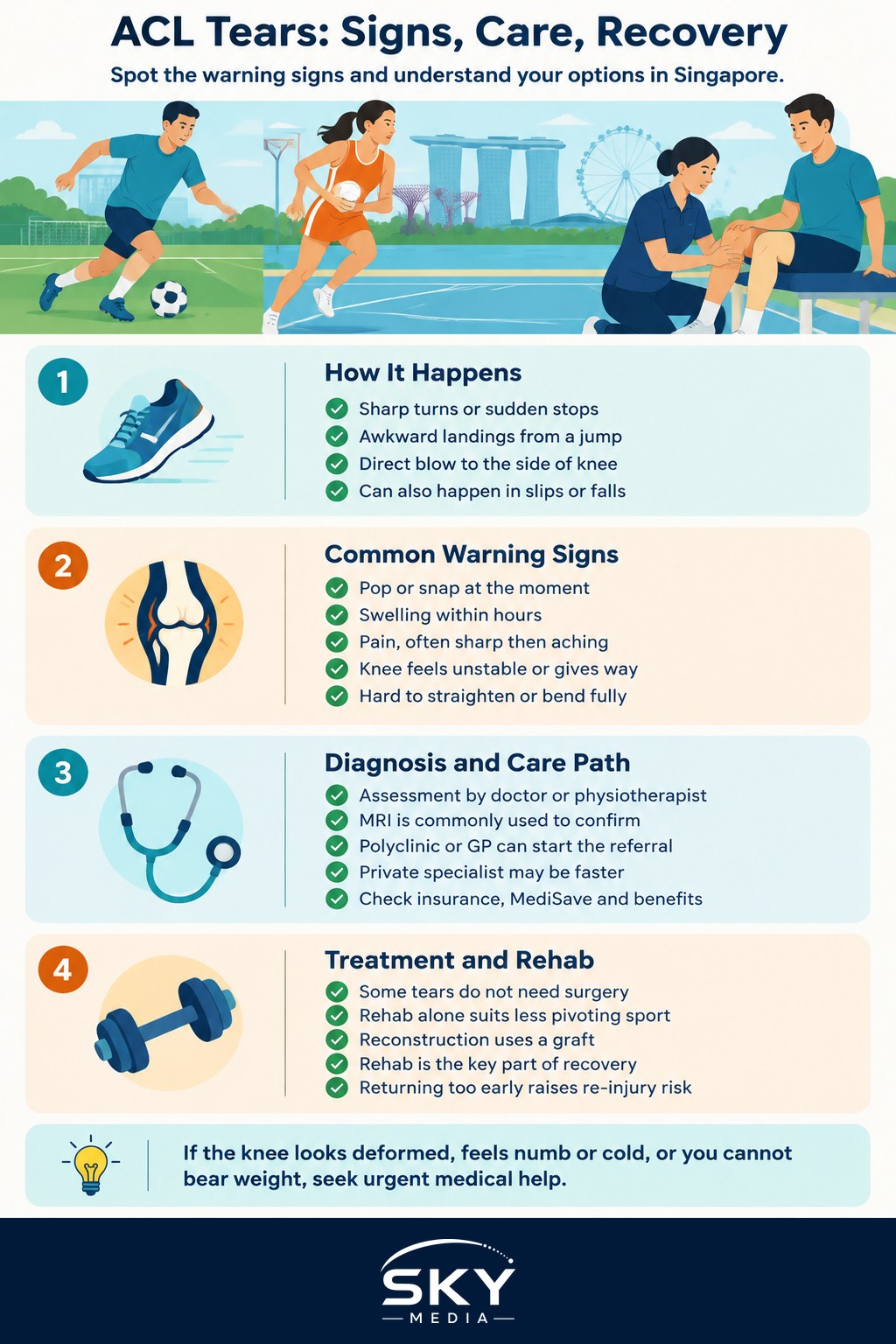
What the ACL Does and How It Gets Injured
The ACL is one of four main ligaments in the knee. It runs diagonally through the middle of the joint, connecting the thigh bone (femur) to the shin bone (tibia), and stops the shin from sliding forward and rotating too much. It matters most during cutting, pivoting, jumping and landing.
Many ACL tears happen without contact. Common situations include:
- Planting the foot and turning sharply, as in football, basketball, badminton or futsal.
- Landing from a jump with the knee caving inwards.
- Stopping suddenly while running.
- A direct blow to the side of the knee, as in a tackle.
ACL injuries also happen outside sport, such as a slip on a wet floor or a fall while hiking. Other structures, like the meniscus (the knee’s cartilage cushion) or other ligaments, are sometimes injured at the same time.
Signs of an ACL Injury
Symptoms vary, but many people describe a similar pattern:
- A pop or snap felt or heard at the moment of injury.
- Swelling within hours, often making the knee look puffy and feel tight.
- Pain, which may be sharp at first and settle into an ache.
- Instability, a feeling that the knee gives way or shifts, especially when turning.
- Reduced range of movement, with difficulty fully straightening or bending the knee.
Some people can walk soon after the injury and assume it is a minor sprain. That is why an assessment matters: a knee that keeps giving way can cause further damage to the cartilage over time.
When to seek urgent care
Go to an emergency department or seek urgent medical help if the knee looks deformed, you cannot bear any weight, the leg feels numb or cold, or the pain is severe. For less dramatic injuries, early assessment by a GP, polyclinic doctor, sports physician or physiotherapist is still worthwhile.
How an ACL Tear Is Diagnosed in Singapore
A doctor or physiotherapist will ask how the injury happened and examine the knee, including specific tests that check how much the shin moves relative to the thigh. If an ACL tear is suspected, an MRI scan is commonly used to confirm it and check for associated injuries.
There are a few routes for care:
- Polyclinic or GP first. A polyclinic or GP can assess you and, if needed, refer you to a public hospital’s orthopaedic or sports medicine service. Referral from a polyclinic is usually the route to subsidised specialist care for eligible patients.
- Private sports physician or orthopaedic surgeon. You can see a private specialist directly, which may be faster but costs more. Check what your insurance or employer’s medical benefits cover.
- Physiotherapist. Physiotherapists can assess the knee and guide early care, and will refer you to a doctor if a significant injury is suspected.
For costs, MediSave can generally be used for approved surgical procedures within withdrawal limits, and Integrated Shield Plans may cover hospital treatment, subject to policy terms. Check with the hospital, CPF Board and your insurer before treatment. If you were injured at work, read about work injury compensation in Singapore.
Surgery or Rehab Alone: Weighing the Options
Not every ACL tear needs surgery. The right choice depends on your age, activity level, the type of tear, other knee injuries and your goals. This decision is made with your doctor.
| Factor | Rehab without surgery | ACL reconstruction plus rehab |
|---|---|---|
| Often considered for | Less active people, or those not planning pivoting sports | Active people aiming to return to cutting and pivoting sports |
| What it involves | Structured physiotherapy to build strength, balance and control | Replacing the torn ligament with a graft, followed by months of rehab |
| Knee stability | May remain unstable during sharp turns for some people | Aims to restore mechanical stability |
| Time off sport | Depends on progress; some activities may need to change | Return to sport commonly takes many months |
| Main risks | Ongoing instability and further cartilage damage if the knee gives way | Surgical risks, graft issues and the need for strict rehab commitment |
About ACL reconstruction
A torn ACL usually cannot simply be stitched back together, so surgeons reconstruct it using a graft. Grafts are often taken from the patient’s own tendons, such as a hamstring, patellar or quadriceps tendon, and sometimes from a donor. The surgery is usually done arthroscopically, through small incisions with a camera. Your surgeon will explain which graft they recommend and why.
Many surgeons advise “prehab” before the operation: reducing swelling, regaining full straightening and building quadriceps strength. Going into surgery with a calmer, stronger knee tends to make recovery smoother.
What ACL Rehab and Recovery Usually Look Like
Rehabilitation is the longest and most important part of recovery, whether or not you have surgery. A physiotherapist will set a programme based on your progress rather than the calendar alone. A typical journey looks something like this:
- Early phase. Controlling swelling and pain, regaining full straightening, activating the quadriceps and walking normally, often with crutches at first.
- Strength phase. Progressive strengthening of the thigh, hip and calf, plus balance and proprioception work (the body’s sense of joint position).
- Running and agility phase. Gradual return to jogging, then straight-line running, then controlled changes of direction, once strength and control targets are met.
- Return to sport phase. Sport-specific drills, jumping and landing training, and testing before returning to competitive play.
After reconstruction, many people return to sport at around nine months to a year, though timelines vary a lot. Returning too early is linked to a higher risk of re-injury, so follow your surgeon’s and physiotherapist’s guidance. Our guide to getting physiotherapy and rehab care in Singapore explains how to find a physiotherapist and what sessions involve.
Reducing the Risk of an ACL Injury
You cannot prevent every injury, but these habits are widely recommended:
- Warm up properly, including dynamic movements and short sprints.
- Train landing technique: land softly with knees bent and in line with the toes.
- Strengthen the hamstrings, glutes and core, not just the quadriceps.
- Wear suitable footwear for the surface.
- Avoid playing hard when exhausted, when form tends to slip.
If you have already had an ACL injury, keep up maintenance exercises after formal rehab ends. The strength and control you build are your best protection against a repeat.
Official sources: HealthHub
Further reading: Concussion in Sport: Signs and When to Return to Play