

Whether you are recovering from surgery, managing a sports injury, easing chronic back pain or helping an older parent regain mobility, physiotherapy and rehabilitation are often the bridge between an injury or illness and getting back to normal life. Getting physiotherapy in Singapore is straightforward once you understand the pathways, but newcomers sometimes waste time and money going straight to the most expensive option when a subsidised route was available. Unlike systems where you might simply walk into a clinic, the public pathway here often begins with a referral, which is worth knowing from the outset.
This guide explains what physiotherapy and rehab cover, how to access them through public and private routes, what to weigh when choosing, and the mistakes newcomers commonly make. It is general information, not medical advice, so let your doctor and therapist guide your specific care.
What Physiotherapy and Rehab Care Cover
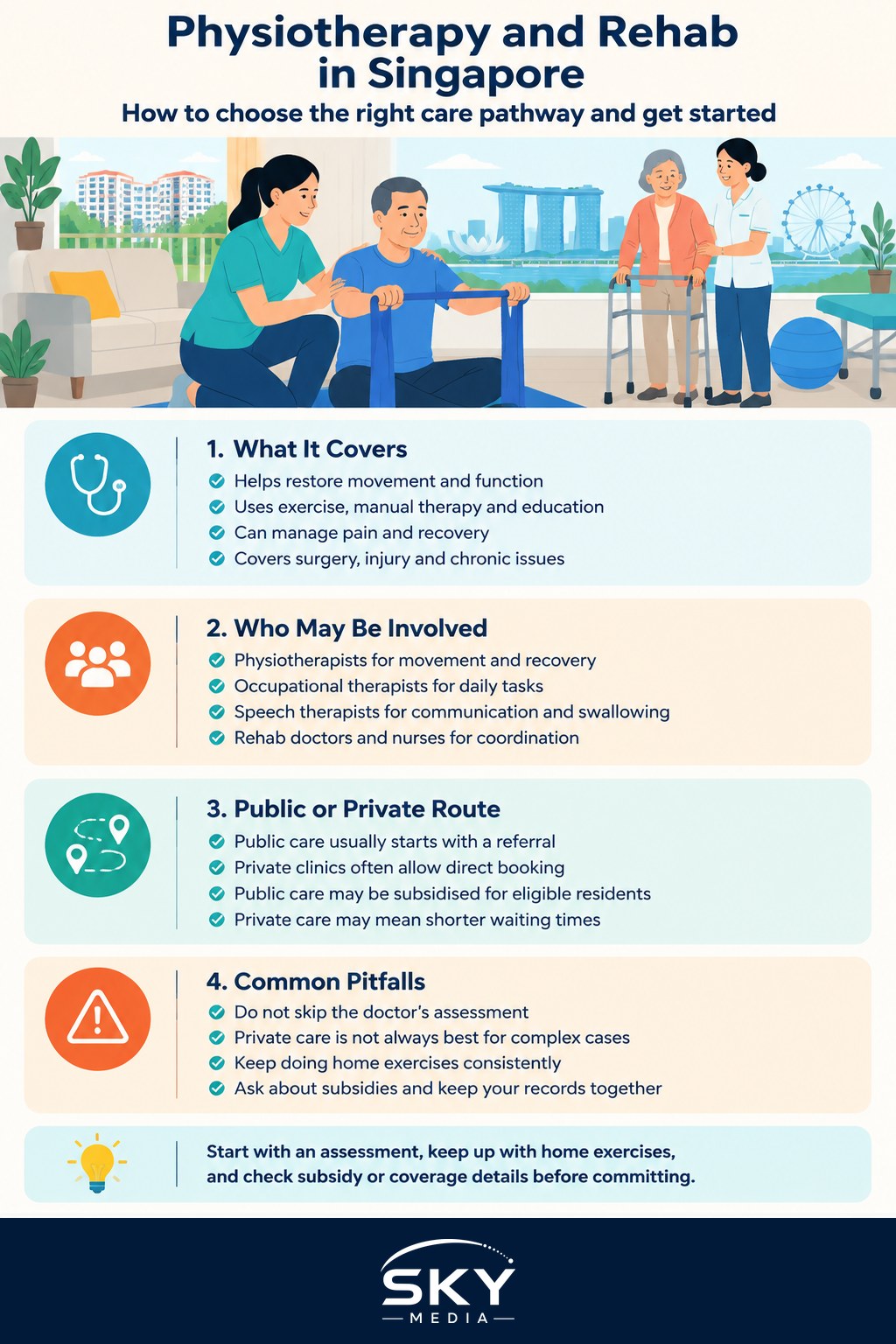
Physiotherapy is a form of allied-health care that helps restore movement and function through exercises, manual therapy, education and techniques to manage pain. Rehabilitation is the broader idea of recovering function after illness, injury or surgery, and it often involves a team.
Alongside physiotherapists, you may work with:
- Occupational therapists, who help you regain the ability to do daily tasks, from dressing to returning to work.
- Speech therapists, who support communication and swallowing, often after a stroke.
- Rehabilitation doctors and nurses, who coordinate more complex recovery.
Physiotherapy helps with a wide range of situations: post-surgical recovery, musculoskeletal pain, sports injuries, stroke rehabilitation, balance and falls prevention in older adults, and management of some chronic conditions. Knowing that it is a broad field helps you ask for the right kind of help rather than assuming physiotherapy is only for athletes.
Rehabilitation is also not always about returning to exactly where you were. For an older parent recovering from a fall, the realistic goal might be walking safely around the flat and managing stairs again, rather than a full return to previous fitness. For a working adult with a desk-related neck or back problem, the aim might be lasting relief and better habits rather than a single fix. Setting a clear, honest goal with your therapist early on shapes the whole plan and keeps everyone focused on progress that actually matters to your daily life.
When to see a physiotherapist
As a rough guide, it is worth booking an assessment when:
- Pain has lasted more than a week or two and is not settling with rest.
- An injury is stopping you from working, exercising or sleeping normally.
- You have been given a diagnosis and told that rehabilitation will help.
- You keep re-injuring the same area, which suggests an underlying weakness or movement fault.
Some symptoms are red flags that call for a doctor first, not a physio: severe unexplained pain, numbness or weakness that is spreading, loss of bladder or bowel control, or pain following a serious accident. If in doubt, start with a GP or the emergency department and let them direct you.
How to Access Physiotherapy: Public and Private Routes
There are two broad pathways, and many people use both at different times.
The public route usually begins with a doctor. A GP, polyclinic doctor or hospital specialist assesses you and, if physiotherapy is appropriate, provides a referral to a public rehab service, whether at a hospital, a polyclinic that offers physiotherapy, or a community rehabilitation centre. If you are not yet set up in the system, start with registering with a polyclinic, and if your issue may need a specialist first, our guide to seeing a specialist and the referral system explains how that works. The advantage of the public route is that eligible residents can receive subsidies, though the exact levels change, so confirm the current position rather than assuming.
The private route lets you book a physiotherapist directly at a private clinic, often without a referral and usually with shorter waiting times. You pay private rates, though some may be claimable through insurance or workplace coverage depending on your plan. This route suits people who want speed and choice and are comfortable with the cost.
For older adults or those needing recovery closer to home, community rehabilitation and home-based therapy may be arranged, and the Agency for Integrated Care (AIC) is a useful body for finding community care services and understanding what support is available.
What a session involves
A first appointment is mostly assessment. Expect the therapist to ask about your history, how the problem started, what makes it better or worse, and your daily activities and goals. They will then examine how you move, test strength and flexibility, and may check specific joints or muscles, before explaining their findings and proposing a plan.
Later sessions can include:
- Prescribed exercises to build strength, mobility and control, usually with a home programme.
- Manual therapy, such as joint mobilisation or soft tissue work.
- Education on posture, load management and pacing so you do not overdo or underdo it.
- Modalities like heat, taping or ultrasound in some cases, used as an aid rather than the main event.
Progress is rarely instant. Many conditions improve over several weeks of consistent effort, and the home exercises matter as much as clinic time. If anything causes sharp or worsening pain, stop and tell your physio so the plan can be adjusted.
Weighing Your Options
Choosing a route is about balancing cost, speed, convenience and the complexity of your condition. The table below lays out the trade-offs in general terms.
| Factor | Public route | Private route |
|---|---|---|
| How you access it | Usually via referral | Often direct booking |
| Cost | Subsidised for eligible residents | Full private rates, may claim on insurance |
| Waiting time | Can be longer at busy centres | Usually shorter |
| Best for | Ongoing, complex or subsidised care | Speed, convenience, specific preferences |
| Location options | Hospitals, polyclinics, community centres | Private clinics, some home visits |
A sensible approach is to start with your doctor’s assessment, understand whether a subsidised public option fits your timeline, and consider private care if speed or convenience matters more to you than cost. For an older relative, factor in travel and whether home-based or community rehab would help them stay consistent, since consistency is what makes rehab work.
Choosing a physiotherapist
In Singapore, physiotherapists must be registered with the Allied Health Professions Council to practise, so registration is a baseline rather than a bonus. Beyond that, look for:
- Relevant experience. A physio who works mainly with sports injuries may suit a runner better than one focused on stroke rehabilitation, and vice versa.
- Clear communication. Someone who explains what is wrong in plain language and sets realistic goals.
- A hands-on plus active approach. Manual therapy can feel good, but lasting improvement usually comes from the exercises you do between sessions.
- Convenience. A clinic near your home or workplace makes it far easier to keep appointments, which matters because rehab works through consistency.
Word of mouth from your doctor, gym or running group is often a reliable starting point. If your goals are more about general strength and prevention than injury, working alongside one of the best personal trainers in Singapore can complement what a physio starts.
Common Mistakes and How to Get the Most From Rehab
A few missteps come up again and again:
- Skipping the doctor’s assessment. Going straight to treatment without a proper diagnosis can mean the wrong therapy. Get assessed first.
- Assuming private is always faster overall. It can be quicker to start, but for complex recovery the coordinated public team may serve you better.
- Stopping too early. Rehab depends on doing the work over weeks, including the home exercises your therapist sets. Quitting when pain eases often leads to relapse.
- Not asking about subsidies. Eligible residents may qualify for support, so ask before assuming you must pay full price.
- Ignoring records. Keep your reports and plans together by using HealthHub to manage your health records so any therapist can pick up where the last one left off.
To get the most from rehab, treat the home exercises as the main event rather than an optional extra, turn up consistently, and tell your therapist honestly what is and is not working so they can adjust.
Where to Get Help and Confirm Details
Start with your GP, polyclinic or specialist for an assessment and, if needed, a referral. For community and home-based rehabilitation, and for helping an older family member, the Agency for Integrated Care is the central resource. For questions about public rehab services and subsidies, the Ministry of Health (MOH) and your healthcare cluster are the reliable references, and private clinics can quote their own fees and availability directly.
Because this is general information and not medical advice, and because subsidies, eligibility and fees change, always confirm the current details with your provider or the official sources before committing. Physiotherapy rewards patience and consistency, and choosing the right pathway early means you spend your energy on getting better rather than on untangling the system.
Explore more: understanding CareShield Life and dementia and caregiver support in Singapore.
Frequently Asked Questions
How many physiotherapy sessions will I usually need? It depends on the condition, how long you have had it and how consistently you do your home exercises. Your physio can estimate after the first assessment and review progress as you go. Many conditions improve over several weeks, not a single visit.
Is physiotherapy covered by insurance or MediSave? Some private insurance, employer plans or schemes may cover part of the cost, but coverage varies by plan and provider. Ask your insurer before booking, and ask the clinic or your doctor whether any public subsidies or MediSave arrangements apply to you.
Can physiotherapy help with neck and back pain from desk work? It often can. A physio can assess your posture and movement, teach strengthening and stretching exercises and suggest changes to how you set up your workstation. Severe pain, numbness or weakness that is spreading needs a doctor’s assessment first.
What should I wear and bring to my first physio appointment? Wear loose, comfortable clothes that let the therapist see and move the affected area, and bring referral letters, scan reports and a list of your medicines. Note down your goals and questions beforehand so the assessment covers what matters to you.
How can I help an elderly parent stick to their rehab exercises? Keep the routine short and simple, tie it to a daily habit, and ask the therapist to demonstrate each exercise so you can supervise safely. Praise progress and tell the therapist if anything hurts. The Agency for Integrated Care can point you to community support.
Further reading: ACL Tears in Singapore: Signs, Surgery and Rehab · Osteopathy in Singapore: What It Is and How It Differs From Physiotherapy