

Wanting to study again after you have started working is not a sign that you fell behind. In Singapore it is treated as normal, even expected, and the country has built a whole system around adults who want to upgrade. If you are weighing the part-time degrees Singapore offers, or shorter courses to sharpen a specific skill, this guide explains the main routes, how funding like SkillsFuture works, and how to pick something that fits around a full-time job.
For newcomers from mainland China, the mindset shift is worth naming. Back home, formal study often stops once you leave university, and the idea of a working adult in their thirties or forties enrolling in an evening degree can feel unusual. Here it is common, employers frequently support it, and the government actively encourages lifelong learning. You are not the odd one out on that Saturday campus; you are one of many.
How Adult Education in Singapore Is Organised
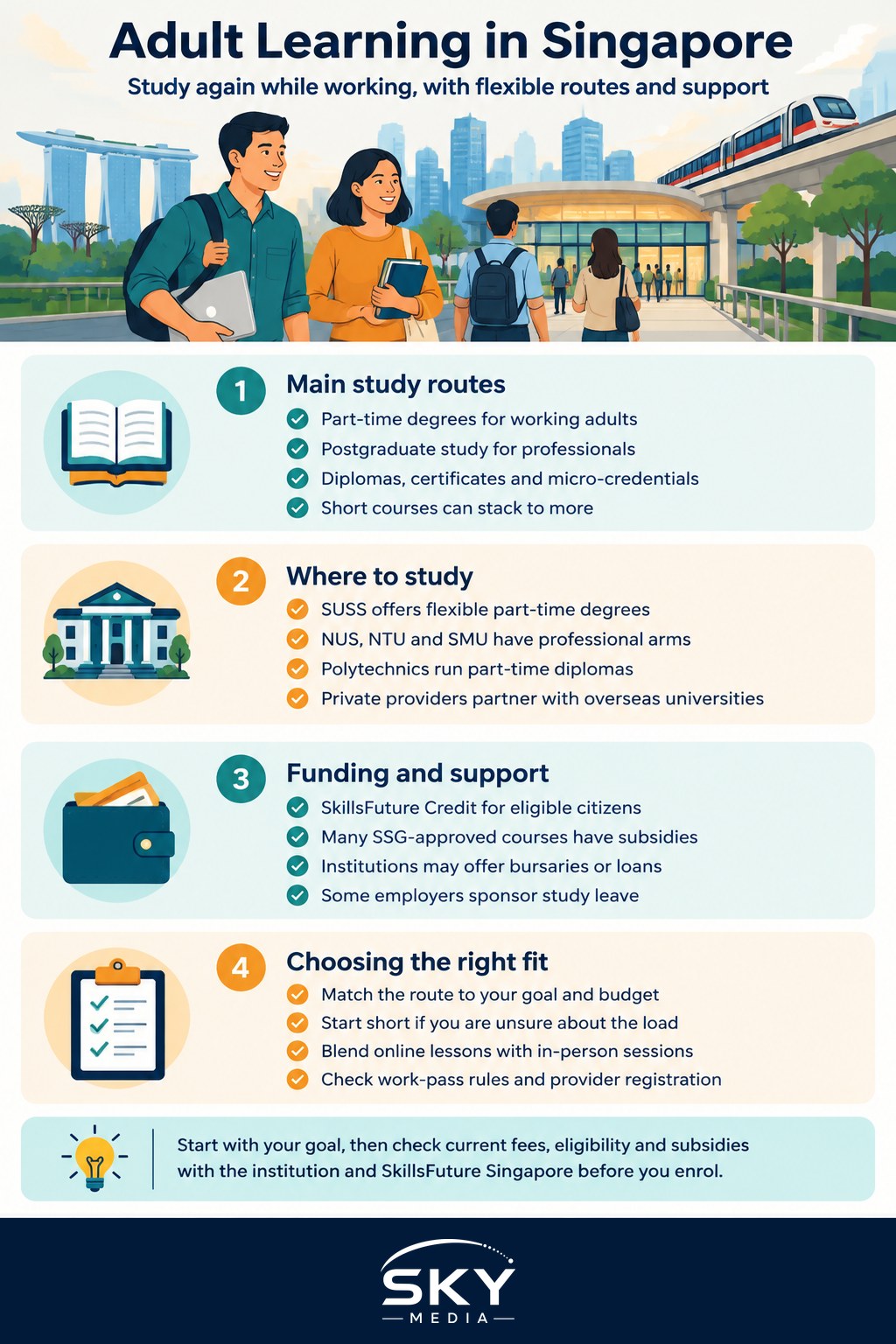
Singapore separates learning into a few broad tracks, and knowing which one you need saves a lot of confusion. The main options are:
- Full part-time degrees: a recognised bachelor’s degree earned over several years while you keep working, usually with evening or weekend classes.
- Postgraduate study: master’s programmes and graduate diplomas, many designed for working professionals.
- Diplomas and certificates: shorter qualifications from polytechnics and private institutions, good for changing fields or formalising experience.
- Short courses and micro-credentials: focused modules lasting days or weeks, often stackable towards a larger qualification later.
The national push behind all this is SkillsFuture, a movement coordinated by the Skills and Workforce Development Agency (SWDA, formed in 2026 from Workforce Singapore and SkillsFuture Singapore) to help everyone keep learning throughout their working life. It is less a single school than an umbrella of funding, subsidies and approved courses that sits above the universities, polytechnics and private providers.
Where Part-Time Degrees Come From
Several established institutions run degrees built specifically for adults, so you are not squeezing into a programme meant for teenagers.
The Singapore University of Social Sciences (SUSS) is perhaps the best known for flexible, modular part-time degrees across business, human resources, social work and more. The other local universities, including NUS, NTU and SMU, offer continuing and professional education arms with part-time or executive formats, particularly at postgraduate level. Polytechnics run part-time diplomas and specialist diplomas that can be a practical step up or a bridge towards a degree.
Alongside these, many private education institutions partner with overseas universities to deliver degrees locally. These can be convenient, but quality and recognition vary, so check that any private provider is registered with the Committee for Private Education (CPE) under SWDA, and look for the EduTrust certification that signals stronger standards. If a qualification matters for a professional licence or for your employer, confirm it is recognised before you enrol.
Paying for It: SkillsFuture and Subsidies
The part that surprises many newcomers is how much public support exists. Rather than quoting figures that change, it is more useful to understand the mechanisms and then verify current amounts.
- SkillsFuture Credit: eligible Singapore Citizens receive credit from the government that can offset the cost of approved courses. Permanent Residents and foreigners are generally not eligible for this personal credit, so confirm your status against the current rules.
- Course fee subsidies: many SWDA-approved courses carry subsidies that lower the fee at the point of enrolment, with the level often depending on citizenship, age and the course.
- Institutional support: universities and polytechnics may offer their own bursaries, instalment plans or loans for part-time students.
- Employer sponsorship: some companies fund relevant study or offer study leave, so it is always worth asking your HR department.
Because eligibility, credit amounts and subsidy rates are updated regularly and differ for citizens, PRs and foreigners, do not rely on a friend’s experience from a few years ago. Check your own eligibility and the current fees directly with the institution and with SWDA before committing.
Comparing the Main Study Routes
The right choice depends on your goal, your time and your budget. This comparison sketches the trade-offs, though exact durations and costs vary by provider.
| Route | Typical length | Best for | Where to verify |
|---|---|---|---|
| Part-time bachelor’s degree | Around three to five years | A formal degree while working full time | SUSS or the local universities |
| Part-time postgraduate | One to three years | Professionals deepening or switching specialism | The university’s professional education arm |
| Polytechnic part-time diploma | About two to three years | Practical, industry-linked skills | The relevant polytechnic |
| Short course or micro-credential | Days to a few months | Targeted upskilling, testing an interest | SkillsFuture course directory |
A sensible tactic for the time-pressed is to start with a short, subsidised course. It lets you test whether you can sustain studying alongside work before you commit to a multi-year degree, and some modules can later count towards a fuller qualification.
Making Study Work Around a Full-Time Job
The hardest part of adult education is rarely the academic content; it is fitting it into a life that is already full. A few habits make the difference:
- Be honest about your hours. A part-time degree can demand many hours a week once assignments are included. Map it against your work and family commitments before enrolling.
- Tell the people around you. Let your manager and family know your class schedule so evenings and weekends are protected during exam periods.
- Use the flexible formats. Many programmes now blend online lectures with occasional in-person sessions, which suits shift workers and parents. If you learned mostly by rote back in China, expect more essays, projects and class discussion here, and lean on the study-skills support the institution provides.
- Mind your pass conditions. If you are here on a work pass, part-time study is usually fine, but check that your specific pass allows it and that the course provider is properly registered.
Give yourself permission to go slowly. Modular systems mean you can often take one subject at a time, pause between semesters, and still finish. Steady progress beats an ambitious plan that burns you out by the second term.
Adult learning here is genuinely accessible, and the infrastructure to support it is one of Singapore’s quiet strengths. Whether you want a full degree or a single practical skill, start by clarifying your goal, then confirm the current fees, subsidies and eligibility with the institution and SWDA so your plan rests on today’s rules rather than yesterday’s.
Explore more
Studying as an adult often sits alongside sorting out your children’s education, so it helps to read our guide to polytechnic and ITE pathways for newcomer families and, if funding is on your mind, scholarships and financial aid for PR students. If your studies are a step towards running your own venture, see how to approach government grants for startups and SMEs.
Related across Sky Media: Part-Time and Holiday Jobs for Students · Hiring a Part-Time Cleaner or Home Help
Frequently Asked Questions
Will my Singapore part-time degree be recognised if I return to China? Recognition of overseas qualifications is decided by the relevant Chinese authorities and employers, so check their requirements before you enrol. This matters most if a return is likely. A registered Singapore institution is a good starting point, but it does not guarantee recognition elsewhere.
Is a part-time degree still worth it if I am in my forties? It can be, if it supports a clear goal such as a career change, a promotion or a professional requirement. Many adults study here at all ages. Weigh the years of effort against what the qualification will actually change for you, and ask your employer whether it counts.
Will a Singapore qualification help my PR or pass application? It may count among many factors, but it is not a guarantee. Applications are decided by ICA and MOM on their own criteria, which can change. Study for the skills and career value, and check the official requirements instead of assuming a course will tip the result.
Can I get into a part-time degree without a first degree, using work experience? Some institutions have routes for mature applicants that consider work experience alongside qualifications, but entry rules vary by programme. Ask the admissions office what your background would need. A diploma or short course can also serve as a stepping stone.
Where can I find approved short courses that are eligible for subsidies? Browse the SkillsFuture course directory, which lists SWDA-approved courses, and compare providers and fees there. Subsidies depend on your citizenship, age and the course, so confirm your own eligibility with the provider and SWDA before paying.
Official sources: SkillsFuture (SWDA)
Further reading: Taking a Second Degree in Singapore: Fees and Subsidy Rules · Are Online Degrees Recognised in Singapore?