

Many people consider a second degree in Singapore after a few years of work. Perhaps your first degree no longer fits the career you want, or you need a specific qualification for a regulated profession. Before you apply, it is important to understand one key point: government subsidies for undergraduate study are generally meant for a person’s first degree, so a second bachelor’s degree can cost far more than the fees you remember paying.
This guide explains how subsidy rules usually work, why fees differ, and what alternatives may get you to the same goal for less time and money. It is general information, not financial advice. Rules are set by the Ministry of Education (MOE) and the universities, and they can change, so confirm your own case with the university’s admissions or finance office before you commit.
How MOE Subsidy Usually Works for Undergraduates
At Singapore’s autonomous universities, such as NUS, NTU, SMU, SUTD, SIT and SUSS, the fees most students pay are subsidised. The government pays a large share of the actual cost of the course, and the student pays the rest as tuition fees. For eligible Singapore Citizens and Permanent Residents (PRs), this subsidy is provided through the MOE Tuition Grant or a direct subsidy, depending on the university and the student’s status. PRs and international students who receive a Tuition Grant usually have to sign a service obligation to work in Singapore for a period after graduating.
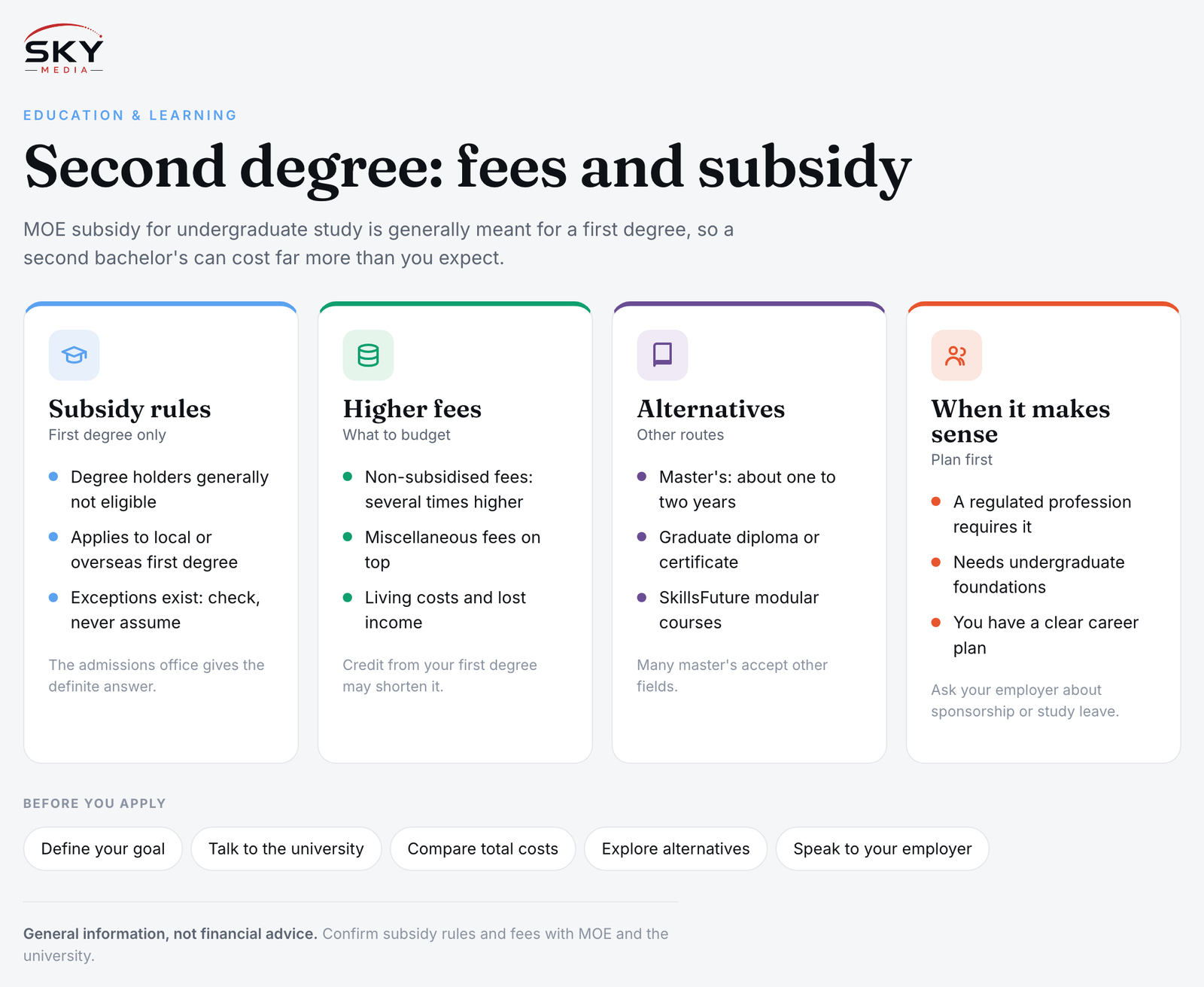
The key principle is that this support is generally intended for a student’s first undergraduate qualification. In broad terms:
- If you already hold a bachelor’s degree, you are generally not eligible for MOE subsidy for another bachelor’s degree, even in a completely different field.
- This usually applies whether your first degree was from a local or an overseas university, and whether or not it was subsidised.
- Some universities and MOE have made exceptions or special arrangements for particular programmes or circumstances in the past. Do not assume one applies to you; check with the university directly.
Because the details depend on your citizenship, prior qualifications and the programme, the university’s admissions office is the best place to get a definite answer.
Why Second Degree Fees Can Be Much Higher
If you are not eligible for subsidy, you will usually be charged the non-subsidised fee for the programme. This reflects much more of the real cost of teaching, and it can be several times higher than the subsidised fee for the same course.
When budgeting, check:
- The published fee schedule on the university’s website, looking specifically at the non-subsidised or “full fee” column for your citizenship category.
- Miscellaneous fees for student services, which are charged on top of tuition.
- Course length. Some universities may grant exemptions or credit for modules from your first degree, which could shorten the programme. This is decided case by case.
- Living costs and lost income if you study full time and stop working.
Financial aid, bursaries and loans are generally designed for subsidised students, so your options may be more limited. Ask the financial aid office what, if anything, is available to second degree students.
Comparing a Second Degree With the Alternatives
A second bachelor’s degree is not the only way to switch fields or upgrade. Depending on your goal, one of these may be more practical.
| Option | Typical length | Funding picture | Suits you if |
|---|---|---|---|
| Second bachelor’s degree | Usually several years, sometimes shortened with credit | Generally non-subsidised for degree holders | A regulated profession requires a specific bachelor’s |
| Master’s degree | About one to two years | Usually full fee, some scholarships or employer sponsorship | You want to specialise or switch fields at graduate level |
| Graduate diploma or certificate | Months to about a year | Some SkillsFuture-funded options | You need targeted skills for a career change |
| Part-time modular courses (SkillsFuture) | Weeks to months per course | SkillsFuture Credit and course fee subsidies for eligible learners | You want to test a field before committing |
| Professional certification | Varies | Often self-funded or employer-sponsored | Your industry values a specific certification |
Many master’s programmes accept graduates from a different field, which can make them a faster route than a second bachelor’s degree. Look closely at entry requirements, as some expect prerequisite modules or work experience.
Situations Where a Second Degree Makes Sense
A second bachelor’s degree is most worth considering when:
- A profession requires it. Some regulated careers need a specific undergraduate qualification for professional registration. Check the relevant professional body’s requirements before deciding.
- The new field builds on undergraduate foundations that a short course cannot replace, and a master’s is not accepted without them.
- You have a clear plan for how the qualification will change your job prospects, ideally after speaking to people already working in that field.
If your main aim is to improve your career prospects in general, a master’s, graduate diploma or targeted SkillsFuture courses may give a better return.
Part-Time Study and Employer Support
If stopping work is not realistic, consider part-time study. SUSS (Singapore University of Social Sciences) and several other institutions offer part-time degree options designed for working adults. Our guide to part-time and flexible degrees explains how these programmes usually work. The same subsidy principle generally applies: if you already hold a degree, a second part-time bachelor’s is likely to be charged at non-subsidised rates.
Your employer may also help. Some companies sponsor further study in return for a bond, or allow study leave. Ask HR what is available before paying yourself.
If you are weighing an overseas or online programme as a cheaper route, read whether online degrees are recognised in Singapore before you enrol.
SkillsFuture and Other Support
The Skills and Workforce Development Agency (SWDA, formed in 2026 from Workforce Singapore and SkillsFuture Singapore) funds a wide range of courses for working adults, and eligible Singaporeans can use their SkillsFuture Credit on approved courses. Full bachelor’s degrees are not generally the focus of these schemes, but many graduate diplomas, certificates and modular courses are. PRs have different eligibility, which our guide to SkillsFuture and training subsidy eligibility for PRs covers.
Check the SkillsFuture website and MySkillsFuture portal for current course listings and funding rules.
Steps to Take Before You Apply
- Define your goal. Write down the job or role you want and what qualification it really needs.
- Talk to the university. Ask the admissions office about subsidy eligibility, fees and possible credit exemptions for your case.
- Compare total costs, including fees, living expenses and lost income.
- Explore alternatives such as master’s programmes, graduate diplomas and SkillsFuture courses.
- Speak to your employer about sponsorship or study leave.
A second degree can be a good investment, but only when you go in with clear eyes about the cost and confirm the rules with MOE and the university first.
Official sources: Ministry of Education (MOE)