

Few parenting topics make grown adults squirm quite like this one. Yet done gently and gradually, sex education at home is one of the most protective gifts you can give your child. It is not a single, cringe-inducing lecture, and it is not about handing over more than a child is ready for. It is the slow, steady, age-appropriate sharing of accurate facts and your family’s values, so your child grows up informed, safe, and comfortable coming to you. This guide offers calm, practical pointers for parents in Singapore, with your own beliefs firmly in the driving seat.
To be clear, this is general parenting guidance, not a curriculum and not medical advice. It works alongside, not instead of, the sexuality education your child receives at school and the trusted information from the Health Promotion Board.
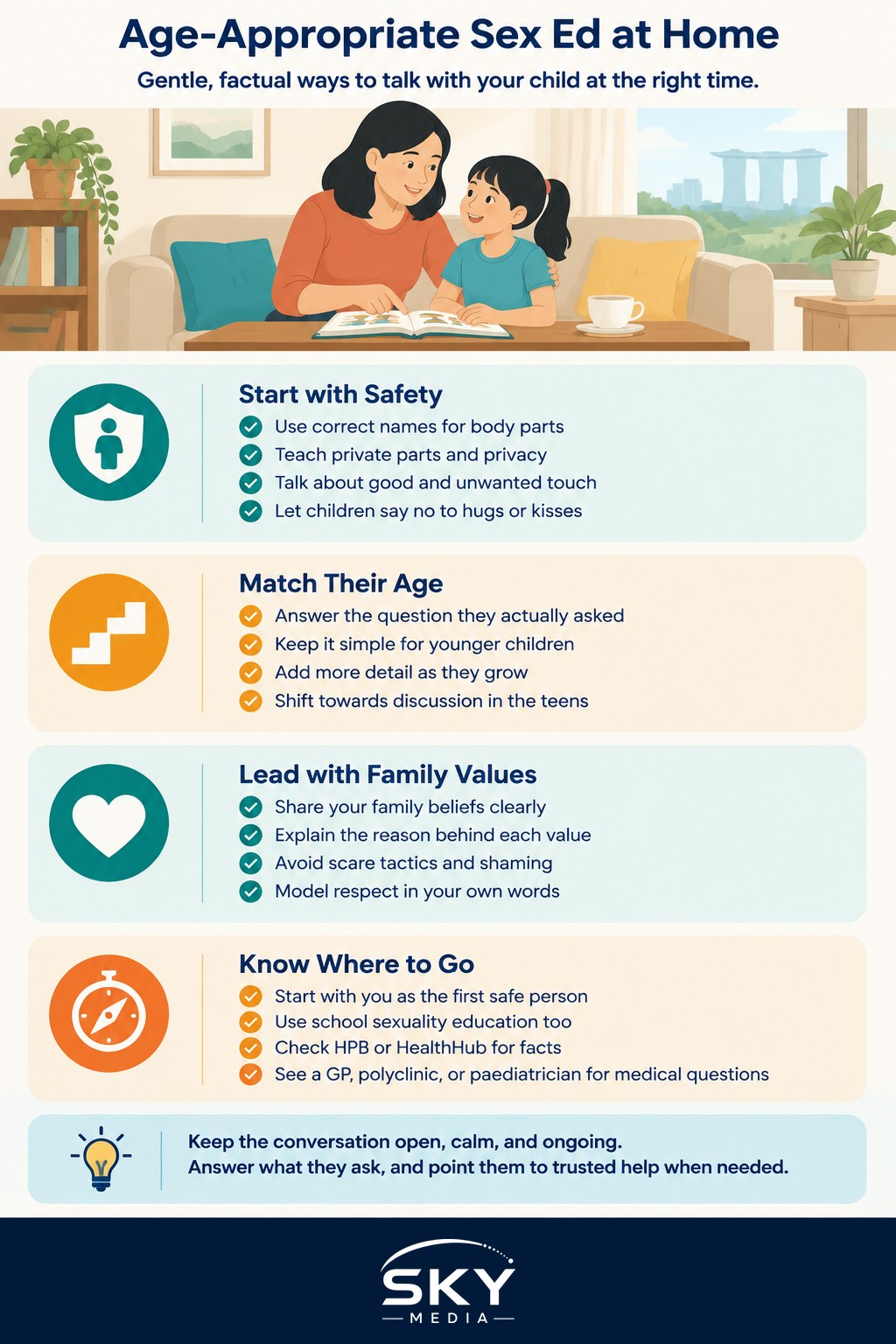
What Age-Appropriate Really Means
The phrase age-appropriate does a lot of work here. It means you answer the question your child actually asked, at a level they can understand, and no more. A curious six-year-old asking where babies come from needs a simple, honest, unfussy answer, not a biology lecture. A twelve-year-old is ready for more.
The guiding principle is to lead with facts, safety, and respect, and to let your values shape how you frame everything. You are not choosing between teaching the facts and teaching your beliefs. You do both at once, because your child needs accurate information to stay safe and your guidance to make good choices.
Getting there early matters. If you have been putting off the puberty talk, our companion guide on having the puberty talk with your child pairs closely with this one, since bodies and relationships are part of the same ongoing conversation.
The Foundations: Bodies, Privacy, And Consent
Long before anything to do with relationships, the earliest and most important lessons are about safety, and you can start these with young children.
- Correct names for body parts. Using plain, accurate words removes shame and, importantly, gives a child the language to tell a trusted adult if something is wrong.
- Private parts and privacy. Teach simply which parts are private and that these are theirs.
- Good touch and unwanted touch. Explain that no one should touch their private parts, and that they can always tell you or another safe adult, even if someone said to keep it secret.
- Their body, their say. Let children decline hugs or kisses if they do not want them. This everyday respect plants the roots of consent.
- Safe adults. Help your child name a few trusted grown-ups they can go to.
These foundations are really about protection. A child who knows the words, understands privacy, and believes you will listen is a far safer child.
Matching The Conversation To Your Child’s Age
Depth should follow readiness. The table below is a general guide to how the conversation can grow, not a fixed schedule, since every child is different and you know yours best.
| Stage | Age-appropriate focus | What you are building |
|---|---|---|
| Early childhood | Correct body names, privacy, safe and unwanted touch | Safety and language |
| Primary years | Bodies change, babies in simple terms, respecting others | Honesty and trust |
| Early teens | Relationships, feelings, boundaries, online safety, your family values | Judgement and values |
| Mid teens | Respect and consent, healthy relationships, where to get reliable help | Responsibility |
Notice that facts and values grow together at every stage. The older your child, the more the conversation shifts from you explaining to the two of you discussing.
Keeping Your Family’s Values At The Centre
Families in Singapore hold a wide range of beliefs about relationships, faith, and what they want for their children, and that is exactly as it should be. Sex education at home is where those values live.
You are entitled to say clearly what your family believes and why. Children actually want to know where you stand. The most effective approach pairs honesty about the facts with warmth about your values, so your child never has to choose between being informed and being close to you. Avoid scare tactics and shaming, which tend to push teens toward secrecy rather than safety. Calm, respectful, values-anchored conversations keep the door open, and an open door is what keeps a child coming back to you as questions get bigger.
A few things that help the values conversation land:
- Explain the reasoning behind a value, not just the rule, so it can travel with them.
- Listen to their views without pouncing, even when you disagree.
- Model respect in how you speak about relationships and other people.
- Make it clear that they can always come to you, whatever has happened.
Where To Point Your Child For Trusted Help
Part of your role is making sure your child knows where reliable information comes from, so they are not left googling in the dark. Point them to you first, then to the trusted sources around them.
Schools in Singapore deliver sexuality education as part of the curriculum, and it can be reassuring to know roughly what your child is covering so your conversations at home line up. The Health Promotion Board and HealthHub offer age-appropriate, factual resources for both parents and young people. For any medical question, whether about the body, development, or health, your GP, polyclinic, or a paediatrician is the right and confidential place to go. If a conversation ever surfaces a safety concern, treat it seriously and seek professional support rather than handling it alone.
The measure of success here is not one perfect talk. It is a child who, years from now, still feels they can bring you anything, knowing they will be met with calm and care rather than judgement.
Explore More
This topic sits within a bigger conversation about growing up. Read it alongside having the puberty talk with your child and understanding the teenage brain and mood swings to support the emotional side too. Because so much of what shapes teens today happens on screens, our guides to helping teens navigate social media and setting phone boundaries with teens are natural next reads.
Further reading: Sex Education and Puberty in Singapore Schools