

Sooner or later, most parents in Singapore hear it: a child comes home from school or the playground and says “Can or not?”, “Wah, so shiok” or “Don’t play play”. Some parents laugh, some wince, and many quietly wonder whether Singlish kids will struggle with “proper” English later.
This guide is not a Singlish phrasebook. It is about parenting: how children learn to move between Singlish and standard English, when it makes sense to step in, and how to set up home habits that build strong language skills without making your child feel their everyday speech is wrong.
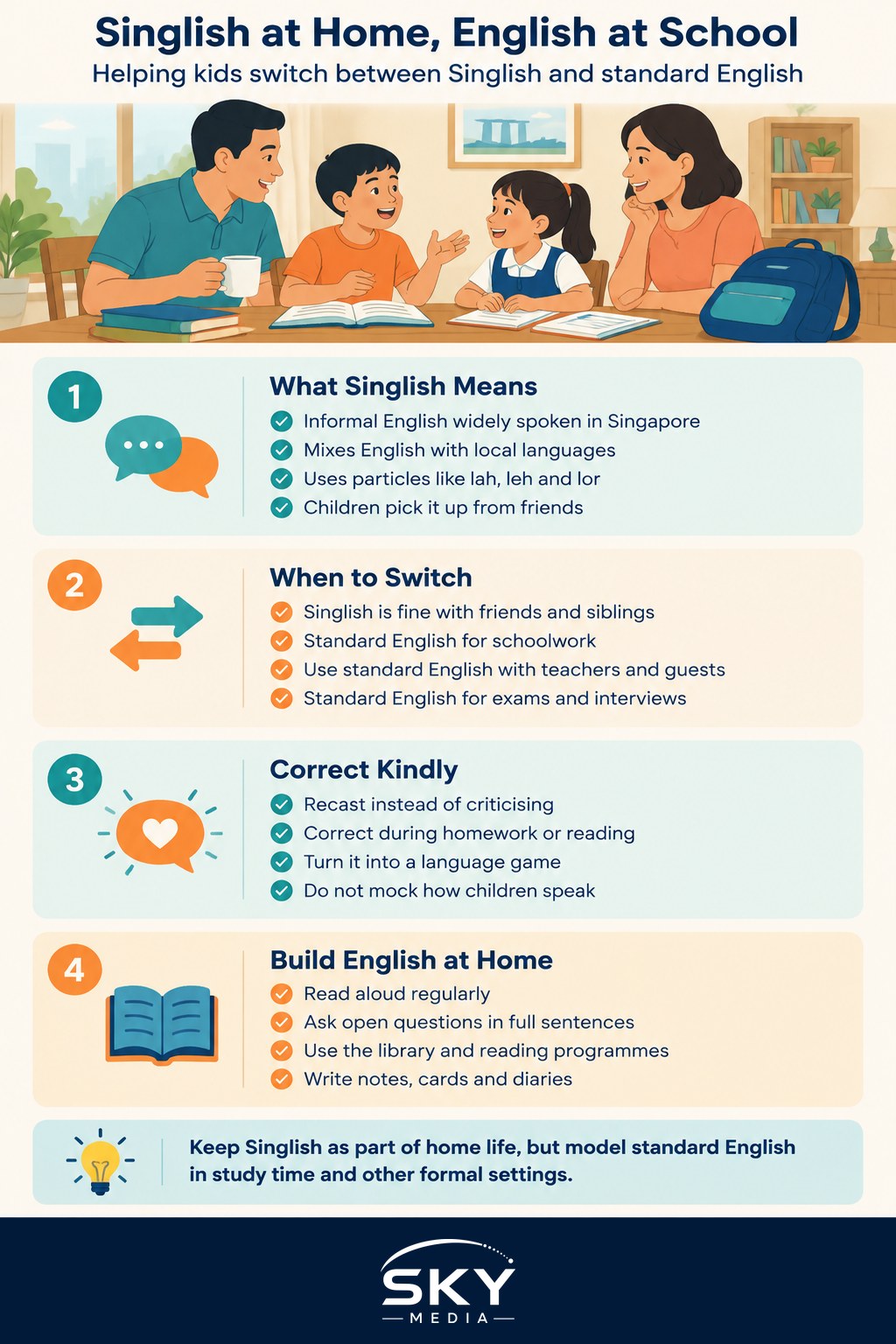
What Singlish Is, and Why Children Pick It Up
Singlish is the informal, colloquial English widely spoken in Singapore. It mixes English with words and grammar patterns from Malay, Hokkien, Teochew, Cantonese, Mandarin and Tamil, and has its own particles such as “lah”, “leh” and “lor”. If you want a refresher, our guide to Singlish explains the common features.
Children pick it up for the simplest reason: it is the language of friendship. It is what classmates, cousins, coaches and hawker uncles speak. Using it helps a child belong. Trying to ban it entirely usually does not work, and can make a child feel self-conscious about how they talk with friends.
At the same time, standard English is the language of school, exams, formal writing, job interviews and international communication. Parents are right to want their children to be confident in it.
Code-Switching: The Skill That Matters Most
Linguists use the term code-switching for moving between different languages or varieties depending on who you are talking to and where you are. Most Singaporean adults do this without thinking: Singlish with old friends, standard English in a meeting, perhaps another language with grandparents.
The goal for most families is not “Singlish or standard English” but helping children do both well and know when to use each. A child who can chat comfortably in Singlish with friends and then write a clear, grammatical school composition has a valuable skill, not a problem.
The real concern is when a child only has Singlish and cannot switch to standard English when the situation calls for it. That is what parents can help with.
When Singlish Is Fine and When to Switch
It helps to talk about language in terms of settings rather than right and wrong. Children understand the idea of different “clothes” for different occasions, and language works similarly.
| Setting | Singlish OK? | What helps |
|---|---|---|
| Playing with friends or siblings | Usually fine | Let it flow, it builds social connection |
| Casual family chat at home | Often fine | Model standard English yourself some of the time |
| Homework, reading aloud, school projects | Switch to standard English | Gently rephrase and explain the difference |
| Speaking to teachers, guests or strangers | Switch to standard English | Practise polite phrases beforehand |
| Oral exams, presentations, interviews | Standard English | Role-play at home in a relaxed way |
Framing it this way avoids shaming. Instead of “That’s wrong”, you might say “That’s how we say it with friends. How would you say it to your teacher?”
How to Correct Without Shaming
Children learn language best when they feel safe, so the way you correct matters as much as whether you correct.
- Recast rather than criticise. If your child says “I go there already”, reply naturally with “Oh, you went there already? What did you see?” They hear the standard form without feeling corrected.
- Pick your moments. Correct during homework or reading time, not in the middle of an excited story about their day.
- Make it a game. Some families play “translate it” where children turn a Singlish sentence into standard English, or the other way round. It shows that both are real skills.
- Do not mock Singlish. Laughing at how a child speaks with friends can make them feel embarrassed or defensive. Respect the variety, while teaching the other one too.
- Praise switching. When your child switches to standard English on their own, notice it: “You explained that really clearly.”
If you want your child to speak up confidently in any setting, our guide to raising children who speak up respectfully has related ideas.
Home Habits That Build Strong Standard English
You do not need to run your home like a classroom. A few steady habits make a big difference over time.
- Read together, every day if you can. Reading aloud exposes children to rich vocabulary and grammar that rarely comes up in conversation. Let older children choose books they enjoy.
- Talk in full sentences sometimes. Ask open questions at dinner, such as “What was the best part of your day, and why?” Longer answers build fluency.
- Model it yourself. Children copy what they hear. If parents only ever speak Singlish at home, children have fewer chances to hear standard English in a relaxed setting.
- Use the library. The National Library Board (NLB) runs public libraries with children’s sections and reading programmes. Check NLB for current activities.
- Watch and listen widely. Documentaries, audiobooks and podcasts in standard English add variety, as long as screen time stays balanced.
- Write for real reasons. Birthday cards, short notes to grandparents or a family trip diary give writing a purpose.
What About Mother Tongue and Other Home Languages
Many Singapore homes use more than one language. Some parents worry that Singlish, standard English and a Mother Tongue language such as Mandarin, Malay or Tamil will confuse children. In general, children are very capable of learning multiple languages, especially when each has a clear role in their life.
If your family speaks Mandarin or a dialect at home, you may notice Singlish features drawn from those languages. That is natural. Our guide to understanding Singlish for Mandarin speakers explains some of the overlaps, and it can help newcomer parents make sense of what their children bring home.
Keep each language rich by using it for real conversation, stories and songs, rather than only for drilling.
When to Seek Extra Help
Most children develop language skills at their own pace, and Singlish alone is not a sign of a problem. But talk to your child’s teacher, school or a doctor if:
- Your child has trouble being understood by people outside the family at an age when most peers do not.
- Your child seems to struggle with understanding instructions in any language.
- Reading and writing remain unusually difficult despite regular support.
- Your child becomes anxious or withdrawn about speaking.
A teacher can tell you how your child is doing compared with classmates, and a doctor or polyclinic can advise on whether a speech and language assessment would help. These professionals are the right people to judge development, not online checklists.
A Balanced Answer for Parents
So, should you let your kids speak Singlish at home? For most families, yes, alongside plenty of standard English. Singlish connects children to friends and to Singapore’s shared culture. Standard English opens doors in school and work. Children who learn to switch between them, and understand when each fits, get the best of both.
Explore more: Singlish 101: A Starter Phrasebook
Further reading: Selective Mutism: Helping a Child Who Won’t Speak at School · When Your Child Starts Swearing: How to Respond Calmly