
When you shop for a new air-conditioner in Singapore, the salesperson will talk about ticks, inverters and BTUs. Few mention the gas inside the pipes. Yet the refrigerant matters for the climate, and the aircon refrigerant R32 has quietly become the default in most new household units here. This guide explains what refrigerants do, why their global-warming potential (GWP) matters, how R32 compares with the older R410A and the newer natural options, and what to look for before you buy.
What a Refrigerant Actually Does in Your Aircon
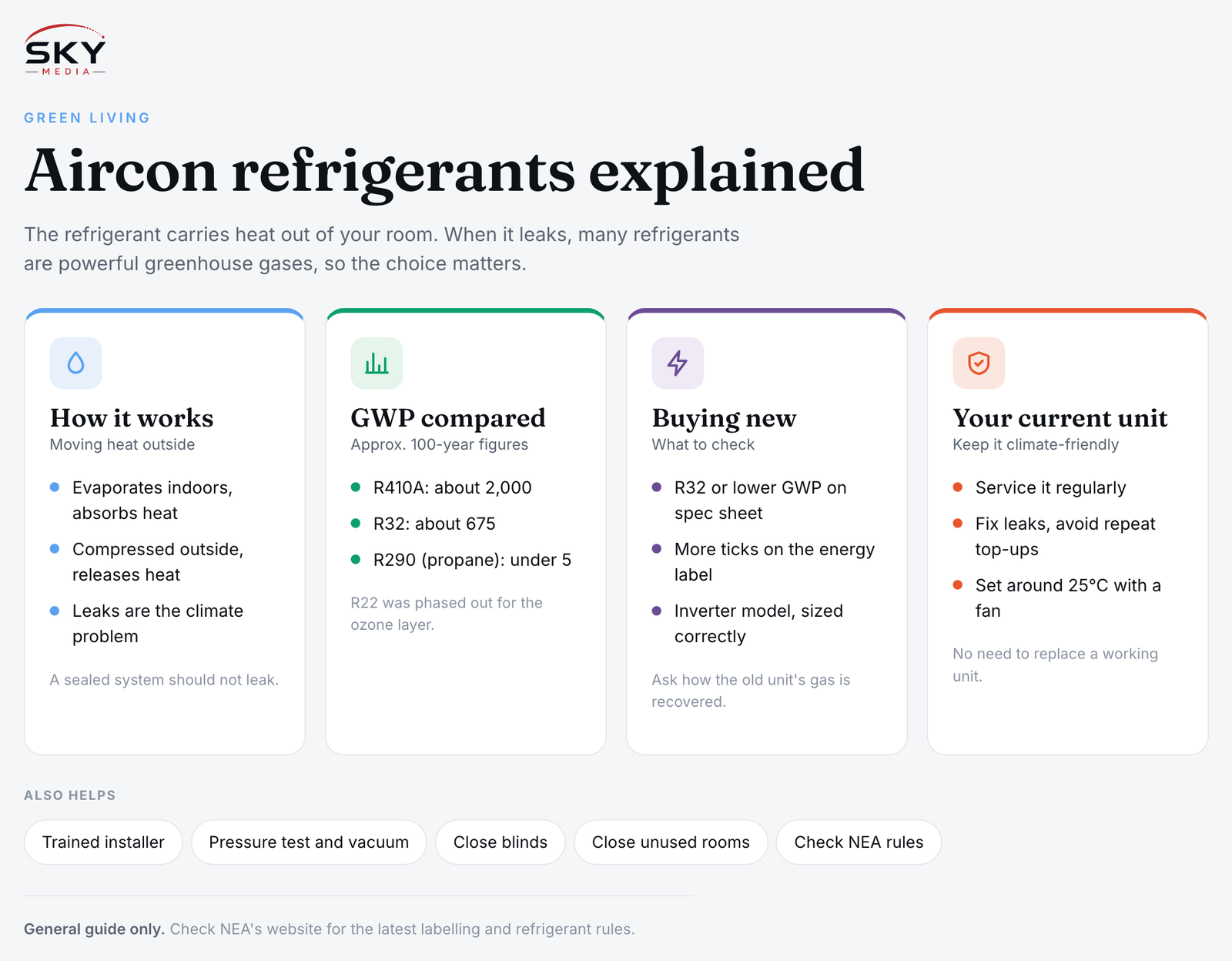
An air-conditioner does not create cold air. It moves heat from inside your room to the outside, and the refrigerant is the working fluid that carries it.
- Inside (the fan coil or indoor unit): the refrigerant evaporates at low pressure and absorbs heat from your room’s air.
- Outside (the condenser or compressor unit): the compressor squeezes the gas to high pressure, and it releases that heat to the outdoor air as it condenses back into liquid.
- Then it loops: the liquid passes through an expansion device, drops in pressure, and returns indoors to pick up more heat.
In a sealed, well-installed system, the refrigerant should stay inside for the life of the unit. The climate problem arises when it leaks: through poor installation, damaged pipes, corroded joints, careless servicing, or when an old unit is scrapped without the gas being recovered.
Global-Warming Potential: The Number That Matters
Most modern refrigerants no longer damage the ozone layer, which was the big concern with older gases like R22. The issue today is different. Many refrigerants are powerful greenhouse gases, far stronger than carbon dioxide when released into the atmosphere.
That strength is measured as global-warming potential (GWP), which compares how much heat a gas traps over a set period (usually 100 years) against the same mass of carbon dioxide, which has a GWP of 1. A refrigerant with a GWP of 2,000 means one kilogram leaking out has roughly the warming effect of two tonnes of carbon dioxide.
Published GWP figures differ slightly depending on which scientific assessment is used, so you will see small variations between sources. The broad picture is consistent, though, and the gap between the main options is large.
R32, R410A and the Alternatives Compared
Here is how the refrigerants you are most likely to encounter in Singapore homes stack up. GWP values are approximate, commonly cited 100-year figures.
| Refrigerant | Approx. GWP | Ozone-depleting? | Where you will see it |
|---|---|---|---|
| R22 | About 1,800 | Yes | Very old units; phased out under the Montreal Protocol |
| R410A | About 2,000 | No | Many units sold in the 2000s and 2010s |
| R32 | About 675 | No | Most new household split units today |
| R290 (propane) | Under 5 | No | Some portable and small units; growing internationally |
A few points worth unpacking:
- R410A replaced R22 because it does not harm the ozone layer, but its high GWP made it a target once climate policy tightened.
- R32 is a single-component gas with roughly a third of R410A’s GWP. It also transfers heat efficiently, so systems often need less refrigerant charge to do the same job. That combination is why manufacturers have shifted to it.
- R290 and other natural refrigerants have a very low GWP, but they are more flammable. Manufacturers manage this through small charge sizes and safety standards, and their use in larger split systems depends on local codes.
R32 is also classed as mildly flammable. That sounds alarming, but units are designed and certified for it. It is one reason proper installation by a qualified technician matters, which we cover below.
What Singapore’s Rules Mean for Buyers
Singapore has signed on to international agreements that phase down high-GWP refrigerants, and the National Environment Agency (NEA) has introduced rules on the supply of household air-conditioners. In recent years NEA has restricted the sale of new household units that use refrigerants above a set GWP limit, alongside minimum energy-efficiency standards. In practice, this is why R32 dominates the shelves.
What this means for you:
- Buying new: most household split units you can buy from mainstream retailers already use a lower-GWP refrigerant. It is still worth confirming on the specification sheet.
- Existing units: you are not required to rip out a working R410A system. The sensible approach is to maintain it well so it does not leak, and plan for a low-GWP replacement when the time comes.
- Rules change: limits, scope and dates can be revised, and NEA has also been looking at standards for technicians who handle refrigerants. Check the current details on NEA’s website before making decisions based on regulation.
What to Look For When You Buy a New Aircon
The refrigerant is one factor. Energy use over the unit’s lifetime usually has an even bigger climate impact, because Singapore’s electricity is largely generated from natural gas. Weigh both.
Check the refrigerant on the spec sheet. Look for “R32” or another low-GWP refrigerant on the product label, brochure or the outdoor unit’s nameplate. If a deal seems unusually cheap, confirm it is not old stock using a higher-GWP gas.
Look at the energy label. NEA’s Mandatory Energy Labelling Scheme rates air-conditioners with ticks; more ticks means better efficiency. The label also shows an estimated annual energy cost, which helps when comparing models.
Choose an inverter model. Inverter compressors vary their speed instead of switching fully on and off, which generally uses less electricity in Singapore’s steady heat.
Size it correctly. An oversized unit cycles on and off and dehumidifies poorly; an undersized one runs flat out. A reputable installer should assess room size, sun exposure and usage rather than guess.
Ask about installation quality. Leaks often come from poorly flared joints and insufficient vacuuming of the pipes. Ask whether the installer pressure-tests and vacuums the system and whether they are trained to handle R32. Check warranty terms on both the unit and the workmanship.
Plan for the old unit. When replacing, ask how your old unit will be removed and whether the refrigerant will be recovered rather than vented. Responsible disposal stops a final burst of greenhouse gas.
Keeping Your Current Aircon Climate-Friendly
You can cut the climate impact of the unit you already own without replacing it.
- Service it regularly. Clean filters and coils improve efficiency, and a technician may spot oil stains or frost on pipes that suggest a leak. Our aircon servicing guide explains what a routine service should include.
- Be wary of frequent “gas top-ups”. A sealed system should not need regular refills. If a technician keeps topping up gas, ask them to find and fix the leak rather than recharge it again.
- Set it sensibly. Running at around 25°C with a fan for air movement often feels comfortable and uses noticeably less power than very low settings.
- Reduce the heat load. Blinds, curtains and closing doors to unused rooms all reduce how hard the unit works. Light, breathable clothing helps too; see our tips on dressing for the climate.
The Bigger Picture
Cooling demand in hot cities is rising, and refrigerant choice is one of the less visible levers for cutting emissions. Choosing a low-GWP unit, installing it properly and keeping it leak-free are small household decisions that add up across thousands of flats. For more on how a warming climate affects the island, read Climate Change and Singapore.
The short version: if you are buying now, an efficient inverter unit using R32 or a lower-GWP refrigerant, installed by a trained technician, is a sound choice. Check NEA’s website for the latest labelling and refrigerant rules, and let the spec sheet, not the sales pitch, have the final word.
Official sources: National Environment Agency (NEA)