

In most Singapore homes, the air-conditioner is one of the biggest items on the electricity bill. Yet few people know what an hour of cooling actually costs. Instead of guessing, you can build your own aircon electricity cost calculator with a few numbers from your unit’s label and your bill. This guide walks through the maths step by step, explains why inverter and non-inverter units behave differently, and shows how to sanity-check your estimate against your actual bill.
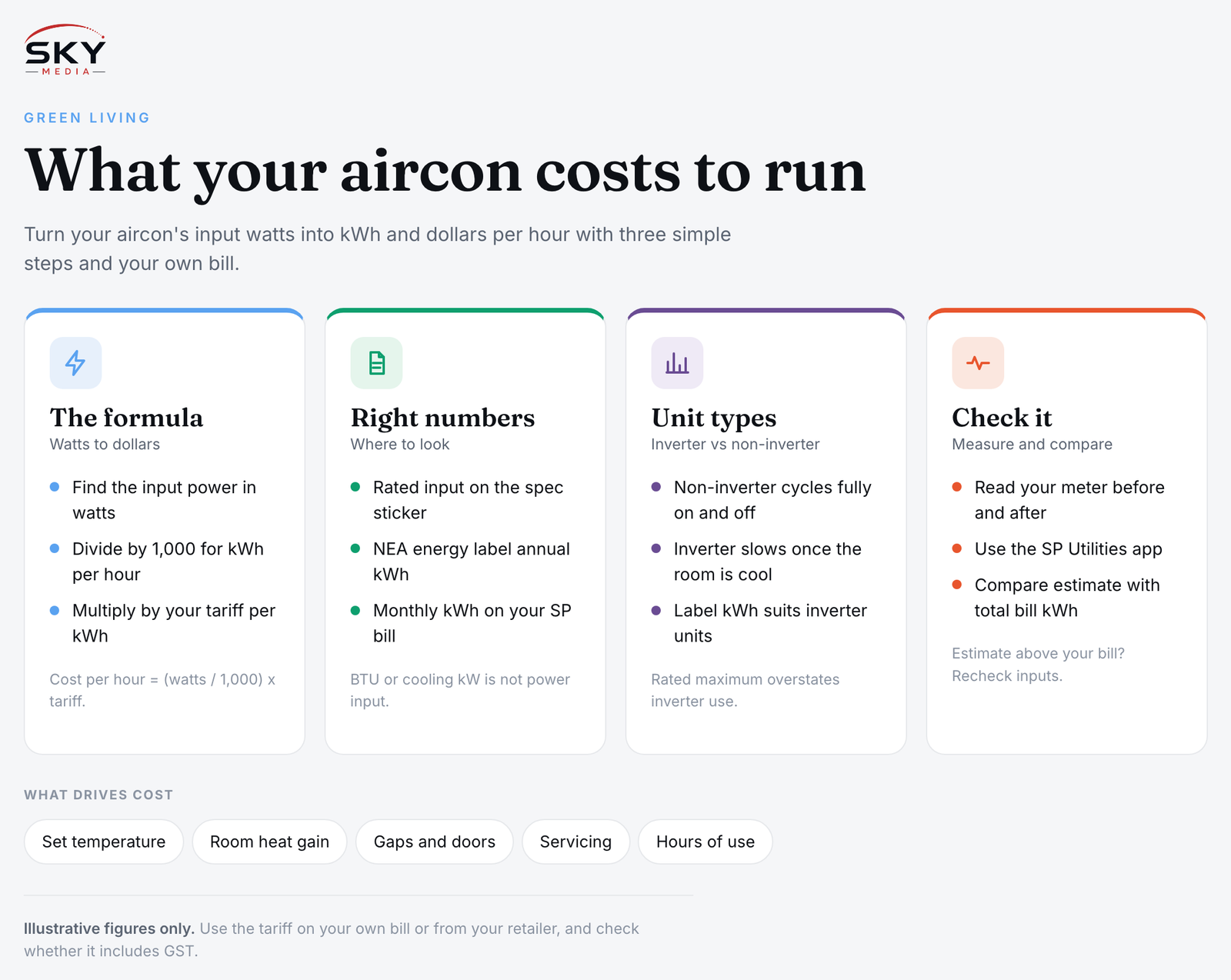
The Basic Formula: Watts to kWh to Dollars
Electricity is billed in kilowatt-hours (kWh). One kWh is the energy used by something drawing 1,000 watts for one hour. The calculation has three steps:
- Find the power draw in watts. This is the electrical input power, not the cooling capacity.
- Convert to kWh per hour. Divide watts by 1,000. A unit drawing 900 W uses 0.9 kWh in an hour of full running.
- Multiply by your tariff. Your bill shows the electricity rate in cents per kWh, including or excluding GST. Multiply kWh by that rate.
So the formula is:
Cost per hour = (input watts ÷ 1,000) × tariff per kWh
A Worked Example
Say your bedroom fan coil draws 800 W when the compressor is working hard, and, purely for illustration, your tariff is 30 cents per kWh.
- 800 ÷ 1,000 = 0.8 kWh per hour
- 0.8 × $0.30 = $0.24 per hour at full load
Run it eight hours a night for 30 nights and the rough figure is 0.8 × 8 × 30 = 192 kWh, or about $57.60 at that illustrative rate. In practice the compressor does not run at full power all night, so the real figure is usually lower.
The tariff used here is only an example. Regulated household tariffs from SP Group are revised every quarter, and if you buy from an electricity retailer in the Open Electricity Market, your rate depends on your plan. Use the rate printed on your own bill or published by your retailer, and check whether it already includes GST.
Where to Find the Right Numbers
The most common mistake is using cooling capacity instead of power input. Aircon specifications often quote cooling capacity in BTU/h (British thermal units per hour) or kW of cooling, such as 9,000 BTU or 2.5 kW. That is how much heat the unit removes, not how much electricity it uses.
Look for these instead:
- Rated power input (W or kW): Found on the specification sticker on the outdoor or indoor unit, the user manual, or the manufacturer’s website.
- Energy label: Aircons sold in Singapore carry the NEA energy label, which shows tick ratings and typically an estimated annual energy consumption in kWh based on a standard usage assumption. Divide that annual figure by the assumed hours to get an average hourly figure. NEA’s website explains the label and its assumptions.
- Your SP bill: Shows total household kWh per month, useful for checking your estimate later.
If you have a multi-split system (one outdoor compressor serving several indoor units), the outdoor unit’s power input is the main figure. Running one bedroom unit does not use the system’s full rated power.
Estimated Cost by Aircon Type
The table below uses illustrative power draws to show how the calculation plays out. Your unit’s figures will differ, so plug in your own numbers.
| Aircon setup | Illustrative average input | kWh per hour | Cost per hour at an example 30 cents/kWh | Notes |
|---|---|---|---|---|
| Small bedroom inverter unit, steady state | 500 W | 0.5 | $0.15 | Draw falls once the room reaches the set temperature |
| Older non-inverter bedroom unit | 1,000 W | 1.0 | $0.30 | Compressor cycles fully on and off |
| Living room unit, larger capacity | 1,500 W | 1.5 | $0.45 | Bigger space and more heat from sun and people |
| Multi-split running two rooms | 1,800 W | 1.8 | $0.54 | Depends on how many indoor units are on |
| Portable aircon | 1,000 W | 1.0 | $0.30 | Often less efficient for the cooling delivered |
These are teaching figures, not product specifications. They show that a few hundred watts of difference adds up quickly over months of nightly use.
Why Inverter and Non-Inverter Units Calculate Differently
A non-inverter aircon runs its compressor at full speed until the room hits the set temperature, then switches off and restarts when the room warms up. Its power draw is either near the rated figure or close to zero, so the calculation is roughly: rated input × the fraction of time the compressor is running.
An inverter aircon varies its compressor speed. It works hard at first to cool the room, then slows down to hold the temperature. Its power draw changes constantly, so the rated maximum overstates typical use. For inverter units, the energy label’s annual consumption figure or a plug-in or smart meter reading gives a more realistic average.
Our explainer on whether an inverter aircon really saves energy goes deeper into when the savings are real.
Measuring Instead of Estimating
If you want real data rather than label figures:
- Read your meter before and after. Note your electricity meter reading, run only the aircon for a set number of hours with other big appliances off, then read it again. The difference, minus a small allowance for the fridge and standby devices, approximates aircon use.
- Use your utility app. Many households with smart meters can see consumption in smaller time intervals through the SP Utilities app, which makes it easier to see the jump on nights the aircon runs.
- Smart aircon controllers or the unit’s app. Some newer units report energy use directly. Treat these as estimates.
- Plug-in energy monitors only work for portable units or window units on a standard plug. Most split systems are hard-wired, so do not attempt to tap into their wiring. Any electrical work should be done by a licensed electrician.
Factors That Push Your Cost Up or Down
Once you have a cost per hour, these factors explain why your number differs from a neighbour’s:
- Set temperature. Each degree cooler makes the compressor work harder. Many people find 25°C comfortable with a fan.
- Room size and heat gain. West-facing rooms, top-floor units and rooms with lots of glass absorb more heat.
- Insulation and gaps. Open doors, gaps under doors and windows left ajar let cool air escape.
- Servicing. Dirty filters and coils reduce efficiency. Regular servicing helps the unit run as designed.
- Age of the unit. Older units generally consume more for the same cooling.
- Hours of use. The single largest factor. Halving the hours roughly halves the cost.
Checking Your Estimate Against the Bill
To see whether your calculation makes sense:
- Add up estimated monthly kWh for each aircon (kWh per hour × hours per day × days).
- Compare it with the total kWh on your bill.
- Remember the fridge, water heater, lights, cooking appliances and devices all use power too. If your aircon estimate exceeds your total bill, recheck your inputs, as you probably used cooling capacity instead of input power.
Doing this once tends to change habits. Seeing that one extra hour every night adds a noticeable amount over a year is often more persuasive than any general tip. The same approach works for other appliances too; see how it applies in how much electricity a gaming PC uses and how to cut your fridge’s electricity use.
Quick Calculator Recap
- Find the input power in watts, not BTU or cooling kW.
- Divide by 1,000 to get kWh per hour.
- Multiply by your tariff from your bill or retailer.
- Multiply by hours and days for a monthly estimate.
- For inverter units, use the energy label’s annual kWh or a meter reading for a realistic average.
With these steps, your own aircon electricity cost calculator takes five minutes on a phone, and gives you a clear, dollar-based reason to adjust settings, hours and maintenance.
Further reading: Aircon Refrigerants Explained: R32, R410A and Their Climate Impact · Aircon Dry Mode vs a Dehumidifier: Which Uses Less Energy?