

If you live in an HDB flat, you pay a monthly bill to your town council called the service and conservancy charges, often shortened to S&CC. Most residents never think twice about it. But a bill can be wrong, arrears can pile up after a job loss or illness, and a reminder letter can arrive when money is already tight. This guide to conservancy charges in Singapore focuses on what you can actually do in those moments: how to query or dispute a charge, how to ask for time to pay, and where to find help.
It is general information, not legal or financial advice. Each town council sets its own procedures, and rebates and assistance schemes change, so check the details with your town council and the relevant government agency.
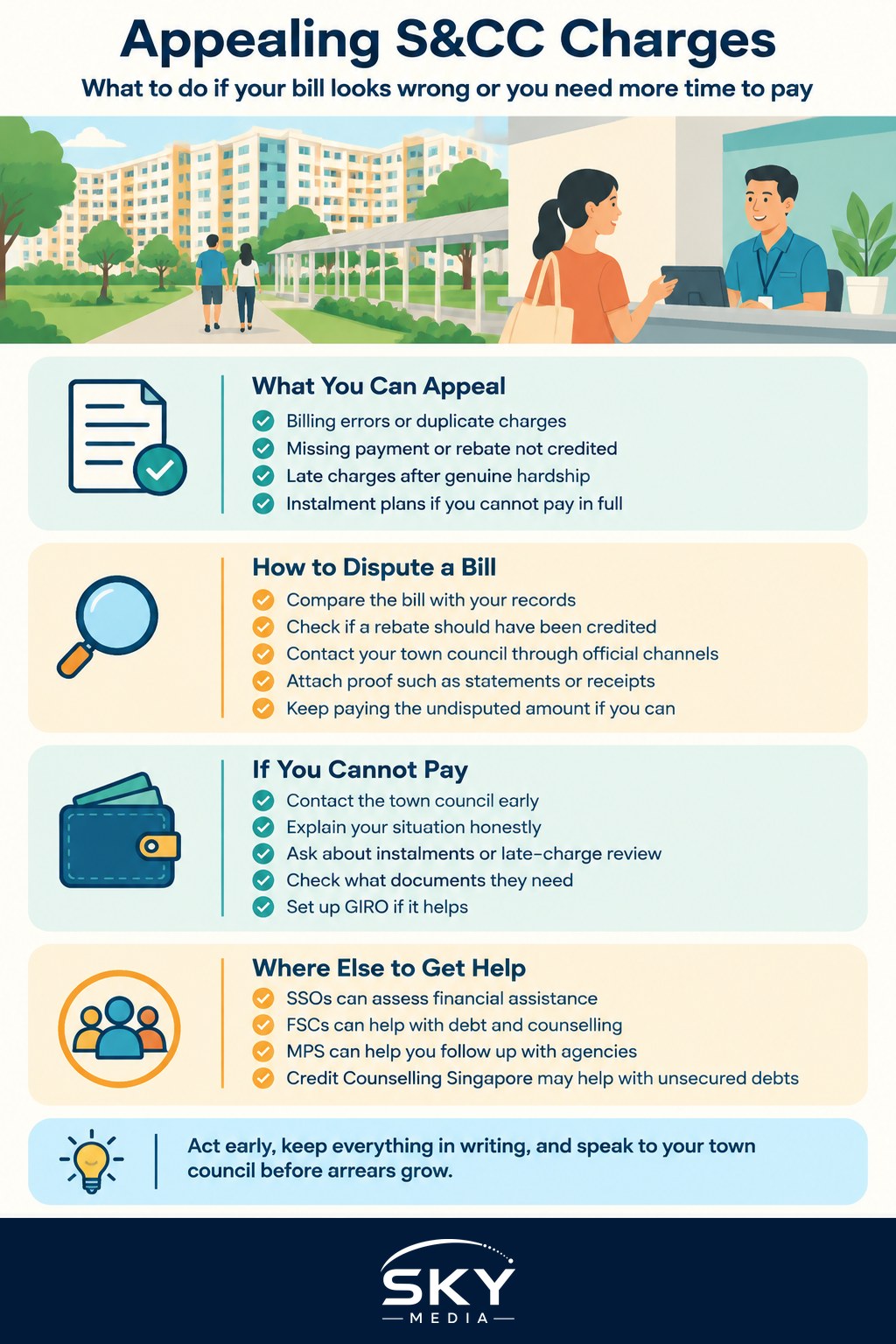
What You Can and Cannot Appeal
It helps to be realistic first. S&CC rates are set by each town council for each flat type to pay for cleaning, lift maintenance, lighting, landscaping and upkeep of common areas. Individual residents generally cannot negotiate a lower rate simply because they use the common areas less or feel the charge is high.
What you can usually raise with your town council falls into three groups:
- Billing errors. A charge for the wrong flat type, a duplicate charge, a payment that was not credited or a rebate that was not applied.
- Penalties and late charges. If arrears built up for a genuine reason, you can ask whether any late payment charges can be reviewed. There is no guarantee, but a clear explanation helps.
- Payment arrangements. If you cannot pay in full, you can ask for an instalment plan.
If your concern is how the town council is run or how the charges are set, that is a different conversation, better raised with your town council management or at a residents’ feedback channel. For the background on how the system works, see our guide to town councils and conservancy charges.
How to Query or Dispute a Wrong Bill
If something on your statement looks wrong, act quickly and keep everything in writing.
- Check your statement against your records. Compare the billed amount with your flat type, previous bills and bank or GIRO records. GIRO is the automatic bank deduction many households use for regular bills.
- Check for rebates. Eligible HDB households receive government S&CC rebates at set times, credited directly to the town council account. If you expected one and it is missing, check the eligibility rules first. Our explainer on utilities and conservancy rebates covers how they work.
- Contact your town council. Use the official channels listed on its website, such as its online form, email or service centre. Give your flat address, account number and a clear description of the issue.
- Attach evidence. Screenshots of payments, bank statements or previous bills make the review faster.
- Keep paying what is not in dispute where you can, so arrears do not build up while the query is reviewed.
- Follow up in writing if you do not hear back within a reasonable time, and keep a record of every reply.
When You Are Struggling to Pay
Falling behind on S&CC is more common than people think, particularly after a retrenchment, a health problem or a family crisis. The worst approach is to ignore the letters. Town councils have legal powers to recover arrears, and unpaid charges can escalate to legal action. Speaking to them early keeps more options open.
When you contact your town council, explain your situation honestly and ask:
- Whether you can pay the arrears in instalments over a period you can realistically manage
- Whether any late payment charges can be waived or reviewed given your circumstances
- What documents they need, such as proof of job loss or medical letters
- Whether setting up GIRO would help you avoid falling behind again
Agree only to a plan you can actually keep. If you miss an agreed instalment, call before the due date rather than after.
Your Options at a Glance
Here is how the main routes usually compare, depending on what has gone wrong.
| Situation | Where to start | What you can ask for | What to prepare |
|---|---|---|---|
| Bill looks wrong | Your town council | Correction, refund or credit | Statements, payment records |
| Missing rebate | Your town council, then the official rebate information | Confirmation of eligibility and crediting | Household details, previous statements |
| Arrears after a hardship | Your town council | Instalment plan, review of late charges | Proof of change in circumstances |
| Wider money difficulties | Social Service Office or Family Service Centre | Assessment for financial assistance | Income and expense details, bills |
| Stuck after raising it | Meet-the-People Session with your MP | Help to follow up with the town council | Copies of all correspondence |
Where to Get Wider Financial Help
If S&CC arrears are a sign of broader money trouble, it is worth getting help beyond the town council.
- Social Service Offices (SSOs) handle ComCare, the government’s financial assistance scheme for lower-income households. They can assess your situation and may help with essential bills.
- Family Service Centres (FSCs) are community-based social service agencies that offer counselling and help with practical problems, including managing debt.
- Meet-the-People Sessions (MPS) are weekly sessions where residents can ask their Member of Parliament for help writing to agencies. They can be useful if you feel stuck.
- Credit Counselling Singapore is a charity that helps people with unsecured debts work out a plan, if your difficulties go beyond household bills.
These services are confidential and used by many Singaporeans at some point. There is no shame in asking.
How to Keep Your Account in Good Standing
Once things are resolved, a few habits help avoid a repeat:
- Set up GIRO so the monthly charge is deducted automatically.
- Check statements a few times a year for errors or missing rebates.
- Update your town council if you change bank accounts or flat ownership changes.
- Budget for S&CC as a fixed monthly cost, alongside utilities and other regular bills.
- Talk early if your circumstances change. A quick call before you miss a payment is far easier than sorting out months of arrears.
Disputing other charges follows a similar logic of acting early and keeping records. If you are also dealing with a penalty from an agency, our guide on how to check or appeal a government fine walks through that separate process.
Official sources: HDB