

Every home in Singapore runs on a small fleet of machines: the fridge, washing machine, aircon units, water heater, cooker hood, hob and perhaps a dryer or dishwasher. None of them lasts forever, and they rarely fail at a convenient moment. An appliance replacement budget turns those surprise breakdowns into planned expenses, so a dead fridge on a Sunday night becomes an errand rather than a financial scramble.
This guide is not about lowering your utility bills or planning a renovation. It is about forecasting the replacements you already know are coming and setting aside money for them in a calm, steady way.
Why Appliance Failures Hurt Budgets More Than They Should
Most households treat appliances as one-off purchases. You buy them when you move in, then forget about them. The trouble is that many were bought at the same time, especially in a new flat or after a renovation, so they also tend to age together. Within a few years of each other, several big items can need replacing.
A few patterns make this worse:
- Clustered purchases. If everything was bought in the same month, replacements may also cluster.
- Urgency pricing. When the fridge dies, you buy whatever is in stock and can be delivered quickly, not the best value option.
- Hidden extras. Delivery, installation, disposal of the old unit, new brackets or piping for aircon, and sometimes small carpentry adjustments can add to the sticker price.
- Borrowing by default. Without savings set aside, many people reach for a credit card or an instalment plan, which can cost more over time if not managed carefully.
Planning ahead does not stop appliances from breaking. It simply means you can choose what to buy, when, and how to pay.
Step One: Build a Simple Appliance Inventory
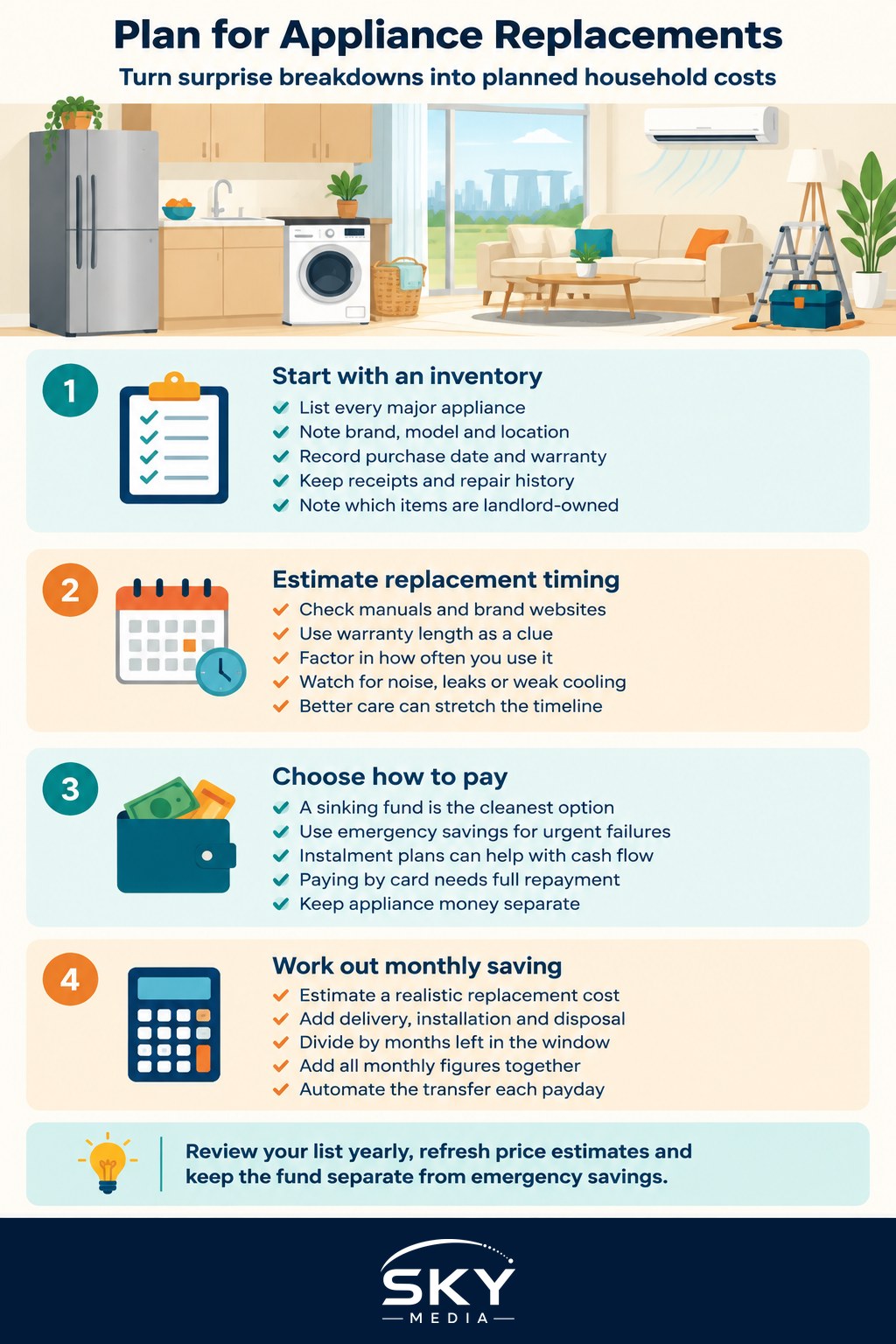
Start with a list. A spreadsheet or a note on your phone works fine. For each major appliance, record:
- What it is and where it sits (for example, “aircon, master bedroom”).
- Brand and model number, usually on a sticker inside the door or on the back.
- Roughly when you bought it, or when it came with the home.
- Warranty status, including any extended warranty you paid for.
- Any repairs so far, with dates.
Keep receipts and warranty cards in one folder, physical or scanned. If you rent, note which appliances belong to the landlord, since those are usually the landlord’s responsibility under the tenancy agreement. Check your lease to be sure.
This inventory is the foundation of the whole plan. Without it, you are guessing.
Step Two: Estimate When Each Item May Need Replacing
You do not need precise predictions. You need a reasonable window. To set one for each item:
- Check the manufacturer’s information. Manuals and brand websites sometimes indicate expected service life or how long spare parts are supported.
- Look at warranty length. A warranty is not a lifespan, but it hints at what the maker expects.
- Factor in your usage. A washing machine in a family of five works much harder than one in a single-person flat. Aircon that runs every night ages faster than one used occasionally.
- Watch for warning signs. Rising noise, longer cycle times, leaks, frequent tripping, ice build-up, weak cooling or repeated repairs all suggest an item is nearing its end.
Good care stretches these windows. Regular aircon servicing, cleaning filters and seals, and descaling where relevant all help. Our guide on how to maintain your home appliances covers the routine checks worth doing.
Once you have a rough window for each item, sort the list by which is likely to go first. That ordering tells you where your savings need to be ready soonest.
Step Three: Choose How to Fund Replacements
There are several ways to pay for a new appliance. Each suits a different situation.
| Funding approach | How it works | Best suited for | Watch out for |
|---|---|---|---|
| Dedicated sinking fund | Save a fixed amount monthly into a separate account for appliances only | Predictable replacements you can see coming | Discipline to avoid dipping into it for other spending |
| General emergency fund | Use your existing rainy day savings | Sudden failures of essential items like the fridge | Leaves you less cushion for job loss or medical needs until topped up |
| Interest-free instalment plan | Spread the price over several months via a card or retailer | Large purchases when cash flow is tight | Missed payments, late fees and the temptation to buy a pricier model |
| Credit card paid in full | Pay by card, then clear the bill at statement date | Earning rewards while paying from savings | Interest charges if the balance is not fully cleared |
For most households, a dedicated sinking fund is the cleanest option. It keeps appliance money visibly separate from your emergency savings, which should be reserved for genuine emergencies such as loss of income.
Step Four: Work Out Your Monthly Saving Amount
Here is a simple method that needs no special tools:
- For each appliance, note a realistic replacement cost. Check current prices on retailer websites or in stores for a comparable model, and add an allowance for delivery, installation and disposal. Prices change, so refresh these figures once a year.
- Divide that cost by the number of months left in its estimated replacement window.
- Add up the monthly figures for all appliances. That total is your monthly contribution.
Items expected to fail sooner will need a bigger monthly share. Items with plenty of life left contribute only a little. As each appliance is replaced, reset its timer and its saving amount.
If the total feels too high, you have options. Stretch replacement windows by maintaining items well, plan to buy mid-range rather than premium models, or accept that one or two lower-priority items (a second TV, a standalone dryer) will be funded later or skipped.
Automate it: set a standing instruction with your bank to move the monthly amount into a separate savings account on payday, and give that account a clear nickname such as “Appliances”.
Making Smart Decisions When Something Breaks
When an appliance fails, pause before buying. Ask:
- Repair or replace? If the item is fairly new and the repair is minor, repair may make sense. If it is old, has had several repairs, or parts are hard to get, replacement is often better value.
- Is it still under warranty? Contact the brand or retailer first. Keep your inventory handy so you can quote the model and purchase date.
- What do I actually need? Household needs change. A growing family may need a larger fridge; empty nesters may downsize.
- Energy efficiency. Singapore appliances such as aircon, fridges and washers carry energy labels under the National Environment Agency’s (NEA) labelling scheme. A more efficient unit can cost more upfront but less to run. Check the current label details on the NEA website.
Our home appliance shopping guide explains what to compare across features, warranties and after-sales service.
Fitting Appliances Into Your Wider Household Budget
Appliance replacement is one line in a larger set of recurring home costs, alongside conservancy charges, property tax, maintenance and repairs. If you own your home, it is worth reviewing all of them together so nothing is left unfunded. Our breakdown of the costs of owning a home in Singapore is a useful checklist.
A few final habits help the plan stick:
- Review once a year. Update your inventory, adjust replacement windows and refresh price estimates.
- Use windfalls wisely. A year-end bonus or tax refund can top up the fund and ease monthly pressure.
- Do not raid the fund for upgrades. Wanting a newer model is not the same as needing a replacement.
An appliance replacement budget is not glamorous, but it is one of the simplest ways to make household finances calmer. Build your inventory this week and the next breakdown will feel far less dramatic.
This article is general information, not financial advice. For decisions that affect your wider finances, consider speaking with a qualified adviser.
Frequently Asked Questions
Who pays for broken appliances in a rented flat? Appliances that belong to the landlord are usually the landlord’s responsibility under the tenancy agreement, but check your lease to be sure. Your own appliances are yours to repair or replace. List which is which in your inventory.
Is a sinking fund better than putting appliances on an instalment plan? For most households a sinking fund is cleaner, because the money is already there and you avoid late fees or buying a pricier model. Instalment plans suit tight cash flow, but missed payments can cost more over time.
Do energy labels matter when choosing a replacement aircon or fridge? Yes, they can. Appliances such as aircon, fridges and washers carry energy labels under the NEA’s labelling scheme, and a more efficient unit may cost more upfront but less to run. Check the current label details on the NEA website.
How do I know my appliance is nearly dead? Warning signs include rising noise, longer cycle times, leaks, frequent tripping, ice build-up, weak cooling or repeated repairs. Regular servicing and cleaning filters and seals can stretch its life, so keep a list of repairs with dates.
Further reading: How to Budget for Home Maintenance in Singapore