

Switching into a new field can feel daunting when you do not have the exact experience employers ask for. This is where a career conversion programme comes in. These are Singapore schemes designed to help mid-career workers move into new roles or industries by combining training with actual on-the-job learning, often with an employer already in the picture. If you have been eyeing a different line of work but were not sure how to bridge the gap, this guide explains how the pathway generally works and where to confirm the current details.
What a Career Conversion Programme Is
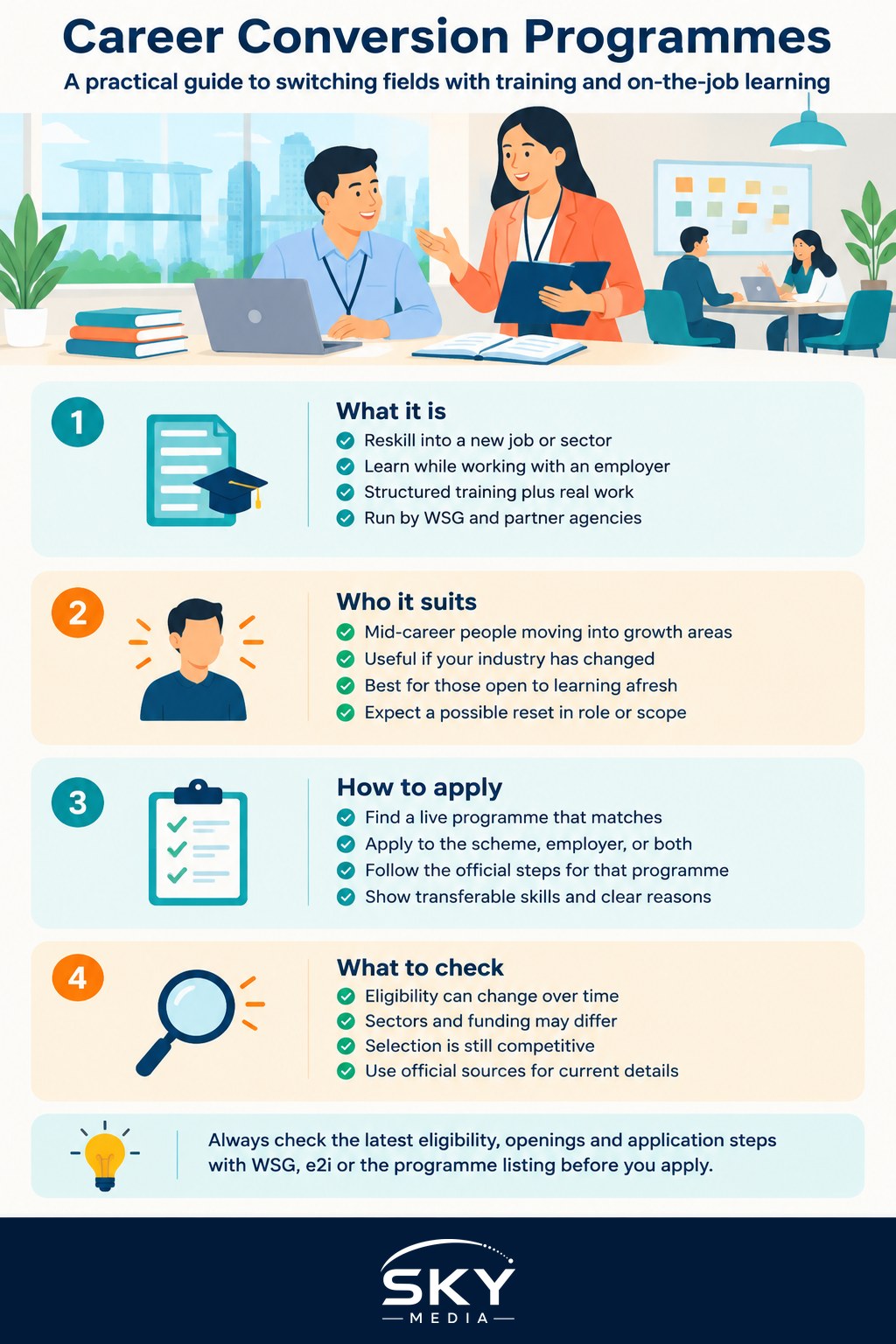
At its heart, a career conversion programme helps people reskill into a new occupation or sector while they work. Rather than studying full time and hoping a job appears at the end, many of these schemes place you with a participating employer who trains you on the job, with structured learning alongside. The idea is to lower the risk for both sides: you get a real role and support to learn it, and the employer gets help developing someone new to the field.
These programmes are run and supported by national agencies, most notably the Skills and Workforce Development Agency (SWDA, formed in 2026 from Workforce Singapore and SkillsFuture Singapore), along with partners such as e2i. The specific programmes available, the sectors they cover, the eligibility rules, and any funding or salary support attached to them change over time. So while the concept is stable, treat any particular figure or requirement as something to verify on the official sources rather than assume from an article or a friend.
Who These Programmes Tend to Suit
Career conversion schemes are generally aimed at mid-career individuals who are ready to move into a growing area but lack direct experience there. If you are feeling stuck, have been affected by changes in your industry, or simply want to head somewhere with better long-term prospects, this route is worth exploring.
They tend to work best when you are genuinely open to learning from the ground up in the new field, even if you were senior in your last one. That mindset matters. Moving across can mean a reset in title or scope for a while, and being honest with yourself about that helps. If you are weighing a bigger life shift, it can help to first read up on transitioning to a new industry and, if this applies to you, changing careers at 40, so you go in with clear eyes.
How the Application Generally Works
While each programme has its own process, the broad shape is usually similar. First, you identify a programme that matches the sector or role you want. National platforms list what is currently open, and the roles are often tied to specific participating employers. Second, you apply, either to the programme, to a hiring employer running it, or both, depending on how that scheme is structured. Third, if selected, you take up the role and go through the training as part of the job.
Because the exact steps, timelines, and who you apply to can differ from one programme to another, the reliable approach is to follow the instructions on the official listing for the programme you want. Do not assume the process from one scheme applies to another.
A few things make your application stronger no matter the programme:
- Be clear about why you want to convert, in a way that connects your past experience to the new field.
- Show transferable skills honestly, rather than pretending you already know the technical parts.
- Prepare as you would for any job, since many programmes still involve a real hiring decision by an employer.
It pays to treat this like a proper job search. Brushing up on researching a company before applying and tailoring your resume for each job will serve you well, because you are often being assessed as a candidate, not just an applicant to a scheme.
Setting Realistic Expectations
A career conversion programme can open a door that would otherwise stay shut, but it is not a guarantee of a job, a salary level, or a smooth ride. Places can be limited, employers still choose who they take, and the market remains competitive. What these programmes do well is give motivated people a structured, supported way in, which is a real advantage over trying to switch entirely on your own.
Go in ready to work hard and learn fast. The people who benefit most treat the training seriously, ask questions, and build relationships in their new team from day one. Pairing the programme with your own effort to keep building in-demand skills makes the switch far more likely to stick.
Where to Check the Current Details
Since eligibility, available sectors, funding, and application steps are updated regularly, always confirm the current specifics with the official bodies. SWDA and e2i are the main places to look for what is open now, who qualifies, and how to apply. SWDA’s SkillsFuture portal is useful for the wider training and reskilling picture if you want to build up skills before or alongside a conversion.
Take it step by step: get clear on the field you want, find a live programme that matches, confirm the current eligibility and process, then prepare properly and apply. A career conversion programme rewards people who are willing to start fresh and commit, and for many Singaporeans it has been a genuine second door into work they find more meaningful.
Frequently Asked Questions
Can I join a career conversion programme if I have no experience in the new field? Yes, that is the purpose. These schemes target mid-career workers who want to move into a growing area but lack direct experience, pairing training with on-the-job learning. You still need to show motivation and transferable skills, and eligibility rules vary, so check the official listing.
Will I have to take a lower job title or scope when I convert? Possibly, for a while. Moving across can mean a reset in title or scope even if you were senior before, so it helps to be honest with yourself about that. Many people see it as a trade-off for entering a field with better long-term prospects.
Do I apply to the programme or directly to an employer? It depends on how each scheme is structured. You may apply to the programme, to a hiring employer running it, or both. Follow the instructions on the official listing for the programme you want, and do not assume one scheme’s process applies to another.
How can I make my application stronger when I am switching fields? Explain clearly why you want to convert and link your past experience to the new field. List transferable skills honestly instead of pretending to know the technical parts, and prepare as for any job interview, since employers still make a real hiring decision.
Does completing a conversion programme guarantee a job afterwards? No. Places can be limited, employers still choose who they take, and the market remains competitive. What the programme offers is a structured, supported way in, with real work experience that is hard to get when switching entirely on your own.
Official sources: Ministry of Manpower (MOM)
Further reading: SkillsFuture Career Transition Programme: Who Can Apply and How It Works