

International Women’s Day each March is a good moment to look at a question many young adults ask quietly: is there room for me in tech? For women in tech Singapore has built a fairly clear ecosystem of government-backed programmes, employer pledges and grassroots communities. Whether you are a fresh graduate, a mid-career professional thinking about a switch, or someone returning to work after a break, there are real routes in.
This guide walks through what the national efforts look like, where to find community, and the practical paths for moving into a tech role. Schemes and eligibility rules change, so treat this as a map and confirm details with the official agency before you apply.
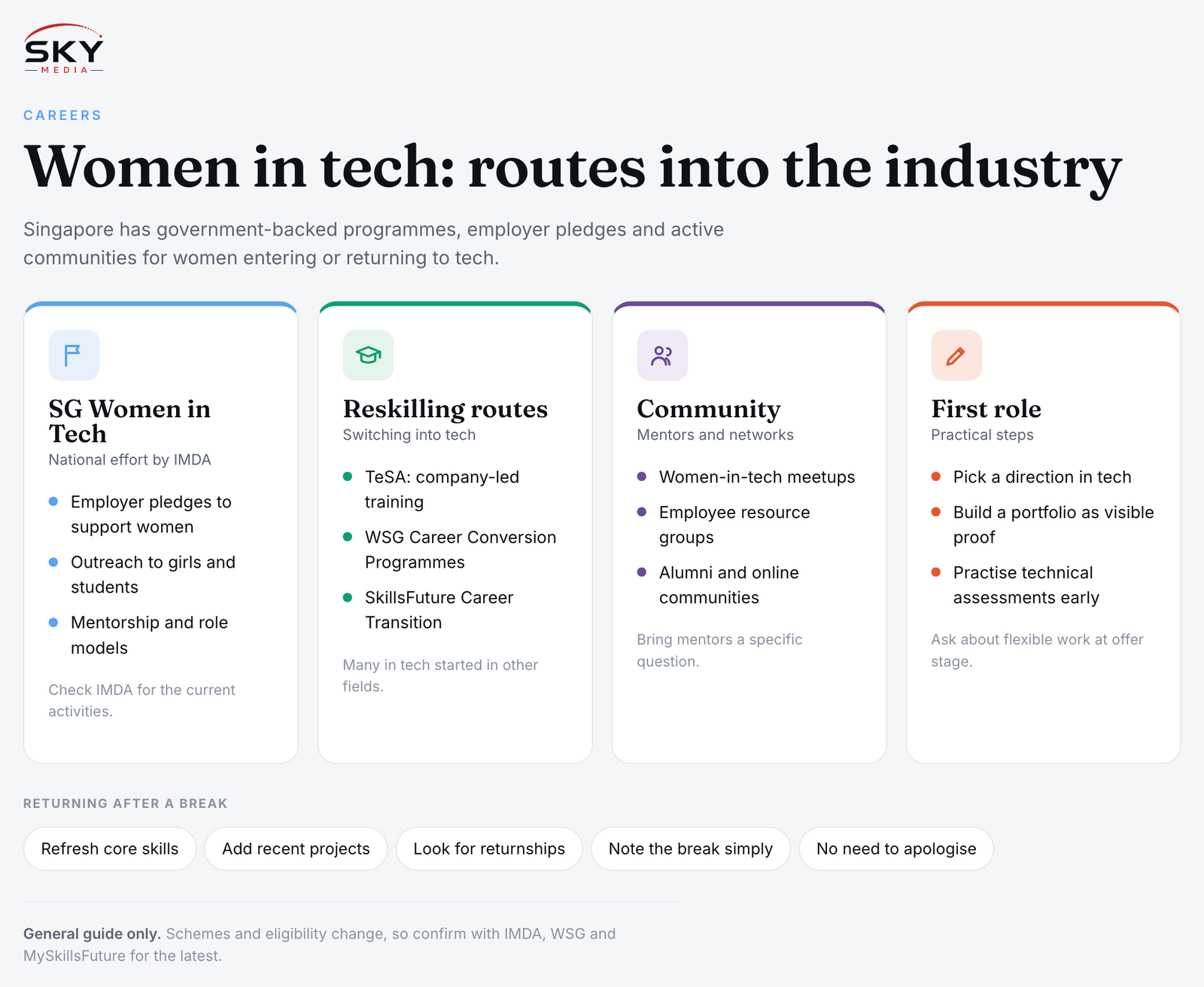
What SG Women in Tech Is and Why It Matters
SG Women in Tech is a national effort led by IMDA (the Infocomm Media Development Authority, the agency that oversees Singapore’s digital economy and tech workforce development). Its aim is to attract more women into tech careers, help them stay and grow, and encourage more women into tech leadership.
In practice, the effort works on several levels:
- Employer commitments. Companies can pledge to support women in their tech teams, for example through mentorship, flexible work arrangements, inclusive hiring and leadership development. A company’s participation can be a useful signal when you are comparing employers.
- Outreach to students. There are efforts to expose girls and young women to tech careers early, through school talks, role-model stories and events, so that tech feels like a normal option rather than a niche one.
- Mentorship and visibility. Showcasing women working in software, data, cybersecurity, product and design helps newcomers see realistic career paths.
The value for you is less about any single programme and more about the wider environment. Many employers in Singapore now actively want to widen their talent pool, and that opens doors. Check IMDA’s official website for the current shape of SG Women in Tech, as its activities evolve from year to year.
Reskilling Routes Into Tech
If you are not coming from a computing degree, you are far from alone. Many people working in tech in Singapore started elsewhere: teaching, finance, healthcare, marketing, operations. The main structured routes are below.
TechSkills Accelerator (TeSA)
TeSA is an IMDA initiative, run with partners such as the Skills and Workforce Development Agency (SWDA, formed in 2026 from Workforce Singapore and SkillsFuture Singapore), focused on building digital skills for the workforce. It includes programmes for mid-career switchers as well as upskilling for people already in tech. Some tracks are company-led, meaning an employer hires you and trains you on the job. Look up TeSA on IMDA’s website for the current list of programmes and who they are for.
Career Conversion Programmes
Career Conversion Programmes (CCPs), administered by SWDA, support mid-career individuals moving into new roles, including tech roles, with training while employed. Our guide to Career Conversion Programmes in Singapore explains the structure and how employers and trainees take part.
SkillsFuture Career Transition Programme
The SkillsFuture Career Transition Programme offers industry-relevant training for mid-career individuals, often in partnership with institutes of higher learning. It suits people who want structured coursework before job hunting. Check the MySkillsFuture portal for current courses and who can apply.
Self-directed learning plus a portfolio
Some women switch through online courses, bootcamps and personal projects, then apply directly. This route is flexible but requires discipline. If you go this way, check whether a course is eligible for SkillsFuture Credit on the official MySkillsFuture portal, and be wary of any provider promising guaranteed jobs or salaries.
Comparing the Main Routes
| Route | Best for | What to expect | Where to check |
|---|---|---|---|
| Company-led TeSA or CCP role | Mid-career switchers who want to earn while learning | You are hired first, then trained on the job | IMDA and SWDA websites |
| SkillsFuture Career Transition Programme | People who want structured classroom training first | Course-based learning, then job search support | MySkillsFuture and SWDA |
| Bootcamp or self-study with portfolio | Self-motivated learners with some time to invest | Flexible pace, results depend on your projects | MySkillsFuture for course eligibility |
| Internship or graduate programme | Students and fresh graduates | Structured entry with mentoring | University career offices, employer sites |
Many people combine routes, for example by doing a short course to test their interest before committing to a full conversion programme.
Finding Community and Mentors
Programmes give you skills. Community gives you confidence, referrals and honest advice about what a job is really like.
- Women-in-tech groups and meetups. Singapore has a lively scene of tech meetups, some specifically for women and non-binary people in tech. Search event platforms and professional networking sites for groups focused on coding, data, product, UX or cybersecurity.
- Employee resource groups. Larger tech employers often run internal women’s networks. When interviewing, it is fair to ask whether one exists and what it actually does.
- Alumni and university networks. Polytechnic and university alumni groups frequently host tech talks and mentoring sessions.
- Online communities. Forums and chat groups around specific languages or tools are useful for problem-solving and for spotting job openings early.
If you enjoy gaming or game development, our piece on Women in Gaming in Singapore covers that corner of the industry, which overlaps with tech in design, engineering and community roles.
How to get the most from a mentor
Come with a specific question rather than “how do I get into tech?” Ask about a particular role, a skill gap, or how they handled a career decision. Mentors respond better to focused asks, and you will get more useful answers.
Practical Steps for Your First Tech Role
- Pick a direction. Tech is broad. Software engineering, data analytics, cybersecurity, cloud, UX design, product management and IT support all need different skills. Read job descriptions and talk to people in those roles before choosing.
- Build visible proof. A small portfolio of projects, a GitHub profile, a case study or a certification shows employers what you can do. Projects that solve a real problem, even a small one, stand out.
- Translate your past experience. A former teacher brings communication and training skills. Someone from finance brings domain knowledge that fintech teams value. Frame your background as an asset.
- Prepare for technical assessments. Many tech roles include coding tests or take-home tasks. Practise early rather than the week before.
- Ask about flexibility and support. If you have caregiving responsibilities, ask about flexible work arrangements during the offer stage. Singapore’s tripartite guidelines on flexible work requests encourage employers to consider such requests properly; check MOM and Tripartite Alliance resources for the current guidelines.
For a broader look at career paths, salaries to research and skills to build, see How to Build a Career in Tech in Singapore.
Returning to Tech After a Career Break
Many women step away from work for caregiving and worry their skills have gone stale. Tech moves quickly, but fundamentals last. A sensible return plan:
- Refresh core skills with a short course before applying.
- Update your portfolio with one or two recent projects.
- Look for “returnship” style roles or employers that explicitly welcome returners.
- Be straightforward about the break on your CV. A single line such as “career break for caregiving” is enough; you do not need to apologise for it.
A Realistic Outlook
Entering tech takes effort, and no programme guarantees a job. But the combination of national support, employers keen to diversify and active communities means women in Singapore have more structured paths into tech than ever. Start small, test your interest, connect with people already doing the work, and use the official schemes where they fit.
Explore more: How to Build a Career in Tech in Singapore · Career Conversion Programmes in Singapore
Frequently Asked Questions
Do I need a computer science degree to get a tech job? Not always. Many people working in tech in Singapore started in teaching, finance, healthcare, marketing or operations, and routes such as company-led conversion programmes, courses and portfolios exist. Some roles and employers still prefer a degree, so read job descriptions closely for each role.
Are coding bootcamps worth it for a career switch? They can be, if you are self-motivated and build projects that show what you can do. Results depend on your effort, not the bootcamp’s name. Check whether the course is eligible for SkillsFuture Credit on MySkillsFuture, and be wary of any provider promising guaranteed jobs or salaries.
Can permanent residents or foreigners join programmes like TeSA? Eligibility differs by programme and is set by the agency running it. Many schemes prioritise citizens and, in some cases, permanent residents. Check IMDA’s website for each TeSA track and the SWDA website for conversion programmes before applying.
How do I pick which tech role to aim for? Read job descriptions for software engineering, data analytics, cybersecurity, cloud, UX design, product management and IT support, since each needs different skills. Talk to people in those roles, then try a short course to test your interest before committing to a full conversion programme.
How should I explain a career break when applying for tech jobs? Be straightforward. A single line such as career break for caregiving is enough, and you do not need to apologise. Refresh core skills with a short course, add one or two recent projects to your portfolio, and look for returnship-style roles or employers that welcome returners.
Further reading: Switching Careers Through a Coding Bootcamp in Singapore