

The argumentative essay is the question many secondary students dread, yet it is also the one that rewards clear thinking more than fancy vocabulary. Unlike the narrative compositions you wrote in primary school, an argumentative essay secondary English task asks you to take a position on an issue, defend it with reasons and evidence, and show that you have considered the other side. This guide walks through how to plan, structure and polish one, whether you are in Secondary 1 or preparing for the Singapore-Cambridge Secondary Education Certificate (SEC) papers.
Exam formats, word limits and marking descriptors can change, so always check the current English Language syllabus on the SEAB (Singapore Examinations and Assessment Board) website and follow what your teacher tells you about your school’s papers.
What Markers Are Actually Looking For
Before you write a word, understand what separates a strong argumentative essay from an average one. Markers are generally looking for:
- A clear stand. The reader should know your position by the end of your introduction. Sitting on the fence for the whole essay usually reads as indecision, not balance.
- Relevant, developed reasons. Three well-explained points beat six thin ones.
- Evidence and examples. Specific, realistic examples make your reasons convincing.
- Awareness of the other side. Acknowledging a counterargument and then answering it shows maturity.
- Organisation. Paragraphs that each do one job, linked with clear transitions.
- Accurate, appropriate language. A formal but natural tone, varied sentences and correct grammar.
Reading the Question and Choosing Your Stand
Many weak essays fail at the first step: misreading the question. Take two minutes to break it down.
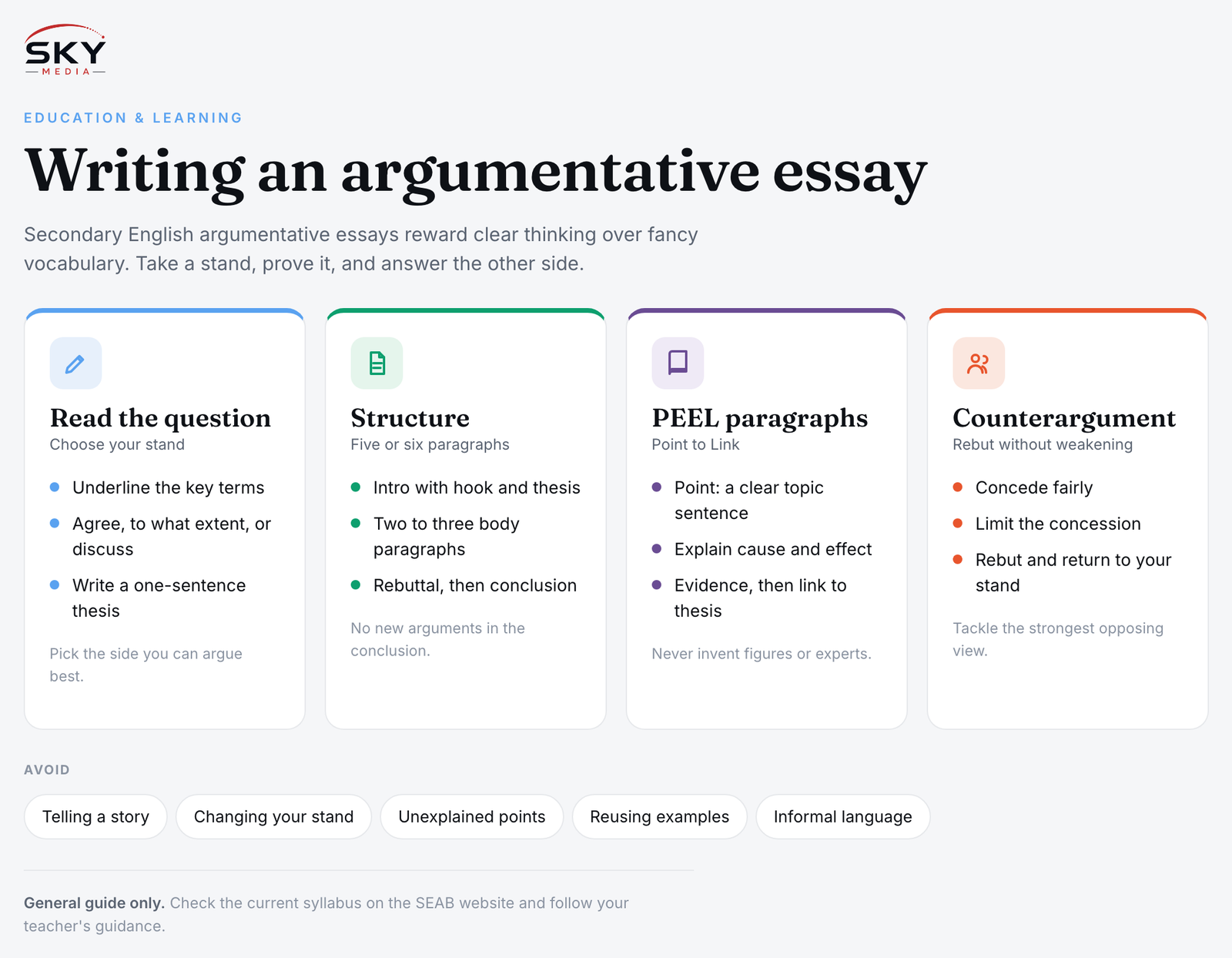
- Underline the key terms. In a question like “Social media does more harm than good to teenagers. Do you agree?”, the key terms are “more harm than good” and “teenagers”. Your essay must weigh harm against good, and it must be about teenagers, not people in general.
- Spot the question type. “Do you agree?” invites a stand. “To what extent” invites a measured stand, such as “largely agree, but with limits”. “Discuss” allows you to weigh both sides before concluding.
- Pick the side you can argue best. Your personal opinion matters less than which side you can support with stronger reasons and examples in the time given.
- Write a one-sentence thesis. For example: “Although social media helps teenagers stay connected, its harm to their focus, sleep and self-esteem outweighs these benefits.”
That thesis becomes the spine of the essay. Every body paragraph should prove one part of it.
A Reliable Structure: Introduction, Body, Counterargument, Conclusion
A five or six paragraph structure works for most timed essays. Here is how each part functions:
- Introduction (one paragraph). Open with a brief hook, such as a relatable situation or a striking observation (avoid invented statistics). Give context in a sentence or two, define any vague term, then state your thesis.
- Body paragraphs (two to three). Each one argues a single reason supporting your stand.
- Counterargument and rebuttal (one paragraph). Present the strongest opposing view fairly, then explain why your position still holds.
- Conclusion (one paragraph). Restate your stand in fresh words, pull your reasons together and end with a forward-looking thought or recommendation. Do not introduce new arguments here.
Some students place the counterargument second instead; either works if the flow is logical.
Building Strong Body Paragraphs With PEEL
Most Singapore schools teach a paragraph framework such as PEEL. It keeps each paragraph focused.
- Point: a topic sentence that states the reason. “Firstly, constant notifications erode teenagers’ ability to concentrate.”
- Explain: unpack why this is true. Show the cause and effect.
- Evidence or Example: give a concrete illustration. This can be a realistic everyday scenario, a widely known trend, a news event you are sure of, or a reasoned hypothetical.
- Link: connect back to the question and your thesis. “Thus, the harm to focus is a significant cost that outweighs the convenience of staying connected.”
Compare a weak and a strong paragraph:
| Element | Weak version | Strong version |
|---|---|---|
| Point | “Social media is bad.” | “Social media disrupts teenagers’ sleep, which affects their learning.” |
| Explanation | Repeats the point in different words | Explains the cause: late-night scrolling, blue light and fear of missing out |
| Evidence | “Many studies show this.” (vague, unverifiable) | A specific, realistic scenario: a student who replies to group chats until 1am and struggles in first period |
| Link | Ends abruptly | Ties back: “Since sleep underpins learning, this harm is hard to justify.” |
| Language | Informal: “super bad”, “like” | Formal and precise: “detrimental”, “consequently” |
A word on evidence: never fabricate figures or quote “experts” you cannot name. Markers can tell, and invented numbers weaken credibility. Well-chosen examples from school life, Singapore society or current affairs you genuinely know are safer and more persuasive.
Handling Counterarguments Without Weakening Your Case
The rebuttal paragraph is where many students lose marks, either by skipping it or by accidentally arguing the other side too well. Use this pattern:
- Concede fairly. “Admittedly, social media allows teenagers to find support communities and learn new skills.”
- Limit the concession. “However, these benefits depend on disciplined use, which many teenagers find difficult.”
- Rebut with reasoning. Explain why the benefit is smaller, less common or outweighed by the harms you have argued.
- Return to your stand. End the paragraph by reaffirming your thesis.
Useful phrases include “While it is true that…”, “Critics may argue that…”, “Nevertheless…”, and “This view overlooks…”. Pick the strongest opposing argument, not a weak “straw man” that is easy to knock down; markers reward engaging with a serious objection.
Planning and Timing in the Exam
Under exam pressure, planning feels like a waste of time. It is the opposite. A five-minute plan prevents a messy, repetitive essay.
- Spend about five minutes planning. Jot your thesis, three reasons, one example for each, and the counterargument you will rebut.
- Write steadily. Aim to finish your body paragraphs with time to spare for the conclusion. A missing conclusion makes an essay feel unfinished.
- Leave a few minutes to check. Look for subject-verb agreement, tense consistency, missing words and spelling of key terms.
- Watch the word guidance. If your paper states a suggested length, stay near it. Overly long essays often become repetitive.
Practising Between Exams
Argumentative writing improves with deliberate practice, not just more essays.
- Read opinion pieces. Newspaper commentaries and editorials model how writers state a view, use evidence and handle objections. Notice their transitions.
- Argue both sides orally. With a friend or parent, pick a topic and each argue a side for two minutes, then switch. This trains you to anticipate counterarguments.
- Build an example bank. Keep a notebook of examples across common themes: technology, environment, education, family, sports, the arts and community. Note what each example can prove.
- Rewrite one paragraph at a time. Take a returned essay, choose your weakest paragraph and rewrite it using PEEL. This is often more useful than writing a whole new essay.
If you are in your first year and still adjusting to the jump in expectations, the move from primary-level narrative writing to secondary-level argument is normal to find hard. Our guides on the transition to secondary school and supporting the move to secondary school cover the wider adjustment, and parents can find practical preparation tips in the Secondary 1 back-to-school checklist.
Common Mistakes to Avoid
- Writing a narrative or personal story instead of an argument.
- Changing your stand halfway through the essay.
- Listing points without explaining them.
- Using the same example for two different reasons.
- Ending with a rhetorical question that leaves your position unclear.
- Using informal language, abbreviations or Singlish in a formal essay.
Master the structure first, then work on style. Once planning, PEEL paragraphs and rebuttals become habits, you can spend your exam time on what really lifts an essay: sharper reasoning and better examples.
Frequently Asked Questions
How long should an argumentative essay be for secondary school English? Follow the suggested length stated in your paper and your teacher’s guidance, as formats can change. Check the current syllabus on the SEAB website. Staying near the guideline matters because overly long essays often become repetitive.
Can I use personal experience as evidence in an argumentative essay? Yes, if the example is realistic, relevant and used to prove a point rather than to tell a story. School life, family or community scenarios work well. Avoid writing a narrative, and never invent statistics or quote experts you cannot name.
What if I do not know much about the topic in the exam? Break down the key terms in the question, choose the side you can support with stronger reasons and plan in five minutes. Everyday examples from school, home and society often suffice. An example bank built beforehand across common themes helps.
Should my essay pick a side or discuss both sides equally? Take a clear stand, because markers want to know your position by the end of the introduction. Show awareness of the other side through a fair counterargument and rebuttal. Sitting on the fence all the way through usually reads as indecision.
How can I improve my vocabulary without sounding unnatural? Aim for formal but natural language, using precise words you fully understand rather than fancy ones. Read newspaper commentaries to see how writers phrase views and transitions. Using a word wrongly costs more marks than a simple word used well.
Further reading: Summary Writing for Secondary English: The Step-by-Step Method