

Once your child has a school place, the next question is how they will get there and back each day. Sorting out a school bus in Singapore, or deciding whether the MRT, a walk or your own driving makes more sense, is one of those small logistics that shapes the whole family routine. If you have come from a mainland city where the school was often within the compound or a short scooter ride away, the choices here can feel unfamiliar. This guide walks through the main options, what to weigh up, and how to set your child up for a safe, calm commute.
The Main Ways Children Get to School
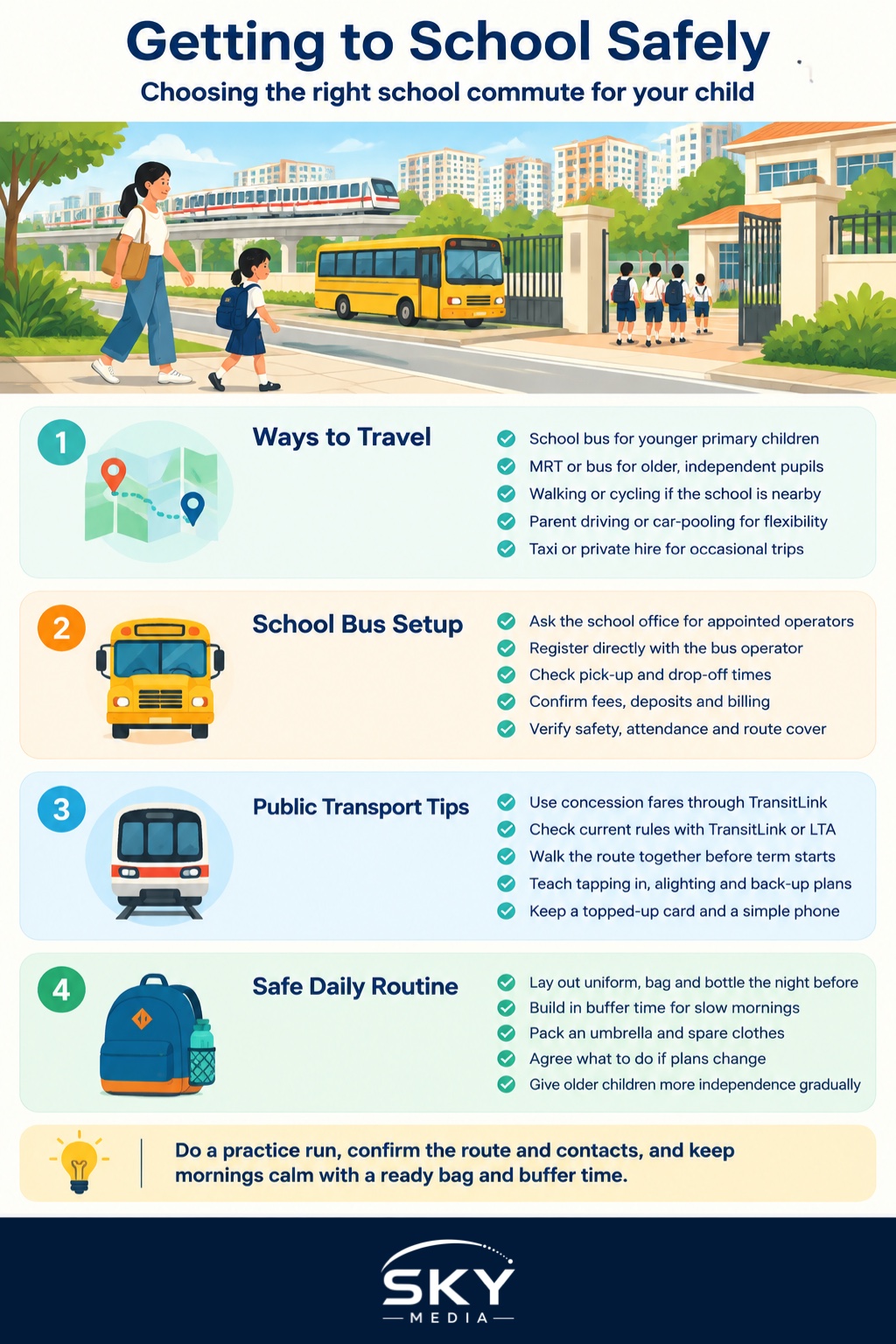
Singapore children reach school in a handful of common ways, and most families settle on one or a mix. Your best option depends on how far you live from the school, your child’s age, your work hours and your budget.
The usual choices are:
- School bus: a private operator, usually appointed through or known to the school, picks your child up near home and drops them back. Popular for younger primary children.
- Public transport: the MRT and public buses, run under the Land Transport Authority (LTA) network, work well for older children and those living along a convenient line.
- Walking or cycling: ideal when the school is genuinely nearby and the route is safe.
- Parent driving or car-pooling: flexible but tied to your own schedule and the morning traffic.
- Private hire or taxi: occasional use rather than a daily norm for most families, given the cost.
There is no single right answer. A Primary 1 child living twenty minutes away is a natural school-bus candidate, while a Secondary student two MRT stops from school will often prefer the independence of public transport.
Signing Up for a School Bus
School bus services in Singapore are run by private transport operators, not by the school itself, though schools usually maintain a list of appointed or recommended operators. When your child is offered a place, the school typically shares the transport arrangements, and you register directly with the operator. Ask the school office first rather than searching randomly online, because using a school-linked operator means the routes and timings are already built around that school.
When you speak to an operator, it helps to confirm:
- Whether they cover your block or estate, and the likely pick-up and drop-off times.
- The monthly fee and how it is billed, plus any deposit or term-based payment.
- The size of the bus or van and whether an attendant rides along, which matters for younger children.
- How they handle a child who is absent, or a change in your address or timing.
- Their track record and whether they follow the safety expectations for school transport vehicles.
Fees vary with distance and operator, so ask for the specific figure for your address rather than assuming, and treat any number a neighbour quotes as a rough guide only. Do not pay a large sum upfront to an operator you cannot verify through the school. A quick call to the general office to confirm the operator is genuinely appointed protects you from the rare scam.
Public Transport, Concession and Safety
For older children, Singapore’s public transport is safe, clean and extensive, and many families find it cheaper and more flexible than a bus contract. The key money-saver is a concession card. Students can travel on discounted fares using a concession scheme administered through TransitLink, and the card is used across MRT and public buses. Because the eligibility rules and fare amounts are set by the authorities and updated periodically, confirm the current concession details and how to apply through TransitLink or the LTA rather than relying on old information.
If your child will use the MRT and buses, a practice run before term starts is worth an afternoon. Walk the route together, ride it once or twice, and point out where to tap in and out, where to alight, and what to do if they miss a stop. Teach a few habits early: keep the card and a little stored value topped up, sit near the driver or other commuters if travelling alone, and call you if plans change. A cheap prepaid phone or a basic smartwatch gives many parents peace of mind, though agree screen rules so it does not become a distraction.
Here is a simple way to compare the daily options:
| Option | Best suited to | Cost to weigh up | Watch-outs |
|---|---|---|---|
| School bus | Younger primary children | Monthly fee set by operator | Fixed timings, less flexible |
| MRT and public bus | Older children on a convenient line | Concession fares via TransitLink | Needs route familiarity first |
| Walking or cycling | Children very near school | Little to none | Route safety, weather, heavy bags |
| Parent driving | Families with matching schedules | Fuel, parking, time | Morning traffic, drop-off rules |
Use this to shortlist, then confirm the real numbers for your address and your child’s school.
Building a Safe, Calm Routine
Whatever mode you pick, the routine matters as much as the method. Children cope best when mornings are predictable. Lay out the uniform, bag and water bottle the night before, and build in a buffer so a slow morning does not turn into a panic or a missed bus. Our weather adds its own wrinkle, so a small foldable umbrella and a spare set of clothes in the bag save many soggy afternoons.
Agree a clear plan for the unexpected. Your child should know who to call if the bus does not come, what to do if they feel unwell, and where to wait if you are running late at pick-up. Store your number and a trusted local contact somewhere they can reach easily. For younger children, a simple laminated card in the bag with names and numbers works well. As your child grows, gradually hand over more independence, letting a confident Primary 5 or 6 child manage more of the journey themselves, which builds the self-reliance they will need in secondary school. Settle the transport well and it quietly disappears into the background, leaving your child free to focus on settling into school life.
Explore more
Getting to school is one part of a bigger family transition. If you are still sorting out a school place, start with the AEIS exam for international students explained. Mothers staying to support a studying child should read about the Student’s Guardian Pass, and families bringing a child over will find bringing a child who stayed in China to join you a helpful next step.
Frequently Asked Questions
When should I register for a school bus once my child has a place? As soon as the school shares its transport arrangements, since you register directly with the operator. Ask the school office which operators are appointed or recommended, and confirm pick-up times for your block before the term begins, so the first week runs smoothly.
What happens to the school bus fee if my child is absent or we move house? It depends on the operator, so ask before you sign. Check how they handle absences, refunds, and a change of address or timing, and get the answer in writing. A school-linked operator can explain its terms in the school office too.
At what age can a child travel to school alone on the MRT or bus? There is no single age, and it depends on the child’s maturity and the route. Practise the journey together first, show them where to tap and what to do if they miss a stop, and give them a way to reach you. Many children manage this around the upper primary years.
Is it safe for my child to walk or cycle to school? It can be, if the school is genuinely nearby and the route is safe. Walk it together first, point out crossings, and plan for rain, heat and heavy bags. For younger children, a school bus or a parent drop-off may be a better fit.
How do I check that a school bus operator is legitimate? Call the school’s general office and confirm the operator is appointed or recommended before paying anything. Do not hand over a large deposit to an operator you cannot verify through the school. Ask about the safety expectations they follow and whether an attendant rides along.
Official sources: Land Transport Authority (LTA)
Further reading: What to Check About School Bus Access Before Moving