

Many capable people find it surprisingly hard to ask for help. They will stay late to untangle a problem a colleague could solve in five minutes, struggle through a house move alone, or keep quiet about feeling overwhelmed. In Singapore, where self-reliance and not “troubling others” are often quietly valued, the instinct to manage alone can run deep.
Learning how to ask for help is a skill, not a personality trait. Like any skill, it gets easier with practice and a few good habits. This guide covers why asking feels uncomfortable, how to choose the right person, how to phrase a request clearly, and how to receive help gracefully. It is about seeking support, not about setting boundaries or handling conflict, which are separate skills.
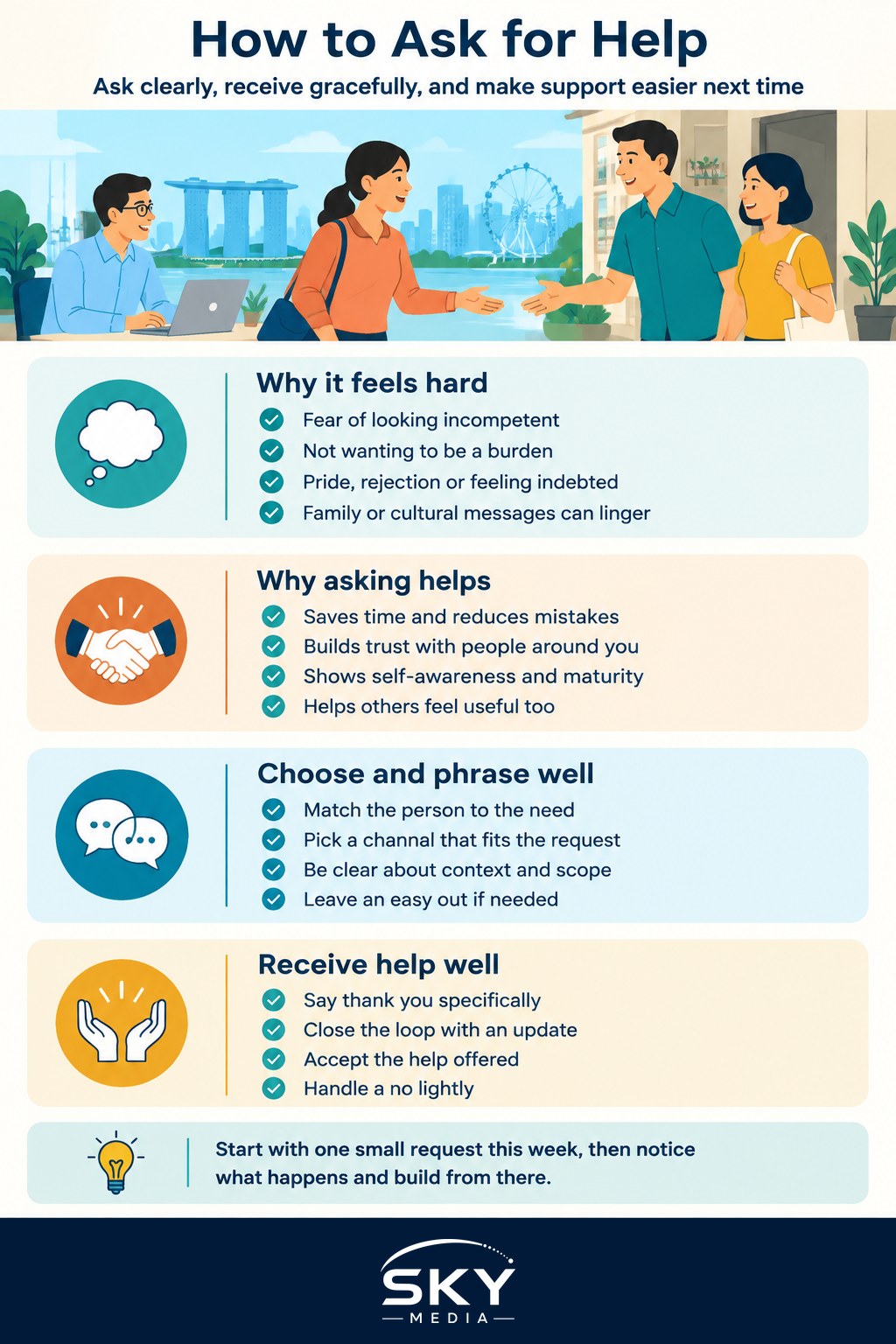
Why Asking for Help Feels So Hard
Understanding the discomfort makes it easier to work around. Common reasons people hold back include:
- Fear of looking incompetent. Especially at work, people worry that a question signals they are not good enough.
- Not wanting to be a burden. Many of us assume others are too busy, or that our need is not important enough.
- Pride and independence. Doing it yourself can feel like part of who you are.
- Fear of rejection. Hearing “no” can feel personal, even when it is not.
- Feeling indebted. Some people worry that accepting help creates an obligation they will have to repay.
- Cultural or family expectations. Messages from childhood, such as “settle it yourself” or “don’t make a fuss”, can linger into adulthood.
Here is a useful counterweight: most people like being asked for help when the request is reasonable and clear. It signals trust and lets them feel useful. Research on helping behaviour has often found that people underestimate how willing others are to help. The discomfort you feel is usually larger than the cost to the other person.
Asking for Help Is a Strength, Not a Weakness
Reframing the request changes how it feels.
- Asking saves time and reduces mistakes. At work, a quick question early is often better than an expensive error later.
- It builds relationships. Small exchanges of help create trust between colleagues, neighbours and friends.
- It shows self-awareness. Knowing the limits of your knowledge or capacity is a mature quality, not a flaw.
- It models healthy behaviour. Parents, managers and team leads who ask for help make it easier for others to do the same.
Confident people are not those who never need help. They are the ones who ask without apologising for existing.
Choosing Who to Ask and When
A well-placed request is far more likely to succeed. Before you ask, think through:
- Who is best placed to help? Match the person to the need. A colleague who knows the system, a friend with a car, a neighbour who has done renovations, a professional for specialised issues.
- What is their capacity right now? Avoid catching someone in the middle of a deadline or a stressful week if the request can wait.
- Which channel suits the request? Quick factual questions work by message. Bigger favours or personal matters are often better in person or on a call.
- Is this a one-off or ongoing? If you will need help regularly, consider spreading requests across several people so no one feels stretched.
Building a wider network makes this easier. If reaching out to new people feels uncomfortable, our guide on how to network without feeling awkward has practical ways to build connections before you need them.
How to Phrase a Clear, Confident Request
Vague requests are harder to say yes to. A clear request respects the other person’s time and makes it easy for them to help. A useful structure is: context, specific ask, scope, and an easy out.
- Context: “I’m setting up the new reporting dashboard and I’m stuck on the data import.”
- Specific ask: “Could you spare 15 minutes to show me how you connected it last time?”
- Scope: “Just the import step, I can handle the rest.”
- Easy out: “If this week is busy, early next week works too.”
The table below shows how small changes in wording affect how a request lands.
| Situation | Less effective | More effective |
|---|---|---|
| Stuck at work | “Sorry to bother you, I’m hopeless at this, can you help?” | “Could you walk me through the import step? I’ve tried the guide and I’m stuck at the mapping stage.” |
| Moving house | “Anyone free to help sometime?” | “Could you help me carry boxes on Saturday morning for about two hours?” |
| Feeling overwhelmed | “I’m fine, just tired.” | “I’ve had a hard few weeks. Could we grab a coffee? I’d like to talk it through.” |
| Learning a new skill | “Teach me everything you know.” | “What’s one resource you’d recommend for a complete beginner?” |
Notice what the more effective versions avoid: excessive apology, self-criticism and vagueness. A brief “thank you” is better than a long “sorry”.
At work, the same principles apply to bigger requests, such as changes to your schedule. Our guide on how to ask for flexible working shows how to structure a formal request.
Receiving Help Gracefully
Asking is only half the skill. How you receive help affects whether people are happy to help again.
- Say thank you specifically. “Thanks, that saved me an afternoon of guesswork” means more than a generic thanks.
- Close the loop. Let the person know how things turned out. People like knowing their help made a difference.
- Accept the help that is offered, even if it is not exactly how you would have done it.
- Reciprocate naturally, not transactionally. You do not need to repay every favour immediately. Being generous with your own time over months and years keeps relationships balanced.
- Handle a “no” lightly. “No problem at all, thanks for letting me know” keeps the door open for next time.
Practising the Skill Step by Step
If asking for help feels daunting, start small and build up.
- Ask for low-stakes help this week. A recommendation, directions or a quick opinion.
- Notice the outcome. Most small requests go better than expected, which gradually rewrites the fear.
- Make one clearer request at work, using the context, ask, scope and easy-out structure.
- Ask someone you trust for emotional support when you need it, even if it is just a conversation.
- Reflect monthly. Which requests felt easy? Which still feel hard, and why?
Sometimes the help you need is beyond what friends or colleagues can offer. If you are feeling persistently low, anxious or unable to cope, reaching out to your doctor, a counsellor or a mental health professional is itself a powerful way of asking for help. Singapore has a range of community and professional support services, and your doctor or a polyclinic can advise on where to start.
Asking for help does not make you weak or needy. It makes you someone who understands that people do better together, and that is a strength worth practising.
Further reading: The Johari Window Explained: Using It to Spot Blind Spots and Ask for Feedback