

There are days when the list is too long, the demands come from every side, and your mind just seizes up. Learning how to deal with overwhelm is not about doing more or moving faster. It is about slowing down enough to think clearly, then taking one honest step at a time. This is general self-help, not medical or psychological advice. If overwhelm is constant, or is affecting your sleep, appetite or ability to cope with daily life, please speak to a doctor or counsellor.
Overwhelm is what happens when the demands you feel are larger than the resources you believe you have. Notice that word, believe. Part of the fix is real, practical off loading. Part of it is seeing the pile more accurately than your panicked mind is showing you.
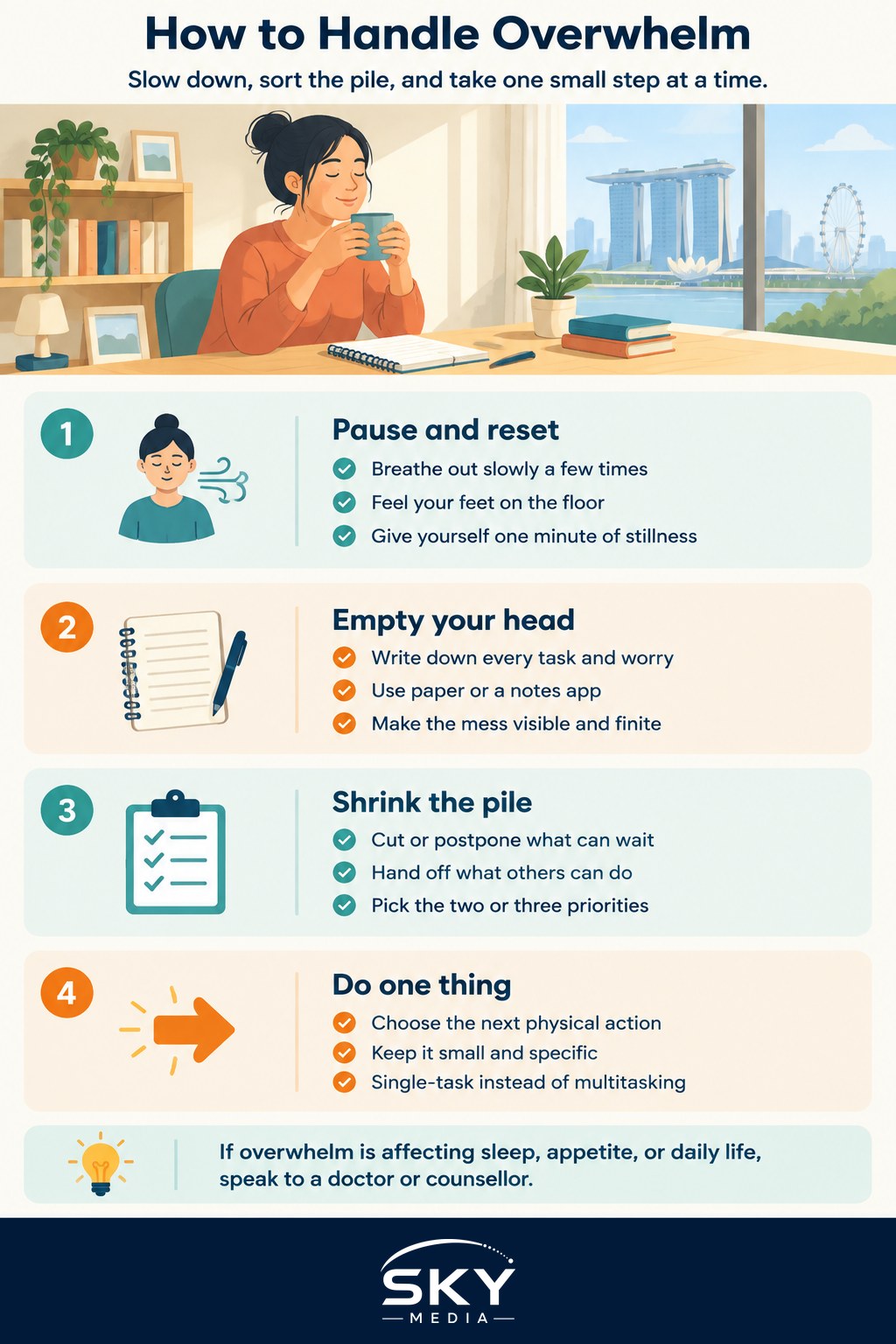
Pause first, because a flooded mind cannot plan
When you are overwhelmed, your body is often in a low grade stress response. Your thinking narrows and everything feels urgent at once. Trying to plan from there is like trying to read in the dark.
So before you touch the to do list, settle the body a little.
- Breathe out slowly a few times, making the exhale longer than the inhale.
- Put both feet flat on the floor and feel the chair holding you.
- Give yourself one honest minute of doing nothing at all.
This is not wasting time. It is the step that makes every other step work.
Empty your head onto paper
Overwhelm feels enormous partly because it is all swirling inside, invisible and uncountable. The moment you write it down, it becomes finite, and finite things can be handled.
Grab paper or a notes app and dump everything out. Every task, worry, errand and half thought. Do not organise yet, just empty. Most people find the list is long but not endless, and seeing its actual edges is a relief in itself. You cannot manage a cloud, but you can manage a list.
Shrink the pile into something doable
Now sort what you dumped. Not everything on that list is yours, and not everything is for today.
- Cut or postpone. What can wait a week? What can you drop entirely with no real harm? Be honest and a little ruthless.
- Hand off. What can someone else do, even imperfectly? Overwhelm loves the belief that only you can do everything.
- Pick the top three. From what remains, choose the two or three things that actually matter today. The rest can queue.
A short list you can finish beats a long list that just haunts you.
Do the next single thing
Overwhelm wants you to look at the whole mountain. The way up a mountain is one step. Choose the very next physical action, make it small, and do only that.
Not “sort out finances” but “open the banking app”. Not “clean the whole flat” but “clear the kitchen counter”. Tiny actions build momentum, and momentum is what melts the frozen feeling. When one small thing is done, the next feels lighter.
Where you can, do one thing at a time. Multitasking feels productive but usually multiplies the sense of overload, because your attention is split and nothing gets finished. Single tasking is calmer and, quietly, faster.
Feeling busy versus being overwhelmed
Busy and overwhelmed are not the same, and telling them apart helps you respond well.
| Feature | Busy | Overwhelmed |
|---|---|---|
| Mind | Focused, engaged | Scattered, frozen |
| Tasks | Moving through them | Circling, not starting |
| Body | Energised | Tense or shut down |
| Sense of control | “I have got this” | “I cannot cope” |
| What helps | Keep going | Stop and reset first |
Busy responds to momentum. Overwhelmed responds to a pause and a reset. Pushing harder when you are overwhelmed usually makes it worse, so read yourself honestly and give yourself what you actually need.
Ask for help sooner than feels comfortable
Many of us treat asking for help as a last resort, something to reach for only when we are completely sunk. Try reaching for it earlier. A colleague, a partner, a friend, a family member. Sometimes help is practical, someone takes a task off you. Sometimes it is just saying out loud, “I am feeling swamped,” and being heard. Both lighten the load.
Asking for help is not weakness. It is one of the most capable, grown up things a person can do.
Small habits that keep overwhelm at bay
- Build in white space. A day packed edge to edge has no room to absorb the unexpected, and the unexpected always comes.
- Learn to say a kind no. Every yes is a claim on your time. Protecting your capacity is protecting your wellbeing.
- Do a weekly reset. Ten minutes to look at the week ahead stops small pile ups from becoming avalanches.
- Rest before you are empty. Rest is not the reward for finishing. It is part of how you keep going.
Being gentle with a stretched self
Overwhelm is not a sign that you are weak or bad at life. It is usually a sign that you are carrying a lot, and that you care, and that you have not yet paused to set some of it down. The way through is steady, not dramatic: pause, empty your head, shrink the pile, do the next small thing, and let people help.
Go easy on yourself. You do not have to carry everything, and you certainly do not have to carry it all at once. If the overwhelm feels relentless, or it is wearing down your health or daily life, please reach out to a doctor or counsellor, and if you need support now you can look up Singapore’s current national mental health helpline. One small step at a time is more than enough.
Explore more: How to Manage Everyday Stress · How to Avoid Burnout · How to Rest Properly
Frequently Asked Questions
How do I cope with overwhelm at work when everything feels urgent? Write down every task, then ask which ones have real deadlines or consequences. Pick the top few for today and let the rest queue. If priorities conflict, ask your manager which matters most rather than guessing. Clear communication prevents silent overload.
How can parents or caregivers deal with overwhelm? Lower the standard for non-essentials, share tasks where possible and accept practical help. Short breaks, regular meals and sleep matter even when time is tight. Speaking to a friend, family member or doctor early is wiser than waiting until you are completely depleted.
How should students handle overwhelm during exams? Break the syllabus into small daily chunks, start with the most pressing topic and take short breaks. Rest and sleep support memory, so cramming through the night rarely helps. Tell a teacher, parent or school counsellor if the pressure becomes too heavy to manage.
What is the difference between overwhelm and burnout? Overwhelm is a short-term feeling of demands exceeding your capacity, and it can ease with a reset and support. Burnout is a longer-term state of exhaustion that builds over time. If you feel drained for weeks, see a doctor or counsellor.
How do I tell my manager that I am overwhelmed? Be factual and specific: list your current tasks and ask which to prioritise, delay or share. Present it as wanting to deliver well rather than complaining. Choose a calm moment, and suggest one or two options so the conversation moves towards a solution.
Further reading: How to Deal With the Sunday Scaries · How to Deal With Disappointment