

“Got boyfriend or not?” “How much are you earning now?” “When are you having a baby?” “Wah, you put on weight ah?” If you are in your twenties or thirties, you have probably heard at least one of these over a plate of pineapple tarts. Awkward questions from relatives at CNY are almost a festive tradition in Singapore, right up there with oranges and red packets.
Most of the time, the aunties and uncles asking these questions mean well. In their generation, asking about marriage, jobs and children was a way of showing interest and care. That does not make the questions any less uncomfortable, especially if you are single by choice, between jobs, struggling with fertility or sensitive about your body. This guide gives you ready-to-use polite scripts for the most common topics, plus ideas for helping your parents set gentle boundaries before the visiting starts.
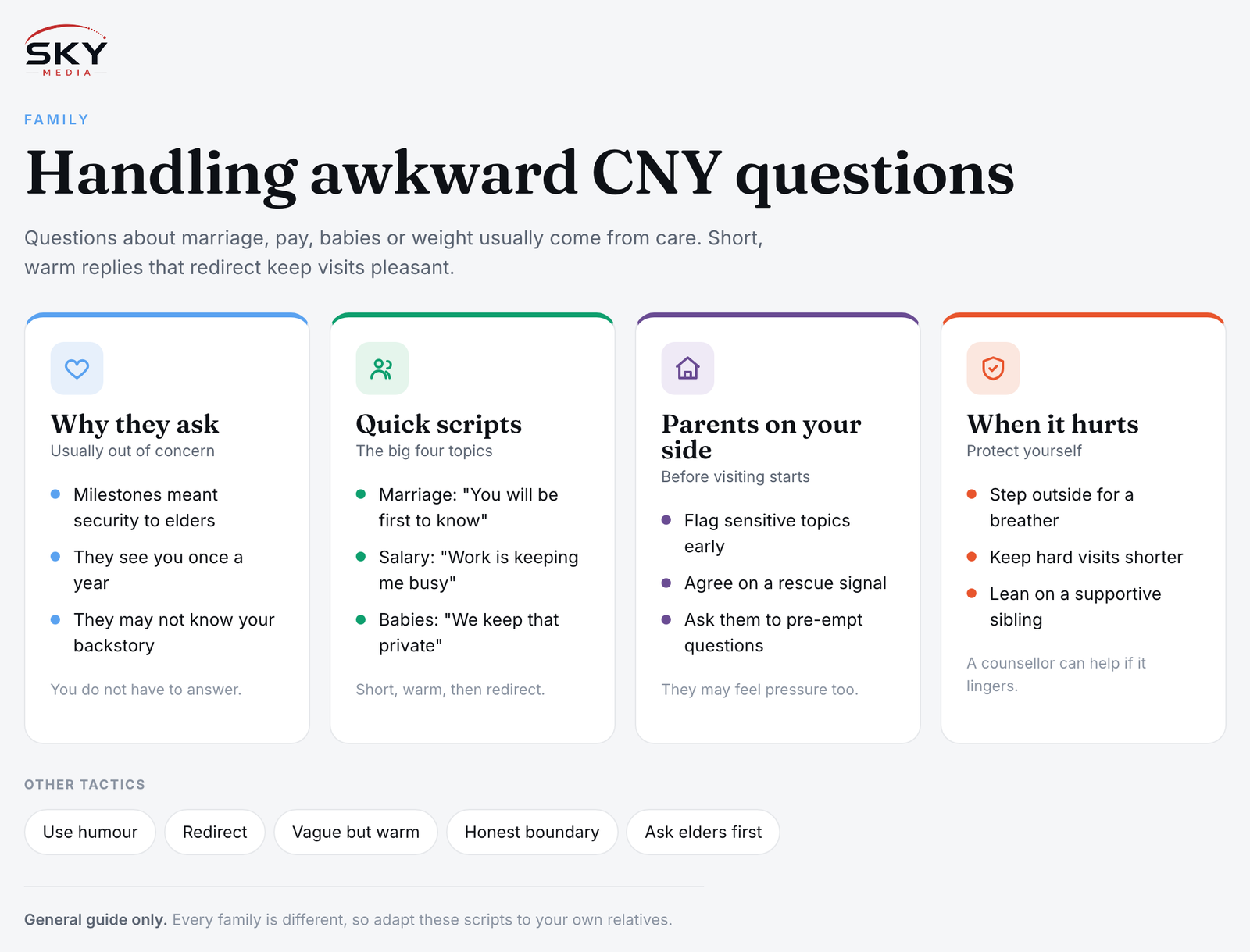
Why the Questions Happen
Understanding the intent can take some of the sting out of it.
- It is how many elders show concern. For older relatives, a stable job, marriage and children were the markers of a secure life. Asking is their way of checking you are okay.
- They see you once a year. With little else to go on, they reach for the big life milestones.
- Comparison is part of the culture. Cousins’ achievements are often shared, sometimes a little too openly.
- They may not know the backstory. An uncle asking about babies probably has no idea about a difficult year you have had.
None of this means you must answer. It simply helps to respond with calm rather than irritation.
Polite Scripts for the Big Four Topics
The best replies are short, warm and redirect the conversation. You do not owe anyone a detailed answer.
Marriage and relationships
- “Still waiting for the right one. Aunty, how did you meet Uncle ah?”
- “When there is news, you will be the first to know.”
- “We are taking our time. How are your grandchildren?”
Salary and career
- “Enough to buy more pineapple tarts! Work is keeping me busy.”
- “I am learning a lot in my role. How is your business doing?”
- If you are between jobs: “I am exploring a few options. I will share when something is confirmed.”
Babies and children
- “Not yet, but thank you for thinking of us.”
- “That is something we keep private, but we are doing well.”
- If you are going through something difficult, it is completely fine to say: “It is a sensitive topic for us, can we talk about something else?”
Weight and appearance
- “Festive season, cannot help it! These love letters are dangerous.”
- “I am feeling good, thank you.”
- A simple smile and “Let me get you some tea” also works.
Choosing Your Approach
Different situations call for different tactics. Here is a quick comparison.
| Approach | What it sounds like | When it works best |
|---|---|---|
| Humour | “Salary? Enough for bak kwa.” | Light-hearted relatives, casual questions |
| Redirect | “Busy with work. How is your garden?” | Repeated or nosy questions you want to move past |
| Vague but warm | “When there is news, I will tell you.” | Marriage and baby questions you prefer not to discuss |
| Honest boundary | “That one is quite personal, I would rather not say.” | Persistent questioning or genuinely painful topics |
| Step away | “Let me help Mum in the kitchen.” | When you feel upset and need a breather |
Helping Your Parents Set Boundaries
Sometimes the most effective step happens before anyone walks through the door. Your parents know their siblings and cousins better than you do, and a quiet word from them can prevent a lot of discomfort.
- Talk to your parents early. A few days before visiting, let them know which topics are sensitive this year. You do not have to explain everything.
- Agree on a rescue signal. A simple phrase like “Ma, the oranges are finished” can be your cue for them to step in or change the subject.
- Ask them to pre-empt. A parent saying “She is doing well at work, very busy” can satisfy curiosity before the questioning starts.
- Be fair to your parents too. They may also feel pressure from relatives comparing children. Reassure them that you are fine, and that a few awkward minutes will not spoil the day.
- Discuss hosting duties. If your family is hosting, keeping guests busy with food, games and activities naturally reduces the room for interrogation.
If your parents themselves are the ones asking, a calm, private conversation after the festive period is usually more productive than a tense exchange at the reunion table.
Handling Comparisons With Cousins
“Your cousin just bought a condo leh.” Comparisons can hurt more than direct questions. A few ways to handle them:
- Celebrate genuinely. “That is great, I must congratulate him.” It takes the edge off immediately.
- Avoid competing. Listing your own achievements tends to prolong the topic.
- Remember your own timeline. Life milestones in Singapore happen at very different ages. Housing, marriage and careers do not follow one schedule.
When It Goes Beyond Awkward
Occasionally, questions cross a line into hurtful remarks, body shaming or pressure that leaves you upset. It is okay to protect yourself.
- Step outside for a few minutes or take a short walk.
- Keep visits to relatives who repeatedly upset you shorter.
- Lean on a supportive sibling, cousin or partner during the visit.
- If family pressure is affecting your mental wellbeing beyond the festive season, consider speaking to a counsellor or a trusted professional.
If you said something you regret in the heat of the moment, our guide on how to recover from a socially awkward moment gracefully has practical tips.
Turning the Conversation Around
The simplest way to survive a long day of visiting is to ask questions first. Elders often love to talk about their own lives, and they are rarely asked. Try:
- “How did you celebrate Chinese New Year when you were young?”
- “What was your first job?”
- “Can you teach me how to make your kueh?”
Knowing what to call each relative helps too. If you mix up your er yi and san gu, our explainer on Chinese kinship terms will set you straight before the visits begin.
You might be surprised by the stories you hear. With a few scripts in your pocket and your parents on your side, CNY visiting can become a time to reconnect rather than something to dread.