

A house backing onto a school or a big open field sounds ideal to many parents. There is no block staring into your living room, the children can walk to class, and the view stays green. For plenty of families it works out well. For others, the reality of a 7am school bell, weekend football and floodlights at night comes as a surprise.
This guide looks at what life is actually like in a home beside a large institutional or open site in Singapore, whether that is an HDB flat facing a school field, a condo unit overlooking a sports ground or a landed house backing onto a campus. It focuses on four things: noise, openness, privacy and how the land next door might change in future.
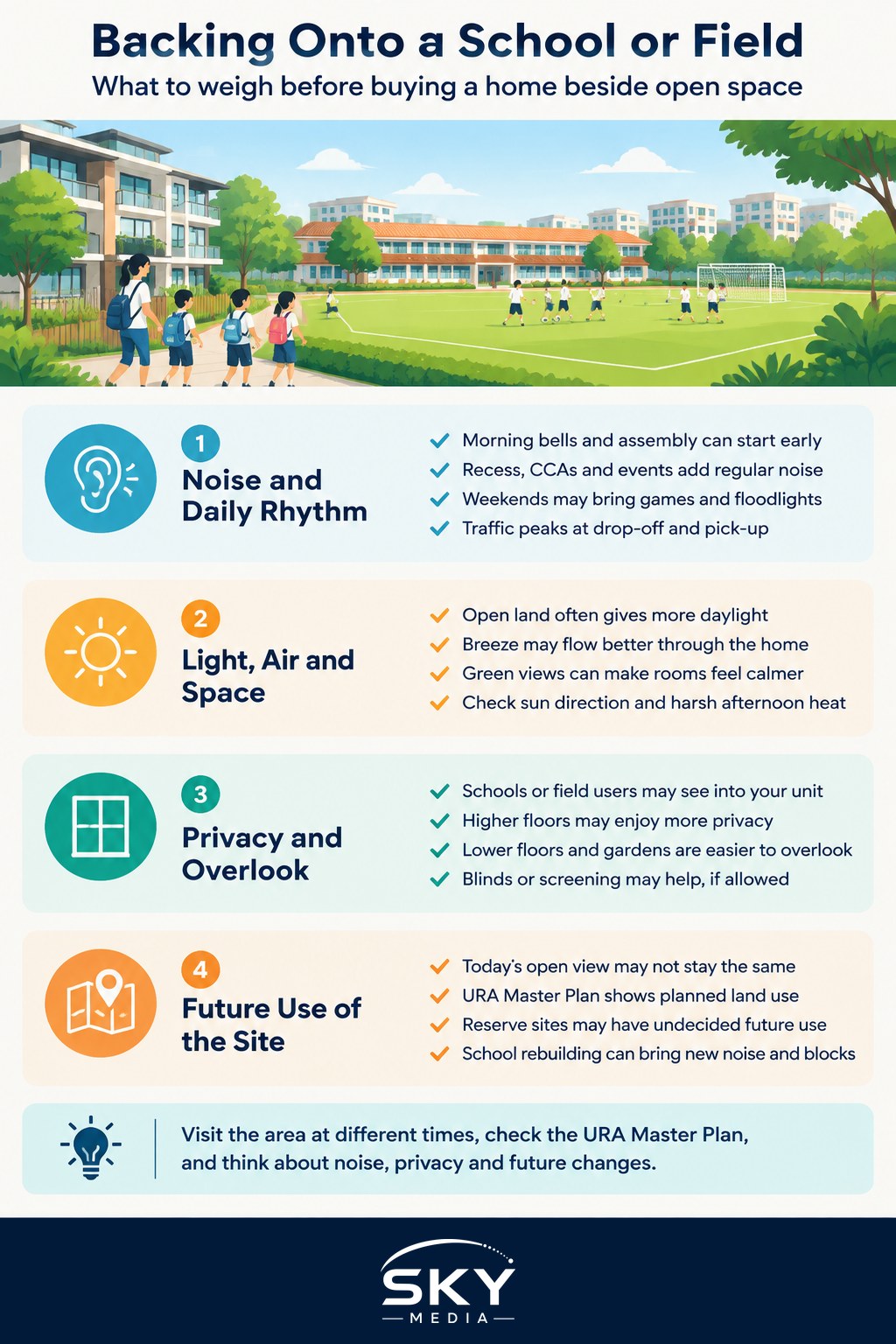
The Noise Pattern Is Predictable, but Not Quiet
Schools and fields make noise on a schedule. That is good news, because you can test it before committing, but it does mean the sound is regular rather than occasional.
Typical sources of noise next to a school include:
- Morning arrival and assembly. Bells, announcements over the public address system and the buzz of hundreds of students, often starting early.
- Recess and physical education. Bursts of shouting and whistles during the school day.
- Co-curricular activities (CCAs). Band practice, drumming, sports training and performances can run into the late afternoon.
- Drop-off and pick-up traffic. School buses, private cars and parents idling along the road, usually twice a day.
- Special events. Sports days, concerts, open houses and celebrations a few times a year.
Open fields and sports grounds have their own rhythm. Evening and weekend games, community events and maintenance such as grass cutting are common. Some fields have floodlights, which can affect bedrooms facing them.
If you work from home or have a baby who naps in the day, the timing matters more than the volume. Think about which rooms face the site and when you will be using them.
Openness, Light and Breeze: The Real Upside
The main reason people seek out a home beside a field or school is the open space. In a dense city, an unblocked outlook is genuinely valuable for daily comfort.
- More daylight. Without a neighbouring block close by, rooms facing the site often get better natural light.
- Better airflow. Open land can let the breeze through, which helps in Singapore’s heat. Check the direction your windows face and whether the afternoon sun will be harsh.
- A sense of space. Green views can make a smaller home feel larger and calmer.
- Easy outdoor time for kids. Depending on access rules, some school fields and community fields can be used outside school hours. Never assume this; check the arrangements with the school or the managing agency.
Weigh the downsides of openness too. Dust from a dry field, insects after rain and stray balls are minor but real. Standing water on any land can attract mosquitoes, and the National Environment Agency (NEA) is the body to approach if you spot a breeding problem nearby.
Privacy: Who Can See In
An open view works both ways. If you can see the school, the school may be able to see you.
- Classroom and corridor sightlines. Multi-storey school blocks may look straight into your windows or garden. Check the height of the buildings and which way the corridors face.
- Spectators and users of the field. People on a running track or at the edge of a pitch may have a view into ground-floor units and landed gardens.
- Upper floors versus lower floors. In an HDB or condo block, a higher unit may look over the school, while a lower unit may be overlooked by it.
Simple fixes like blinds, frosted film, planters or fencing (subject to your town council, MCST or authority rules) can help. MCST stands for Management Corporation Strata Title, the body that runs a condo’s common property, and it usually has by-laws on what you may install.
The table below sets out the main trade-offs side by side.
| Factor | Likely upside | Possible downside | How to check before you commit |
|---|---|---|---|
| Noise | Quiet at night and during school holidays | Bells, PA, CCA practice, traffic peaks | Visit at drop-off, recess, dismissal and on a weekend |
| Openness and light | Unblocked view, daylight, breeze | Harsh afternoon sun, dust, insects | Stand in each room at different times of day |
| Privacy | No neighbouring block close by | Overlooked by classrooms or field users | Look back at your unit from the site |
| Future land use | Site may stay low-rise for years | Zoning or plans can change over time | Check the URA Master Plan and ask the authorities |
| Daily convenience | Short walk to school, outdoor space | Congested road at peak hours | Try the commute at school start time |
Future Use: The Land Next Door Can Change
This is the factor parents most often overlook. An open view today is not a promise for the future. Schools in Singapore have been merged, relocated and rebuilt over the years, and fields can be redeveloped.
Ways to find out more:
- Look up the URA Master Plan. The Urban Redevelopment Authority (URA) publishes the Master Plan, which shows the planned land use and zoning for each plot. You can view it on URA’s online map service. Note the zoning of the site beside the home, such as educational institution, sports and recreation, open space or reserve site. A reserve site generally means its future use has not yet been decided.
- Remember plans are reviewed. The Master Plan is updated periodically, so zoning can change. Treat it as a guide, not a guarantee.
- Watch for school rebuilding. Even if a school stays, it may be upgraded with taller blocks or a new hall, which could change your view and bring construction noise for a period.
- Ask your lawyer or agent. When buying, your conveyancing lawyer can usually make the standard legal requisitions to the relevant authorities. Ask what they cover and whether they will flag road or drainage plans near the property.
If an unblocked view is the main reason you are paying a premium, it is worth spending extra time on this step.
School Proximity and Primary One Registration
Many parents look at homes beside a school because of Primary One (P1) registration. In Singapore, the Ministry of Education (MOE) gives some priority based on how far your home is from the school when a registration phase is oversubscribed. Living close by can help, but it does not guarantee a place, and the rules, phases and distance categories are set by MOE and can change.
A few cautions:
- Check the current P1 registration rules on the MOE website before you buy for this reason.
- MOE uses its own method to measure home-school distance. The closest gate to your door is not necessarily what counts.
- There may be conditions around how long you must live at the address. Confirm these with MOE.
- The school next door may not be the right school for your child. Visit it and look at its programmes and culture.
A Viewing Checklist for Parents
Before you commit to a house backing onto a school or field, run through this list:
- Visit at least three times: early morning on a school day, mid-afternoon, and on a weekend evening.
- Note which rooms face the site, especially bedrooms and any home office.
- Check whether there are floodlights and when they tend to be switched on.
- Talk to neighbours about traffic, events and anything they wish they had known.
- Look up the plot on the URA Master Plan and save a copy of what you see.
- Walk the route to the school gate and observe the drop-off traffic.
- Picture the home during exam season, school holidays and with your child at different ages.
Living beside a school or field can give a family light, space and a short walk to class. Go in with a clear picture of the daily routine next door and the possibility that the site will change, and you will be far less likely to be surprised.
Explore more: Buying a Home Near Good Schools in Singapore · Dealing with Noise and Neighbour Disputes · Questions to Ask at a Property Viewing