

A favourite handbag rarely wears out all at once. Usually it is one part that fails first: a frayed handle, a stuck zip, a sticky lining or edge paint that has started to crack. Bag repair in Singapore is a well-established trade, with cobblers, leather workshops and specialist restorers who can fix these problems for far less than the cost of a new bag. This guide focuses on the most common repairs, what each one involves, and how to choose the right service, so you can keep a good bag going for years.
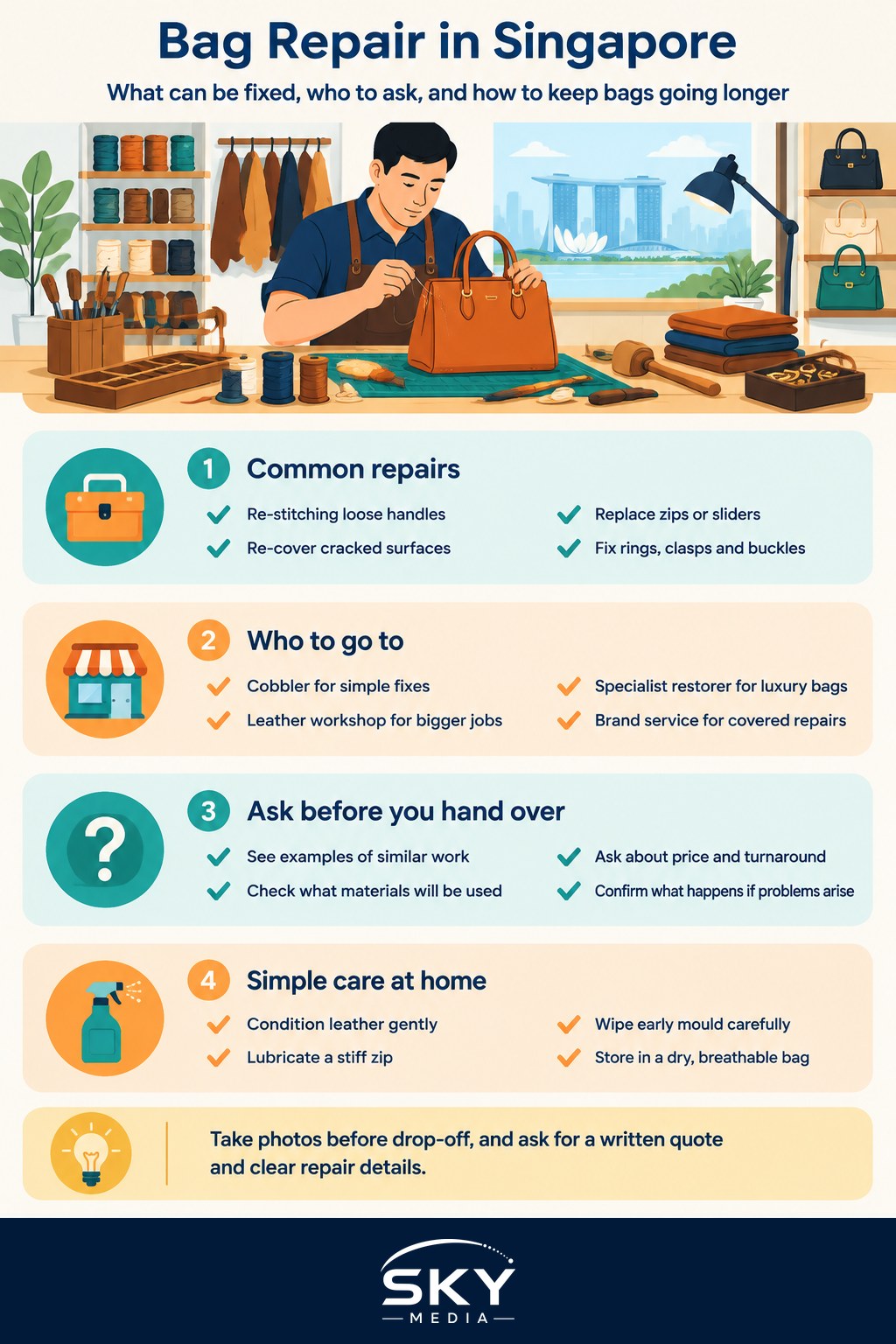
Why Bags Wear Out Faster in Singapore
Our climate is hard on bags. High humidity encourages mould on leather and can make the plastic-coated linings in some bags turn sticky or start to peel. Daily heat, sweat from hands and constant use on public transport add friction to handles and corners. Bags that sit in a cupboard for months can suffer as much as those used daily, because trapped moisture does its damage quietly.
Knowing this helps you spot problems early. Small repairs done promptly are often simpler and cheaper than waiting until a handle snaps or a tear spreads.
Common Repairs and What They Involve
Handles and straps
Handles take the most wear. Repairers typically offer:
- Re-stitching where threads have come loose.
- Re-wrapping or re-covering handles whose surface has cracked or peeled.
- Full replacement of handles or straps, either matched to the original leather or in a new colour.
- Hardware fixes for loose rings, clasps and buckles.
Zips and closures
A broken zip can make a bag unusable. Depending on the problem, a repairer may replace just the slider (the part you pull), or the whole zip. Magnetic snaps, turn locks and press studs can also be replaced. Matching original branded hardware is not always possible, so ask what the replacement will look like.
Linings
Linings tear, stain or, in the case of some synthetic coatings, become sticky with age and humidity. Repairers can clean, patch or fully replace a lining with new fabric. Full replacement involves opening up the bag, so it is more involved.
Edge paint
The coloured coating along the cut edges of leather straps and panels often cracks or peels with use. Edge paint repair involves removing the old coating, sanding and re-applying layers of fresh edge paint, then finishing. Done well, it can make a tired bag look much newer.
Colour and surface restoration
For scuffed corners, faded colour or water marks, restorers may clean, condition and recolour the leather. Results depend on the leather type, so ask to see examples of similar work.
Which Service Suits Which Repair
Different kinds of shops handle different jobs. Use this as a rough guide, and ask each shop what it is comfortable doing.
| Type of service | Suits | Things to ask |
|---|---|---|
| Neighbourhood cobbler or key and shoe repair stall | Simple stitching, slider replacement, minor strap fixes | Whether they work on leather bags, how long it takes |
| Leather workshop or craftsman | Handle replacement, edge paint, lining replacement | Leather matching, examples of past work |
| Specialist bag restorer | Colour restoration, luxury bags, full refurbishment | Turnaround time, written quote, how they treat branded parts |
| Brand boutique or authorised service | Repairs on bags still under brand care policies | Whether repairs are offered, waiting time, cost |
| Repair cafe or community repair event | Simple fixes with guidance, learning to DIY | What volunteers can fix, what to bring |
Our guide to finding a repair cafe or repair service explains how community repair events work and what to expect.
Questions to Ask Before You Hand Over Your Bag
A little clarity up front avoids disappointment later.
- Can you see examples of similar repairs? Photos of past work give you a sense of quality.
- What exactly will be done? Ask for a clear description, especially for colour or edge work.
- Will materials match? Leather, thread colour and hardware may not match the original perfectly.
- What is the price and is it fixed? Get a written quote or receipt that lists the work agreed.
- How long will it take? Turnaround can vary widely by job and shop.
- What happens if something goes wrong? Ask about their policy if you are not satisfied.
- Take photos before drop-off. Record the bag’s condition, including any existing marks, so there is no confusion later.
For high-value bags, note that unauthorised repairs or replacement parts may affect resale value or whether a brand will service it later. If you are thinking of selling, our guide on how to authenticate a preloved luxury bag explains what buyers and resellers often check.
Small Fixes You Can Do Yourself
Not every problem needs a professional. With care, you can try:
- Cleaning and conditioning leather with products suited to the leather type, testing on a hidden spot first.
- Lubricating a stiff zip with a little wax or a zip lubricant.
- Tightening loose screws on hardware with a small screwdriver.
- Wiping away early mould gently, then airing the bag in a dry, shaded place.
Avoid harsh chemicals, heat guns or strong glue on good leather, as these can cause permanent damage. If in doubt, ask a professional.
Caring for Bags to Avoid Repairs
Prevention costs very little:
- Store bags stuffed with tissue or a pillow insert to keep their shape.
- Use breathable dust bags, not plastic, which traps moisture.
- Keep cupboards dry with a dehumidifier or moisture absorbers, which help a lot in Singapore’s humidity.
- Rotate bags so that no single bag takes all the wear.
- Avoid overloading handles and straps.
- Wipe bags after rain and let them dry naturally, away from direct sun.
If you are shopping for a new bag, our article on choosing a work bag that lasts explains which construction details tend to hold up best.
Repair or Replace?
As a rule of thumb, repair makes sense when the bag’s main body is in good condition and you love using it. Replacing a handle, zip or lining can give it years of extra life. If the leather itself is cracking across large areas, or the structure has collapsed, restoration may cost more than the bag is worth to you. Get a quote, consider how much you use the bag, and weigh it against the cost and waste of buying new. Repairing is often the more sustainable choice, and a well-restored bag can carry more character than a new one.