

Walk into any salon in Singapore asking for “something lighter” and you will quickly be asked a follow-up question: balayage or highlights? The two words get used loosely, and plenty of people book one when they actually wanted the other. Understanding balayage vs highlights, plus where ombre fits in, helps you describe what you want, budget for it properly and know how often you will be back in the chair.
This guide focuses on the techniques themselves: how each is applied, how it grows out, what upkeep looks like and what tends to push the price up or down. It is not a guide to colouring at home, which works very differently. If you still need a stylist, start with our guide to finding a good hair salon.
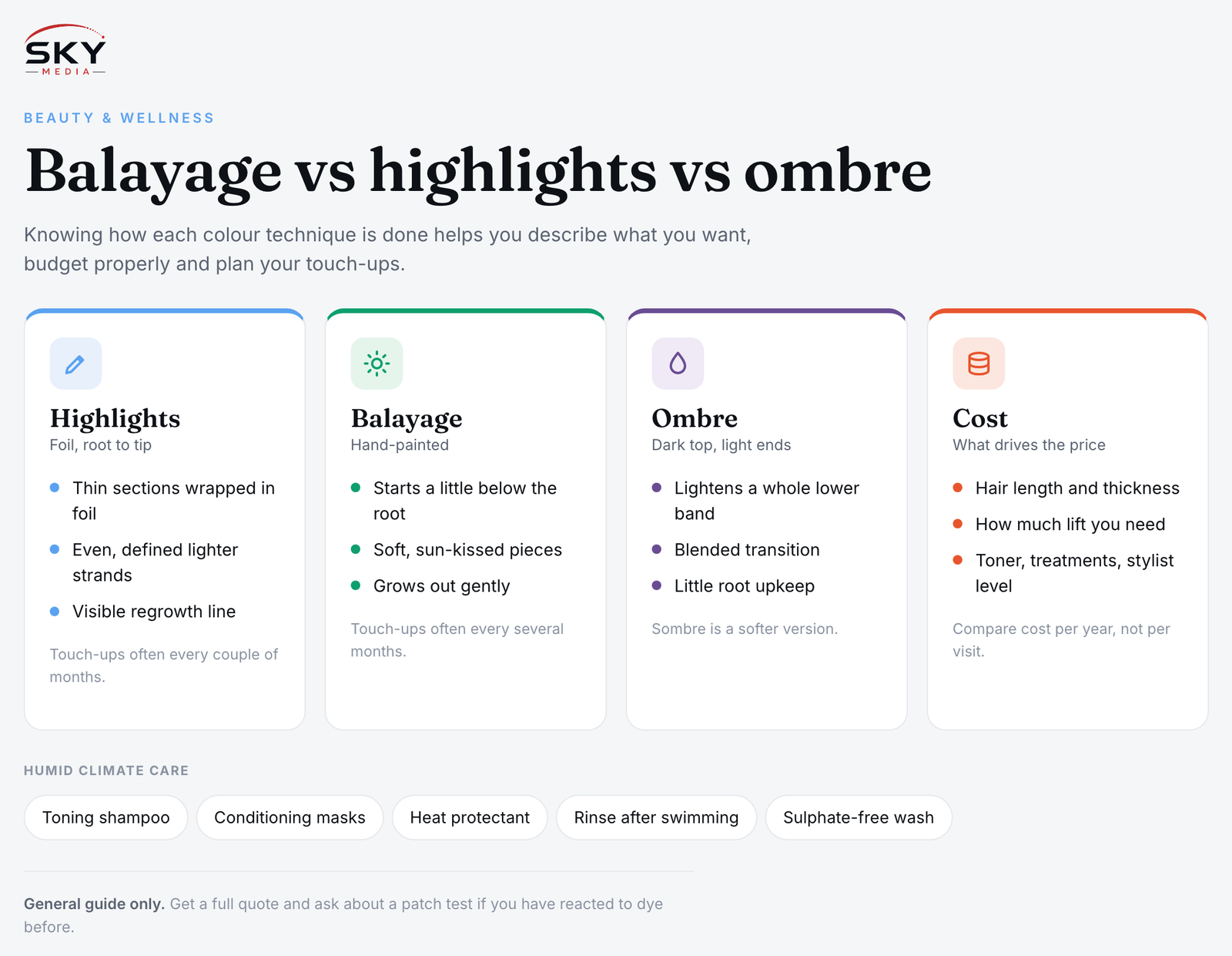
How Each Technique Is Actually Done
The difference starts with the stylist’s hands, not the end colour.
Highlights (foil highlights) are created by weaving or slicing thin sections of hair from the root to the ends, painting lightener over them and wrapping each section in foil. The foil traps heat and keeps the lightener away from the surrounding hair, so the result is precise, even and fairly uniform from root to tip. Very fine versions are often called babylights.
Balayage comes from the French word for “sweeping”. The stylist hand-paints lightener onto the surface of the hair, usually starting a little below the root and getting heavier towards the ends. There is often no foil, or only some, so the lift is softer and less predictable in a deliberate way. The goal is a sun-kissed, lived-in look rather than defined stripes.
Ombre is a gradient. The top section stays close to your natural shade and the lower lengths are lightened, with a blended transition in between. Where balayage scatters pieces of light through the hair, ombre lightens a whole horizontal band. Sombre (soft ombre) is a gentler version with a less obvious line.
Many salons now blend techniques, for example foiling around the face for brightness and hand-painting the rest. So treat these as starting vocabulary, not rigid categories.
Balayage vs Highlights vs Ombre at a Glance
| Factor | Foil highlights | Balayage | Ombre |
|---|---|---|---|
| How it looks | Even, defined lighter strands from root to tip | Soft, irregular, sun-kissed pieces | Dark top, lighter ends, blended band |
| Root regrowth | Visible line as hair grows | Blends in gently | Blends in easily |
| Typical touch-up gap | Shorter, often every couple of months | Longer, often several months | Longer, often several months |
| Best for | Brightness all over, covering some greys, a polished look | Low maintenance, natural movement, waves | Bold contrast with minimal root upkeep |
| Session time | Can be long with many foils | Varies with length and thickness | Varies with how much length is lightened |
Touch-up intervals vary with how fast your hair grows, your base colour and how strong a contrast you chose, so ask your stylist for a realistic schedule.
Upkeep and Grow-Out in a Humid Climate
The biggest practical difference between balayage and highlights is what happens six to ten weeks later.
With foil highlights, the lightened strands begin right at the scalp. As your natural hair grows, a clear band of darker roots appears. Some people like the contrast; most book a regrowth appointment where only the new section is foiled.
Balayage is placed a little away from the root and feathered in, so grow-out is softer. Many people stretch the time between appointments much further, often refreshing with a gloss or toner in between rather than lightening again. Ombre is similar, because the top is meant to look natural.
Singapore’s heat, humidity, sun and swimming habits add a few extra considerations:
- Brassiness. Lightened hair, especially on naturally dark Asian hair, tends to turn warm or orange over time. Sun, chlorine and hard washing speed this up. A purple or blue toning shampoo used occasionally and a salon toner refresh help keep the shade cool if that is what you want.
- Dryness and frizz. Lightener opens the hair cuticle. In humidity, that can mean extra frizz. Regular conditioning masks and a leave-in product with heat protection make a visible difference.
- Swimming. Wetting hair with clean water and applying conditioner before a pool session reduces how much chlorinated water it soaks up. Rinse afterwards.
- Washing frequency. Daily washing is common here because of sweat. A gentle, sulphate-free shampoo for colour-treated hair helps the tone last longer.
What Drives the Cost at a Salon
Salons set their own prices, and they vary a lot between a neighbourhood shop and a premium salon in town, so do not rely on any single figure you see online. Instead, understand what pushes the quote up:
- Hair length and thickness. More hair means more product and more time.
- How much lift you need. Going from very dark hair to a pale, cool blonde often takes more than one session, plus a toner each time.
- Number of foils or sections. Dense, fine highlights take longer than a few chunky pieces.
- Bond-protecting treatments. Many salons offer additives that help protect hair during lightening, usually priced as an add-on.
- Toner and gloss. Often charged separately from the lightening itself.
- The stylist’s level. Senior or director-level stylists commonly charge more.
When you compare costs, think per year rather than per visit. Highlights may be cheaper for a single appointment but need more regrowth sessions. Balayage can cost more upfront and less over twelve months if you only refresh it a few times. Ask the salon for a full quote, including toner and treatment, before they start.
Which Technique Suits You?
There is no universally better option, only a better fit for your hair, lifestyle and budget.
Consider foil highlights if you:
– Want brightness that starts at the root and looks polished
– Have some greys you would like to soften
– Do not mind regular appointments
– Prefer a predictable, uniform result
Consider balayage if you:
– Want low-maintenance colour that grows out gracefully
– Have wavy or layered hair that shows off hand-painted pieces
– Want to try lighter hair without committing to frequent visits
– Like a natural, lived-in effect
Consider ombre if you:
– Want an obvious, fashion-forward contrast
– Are happy for the colour to sit mostly in the lengths
– Plan to cut the ends off later and return to your natural colour
If you have very short hair, balayage and ombre have less length to work with, so highlights or babylights are often more practical. If your hair is fine or already damaged, ask whether the stylist recommends a gentler approach or a strand test first.
Questions to Ask at Your Consultation
A good consultation saves you from disappointment. Bring photos of colours you like and, just as usefully, colours you do not. Then ask:
- Is this result achievable in one session on my hair, or will it take two or more?
- Which technique do you suggest, and why?
- How often will I need a touch-up, and what does a touch-up involve?
- What will the total cost be, including toner and any treatment?
- Which aftercare products do you recommend for my shade?
Lighteners and many permanent dyes contain chemicals that can irritate the scalp or trigger allergies. If you have reacted to hair dye before, tell the stylist and ask about a patch test well before the appointment. Our guide to hair dye allergy and PPD explains the warning signs and when to stop and see a doctor.
Making Your Colour Last Longer
Whichever you choose, a few habits stretch the life of your colour:
- Wait a day or two before the first wash after colouring, if your stylist advises it.
- Use lukewarm rather than hot water.
- Wear a hat or use a UV-protecting hair spray for long days outdoors.
- Keep heat styling moderate and always use a heat protectant.
- Book a gloss or toner between lightening sessions to keep the tone fresh.
Balayage vs highlights is ultimately a choice between soft, low-upkeep movement and crisp, root-to-tip brightness. Know which look you want, how often you are willing to return and what the full cost includes, and you will walk out with colour that suits you for months, not just for the photo.
Further reading: Hair Spa in Singapore: What It Is and Who It Helps · Covering and Embracing Grey Hair