

If you have shopped for a car recently, you may have seen offers promising surprisingly low monthly payments. Often these are balloon financing car singapore dealers promote, or lease-to-own arrangements dressed up as an easy path to a nicer car. These schemes can genuinely suit some buyers, but the low monthly figure only tells part of the story. This article explains how they work and what to watch for, so you can look past the headline number. It is general information rather than financial advice, so the terms of your specific contract and a conversation with the provider are what really matter.
What balloon financing actually is
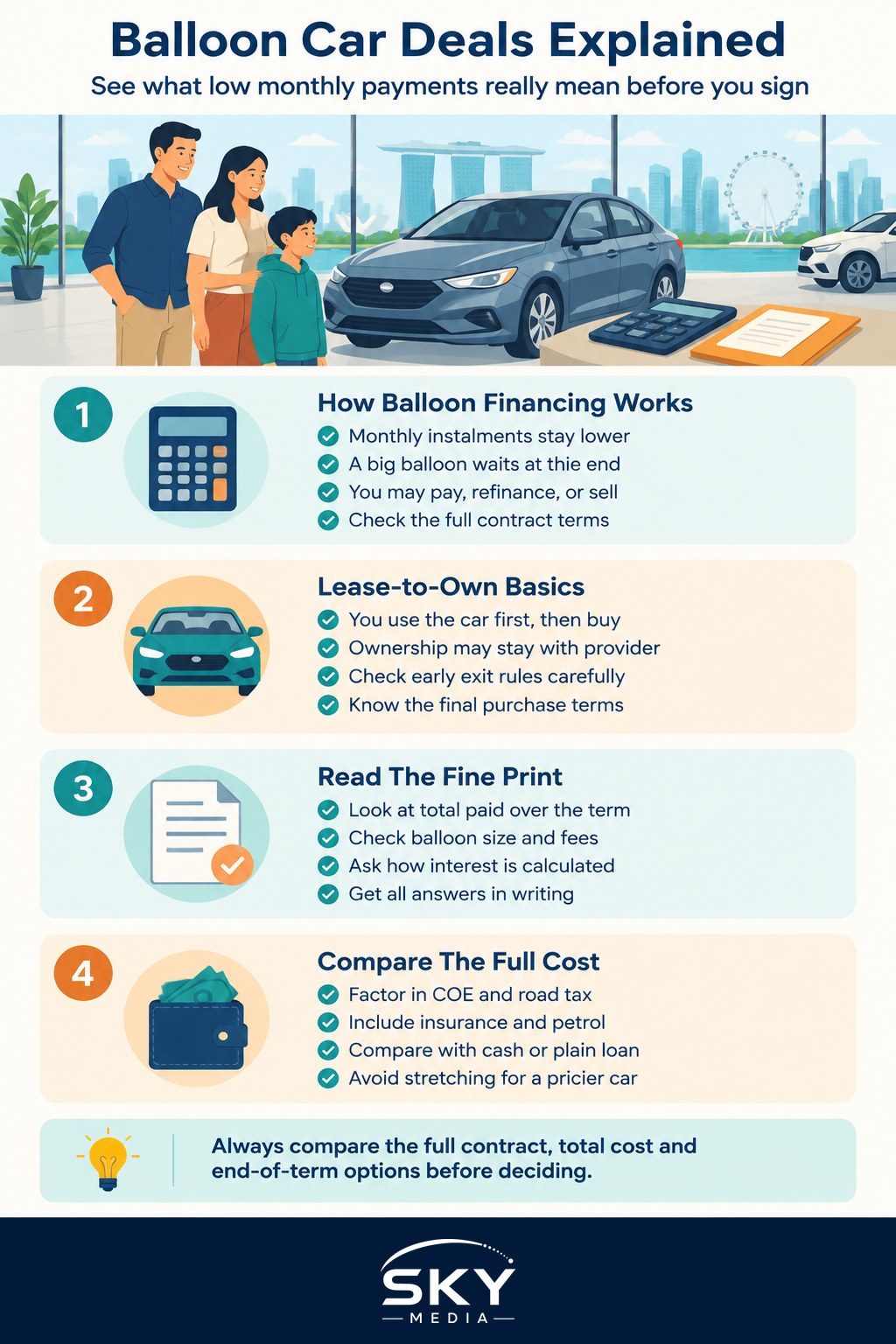
In a conventional car loan, your monthly instalments gradually pay down the full amount you borrowed, so by the end you owe nothing. Balloon financing works differently. A large portion of the car’s value is deferred to the end of the term as a single big final payment, the balloon. Because you are not paying down that deferred chunk each month, your monthly instalments are lower than they would be with a standard loan.
That lower monthly figure is the selling point, and it is why these plans look attractive. But the balloon does not disappear. At the end of the term you face a choice: pay the large final sum to keep the car, refinance that amount into a new loan, or hand the car back or sell it to settle the balloon. Each path has consequences, and the details depend entirely on the contract you sign.
Lease-to-own and similar arrangements
Lease-to-own schemes share a family resemblance. Rather than owning the car from the start, you effectively pay to use it over a period, with an option or an obligation to buy it at the end. The monthly cost may be manageable, but you need to be crystal clear on who owns the car during the lease, what happens if you want to exit early, and what the final purchase involves.
The common thread across balloon and lease-to-own plans is that a low monthly payment can mask a higher total cost or a large obligation waiting at the finish line. There is nothing inherently wrong with these products, but they demand more scrutiny than a plain loan, not less.
Read the contract, then read it again
The single most important step is to read the actual contract in full before you sign anything. Marketing brochures and salesperson summaries are not the agreement. Look specifically for the total amount you will pay over the whole term, the size of the final balloon payment, any fees for early termination, the interest rate and how it is calculated, and exactly what your options are at the end.
Ask direct questions and get the answers in writing. What happens if the car is worth less than the balloon at the end? Can you settle early, and at what cost? What are your obligations if your circumstances change? The specific rates, fees and terms vary by provider and can change, so rely on the current figures from the bank, finance company or dealer offering the plan rather than any example you saw online.
Frame it around total cost of ownership
As with any car purchase, the wise move is to step back from the monthly figure and look at the total cost of ownership. A car in Singapore keeps costing money through COE, road tax, insurance, petrol, parking and servicing, and financing is only one part of the bill. Our guide to the cost of owning a car puts these in perspective, and it is worth comparing any balloon or lease deal against a straightforward loan or paying cash. Our overviews of car loans in Singapore and the trade-offs in car loan versus paying cash give you the baselines to measure against.
A useful sanity check is to ask whether the scheme is helping you afford a sensible car more comfortably, or tempting you into a more expensive car than you would otherwise buy. The former can be reasonable. The latter is how people end up stretched.
Making a confident choice
Balloon financing and lease-to-own plans are tools, and like any tool they suit some jobs and not others. If the lower monthly payment genuinely fits your budget, you understand the balloon or final purchase clearly, and the total cost stacks up against the alternatives, one of these plans may work for you. If the final payment worries you or the contract is hard to follow, that is a strong signal to slow down.
Take your time, compare offers, and never sign under pressure on the showroom floor. If the terms confuse you, ask the provider to explain them plainly or seek advice from a qualified professional. A car should be a source of freedom, not a financial surprise waiting at the end of the term.
Frequently Asked Questions
What if my car is worth less than the balloon payment at the end? You would have to cover the shortfall, which is the main risk of these plans. Ask the provider before signing exactly what happens in that situation, and get the answer in writing. A balloon sum that outpaces the car’s value can leave you paying for a car you no longer own.
Is balloon financing the same as a normal car loan? No. A normal loan pays down the whole amount by the end of the term, while balloon financing defers a large part into one final payment. That is why monthly instalments look lower, though the total you owe in the end does not simply vanish.
Who owns the car under a lease-to-own plan? This varies by contract, so read it closely. Under some arrangements the provider stays the owner until you complete the final purchase. Make sure the document states ownership during the term, what the purchase at the end involves, and what happens if you stop paying.
Can I exit a balloon financing plan early? Possibly, but early exit may involve charges, and the amount to settle can be higher than you expect. Ask the provider for the full settlement figure in writing and read the early termination clause. Compare it with how your car would sell on the open market.
Who should avoid balloon financing or lease-to-own deals? Anyone who would struggle with the large final payment, or who is stretching to afford a pricier car, should be cautious. If the contract is hard to follow, slow down. A plain loan or a cheaper car may be easier to live with.
Official sources: OneMotoring