

If you have shopped for a new car lately, a salesperson may have offered you a guaranteed buyback car singapore package as a headline feature. The pitch sounds reassuring: drive the car for a fixed number of years, then hand it back to the dealer or finance company for a price that is agreed today. It can make monthly payments feel lower and take some worry out of resale. But like any car deal, the details in the contract are what really matter, so it pays to understand how these schemes work before you commit.
This is general information to help you ask better questions. It is not financial advice, and the exact terms, figures, and eligibility come from the dealer, the bank, and the paperwork you actually sign.
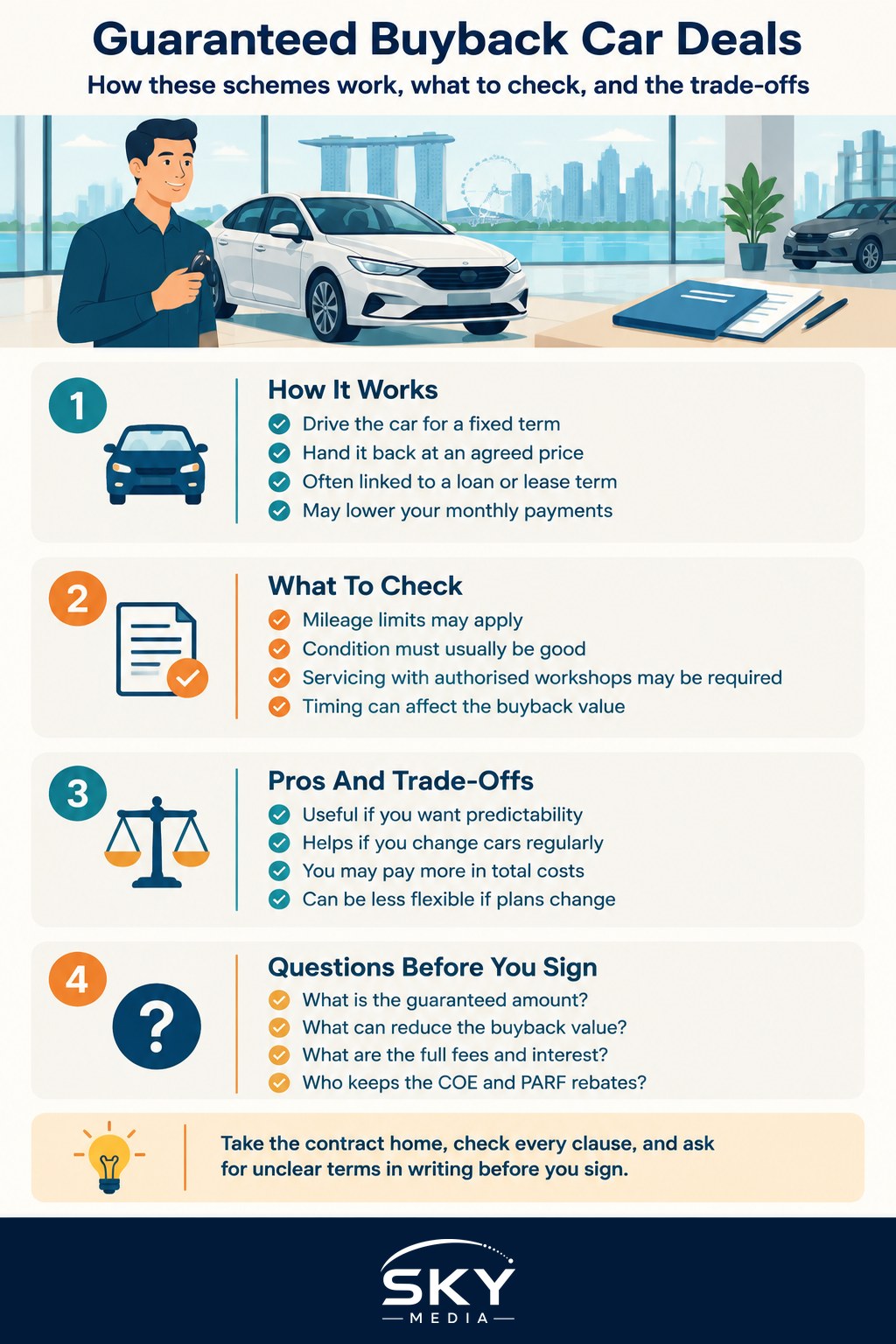
How a guaranteed buyback scheme works
The basic idea is simple. When you buy the car, the seller promises to buy it back from you at a pre-agreed amount after a set period, often at the end of a loan or lease term. Because part of the car’s future value is guaranteed, some schemes structure your instalments so you are effectively only financing the portion you use up during ownership, which can lower the monthly figure compared with a standard loan.
You will see this idea packaged under several names. Some are tied to balloon-style financing, where a large final amount is settled at the end. Others sit closer to a subscription or lease-to-own arrangement. The mechanics differ, so read the agreement rather than the brochure, and if you are weighing your options it helps to compare against a plain car loan versus paying cash approach and to understand the basics of car loans in singapore first.
What the contract actually covers
The buyback price is only as good as the conditions attached to it. Before you sign, look carefully at what could reduce or void the guaranteed amount. Common conditions include:
- Mileage limits. Many schemes cap the kilometres you can drive. Go over, and the buyback figure may drop or per-kilometre charges may apply.
- Condition standards. The car usually has to be returned in good order. Excess wear, accident repairs, or missing service records can trigger deductions.
- Servicing requirements. You may need to service the car with authorised workshops on a set schedule to keep the guarantee valid.
- Timing. The buyback often applies only within a specific window. Handing back early or late can change the terms.
- What happens to the COE and rebates. Understand who benefits from any PARF or COE rebate at the end. Reading up on understanding parf and coe rebates will help you see where the value goes.
Ask for every figure and condition in writing. If a number is quoted verbally but not in the contract, treat it as if it does not exist.
Weighing the pros and cons
A guaranteed buyback can suit drivers who like predictability, plan to change cars on a regular cycle, and do not drive extreme distances. Knowing the exit value in advance removes some of the guesswork around car depreciation explained and resale timing.
The trade-offs are real, though. The guaranteed amount is set to protect the seller, so it may be conservative compared with what you might get selling the car yourself in a strong market. You may pay more in total interest or fees over the term. Mileage and condition rules can limit how you use the car. And if your plans change, exiting the scheme early may be costly.
Compare the whole cost, not just the monthly instalment. Add up what you pay over the full term, factor in the buyback amount, and set it against simply buying, running, and later selling or scrapping the car on your own. If the maths is close, the flexibility of a normal purchase may be worth more than a fixed exit price.
Questions to ask before you sign
- What is the guaranteed buyback amount, and is it fixed or a range?
- What conditions could reduce it, and by how much?
- What is the total cost over the full term, including all fees and interest?
- What are the mileage limits and the charges for exceeding them?
- Can I exit early, and what would that cost?
- Who keeps the COE and PARF rebate value at the end?
The practical takeaway
A guaranteed buyback car singapore scheme is not automatically good or bad. It is a financing structure that trades some flexibility and possibly some total cost for a known exit value and, often, a lower monthly payment. That can be genuinely useful for the right driver, and a poor fit for someone who drives a lot or likes to sell on their own terms.
Take the contract home, read every clause, and if a term is unclear, ask the dealer or bank to explain it in writing. Where large sums are involved, consider getting independent advice. The safest deal is always the one you fully understand before you sign.
Frequently Asked Questions
Is guaranteed buyback better than just selling the car myself later? Not necessarily. The guaranteed figure is set to protect the seller, so it can be lower than what you might get in a strong resale market. What you gain is certainty. Compare the total cost of the scheme with buying, running and selling independently.
What happens if I exceed the mileage limit on a buyback scheme? The buyback amount may be reduced, or per-kilometre charges may apply. The exact penalty is written in your contract, so check the cap and the charge before signing. If you drive a lot, a scheme with a mileage limit may be a poor fit.
Do I still have to service my car at the dealer under a buyback? Often yes. Many schemes require servicing at authorised workshops on a set schedule to keep the guarantee valid, and missing service records can trigger deductions. Confirm the servicing conditions in the agreement and keep every receipt.
Who gets the PARF or COE rebate value when the car is bought back? It depends on the contract, so ask for this to be spelled out in writing. Some buyers assume the rebate is theirs, but the buyback price may already account for it. Reading up on how PARF and COE rebates work helps you spot where the value goes.
Can I get out of a buyback scheme early if my plans change? Possibly, but exiting early may be costly, and the guaranteed price often applies only within a specific window. Ask the dealer or bank what the early exit would cost and how it is calculated, and get the answer in writing before you commit.
Official sources: OneMotoring
Further reading: Balloon Financing and Lease-to-Own Cars in Singapore