

When a family member passes away, money questions arrive quickly. Who can pay the funeral bill? Will the household account still work? What happens to savings held in their name? Understanding what happens to a bank account after death in Singapore helps families avoid surprises and deal with banks calmly during a difficult time. This guide explains how sole and joint accounts are treated, why accounts are frozen, and what documents banks usually ask for. It is general information, not legal or financial advice, and each bank’s procedures differ.
First, Notifying the Bank
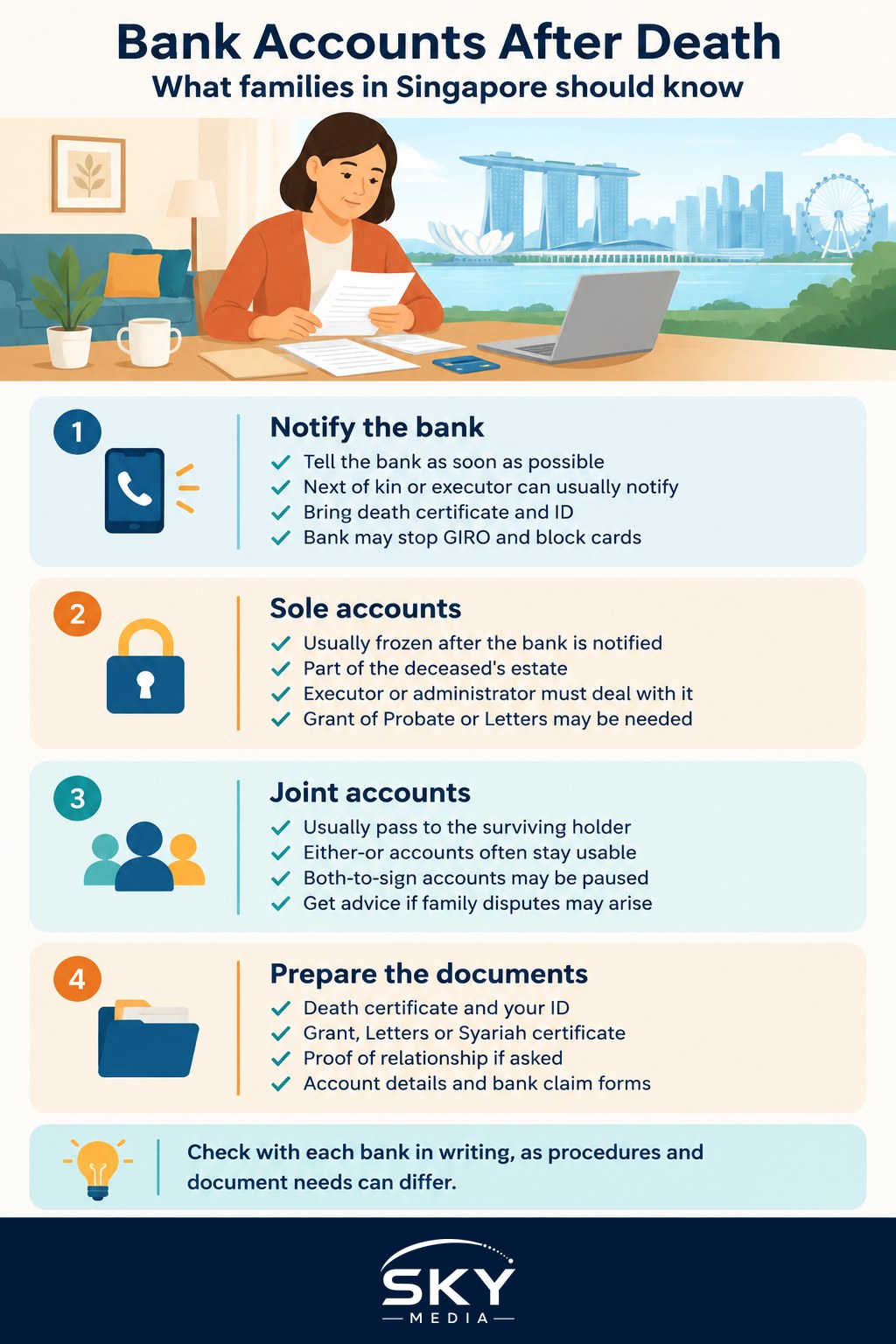
Banks act once they are told about a death. Notification is usually done by the next of kin, an executor named in the will, or a family member, by visiting a branch or using the bank’s bereavement service channel. Many banks have a dedicated team or online form for this.
When notifying, you will typically be asked for:
- The death certificate. In Singapore, death registration is done digitally, and the next of kin can download the digital death certificate through the My Legacy portal.
- The deceased’s NRIC or passport details and account information, if you have it.
- Your own identification and your relationship to the deceased.
Once the bank is notified, it will usually stop standing instructions such as GIRO, block cards and restrict access to the deceased’s accounts. If you are unsure which banks the person used, look through letters, statements, banking apps and their tax or investment records. Our guide on what to do in the first days after a death covers the wider checklist.
Sole Accounts: Frozen Until the Estate Is Administered
An account held in the deceased’s sole name becomes part of their estate. The bank freezes it to protect the money until someone with legal authority is appointed to deal with the estate. Nobody, including a spouse or child, can simply withdraw from it, even if they know the PIN. Using the deceased’s cards or online banking after death is not appropriate and can create legal problems.
To release the funds, the bank generally needs proof of who is entitled to deal with the estate:
- If there is a will: the executor applies for a Grant of Probate.
- If there is no will: an eligible family member applies for Letters of Administration, and the estate is distributed under the Intestate Succession Act.
- For Muslim estates: distribution follows the Administration of Muslim Law Act, and an inheritance certificate from the Syariah Court is usually part of the process, alongside the grant.
Applications are made to the Family Justice Courts. Smaller estates may be handled through the Public Trustee’s Office, which has its own eligibility criteria. Check the Family Justice Courts and Public Trustee websites for current requirements and fees, as these can change.
Some banks have internal policies to release small balances, or pay funeral expenses directly, without a full grant, subject to their own limits and documents. Ask the bank what it can do; do not assume it applies.
Joint Accounts: Usually Passed to the Survivor
Joint accounts work differently. Most joint accounts in Singapore are opened on a basis where the surviving holder takes over the balance when one holder dies. In practice:
- “Either-or” accounts (either holder can operate): the bank typically lets the survivor continue using the account after receiving the death certificate, and removes the deceased’s name.
- “Both-to-sign” accounts (both must sign): the bank may restrict operations until it has updated the account mandate. The survivor usually needs to present documents before transactions resume.
There is an important legal nuance. Even if the bank releases money to the survivor, other family members can sometimes argue that part of the money belonged to the deceased’s estate, for example where one person put in all the funds and the other was added only for convenience. If there is any likelihood of a dispute, get legal advice. Our explainer on joint bank accounts covers how these accounts are set up.
Sole vs Joint: A Side-by-Side View
| Situation | What usually happens | What the bank typically needs |
|---|---|---|
| Sole account, with a will | Frozen until the executor obtains probate | Death certificate, Grant of Probate, executor’s ID |
| Sole account, no will | Frozen until an administrator is appointed | Death certificate, Letters of Administration, administrator’s ID |
| Joint “either-or” account | Survivor usually continues to operate it | Death certificate, survivor’s ID |
| Joint “both-to-sign” account | Operations may be paused until the mandate is updated | Death certificate, survivor’s ID, bank forms |
| Fixed deposits, investments or safe deposit box in sole name | Treated as part of the estate | As for sole accounts; safe deposit box access may need the grant |
Because procedures vary between banks, ask each one for its own checklist in writing.
Documents Banks Commonly Ask For
Prepare a folder, with copies, before visiting branches:
- Death certificate.
- Your NRIC or passport.
- Grant of Probate or Letters of Administration, when obtained. Banks usually want to see the original or a certified extract.
- For Muslim estates, the Syariah Court inheritance certificate.
- Proof of relationship, such as a marriage or birth certificate, if the bank requests it.
- Account details, statements or passbooks for each account.
- Bank-specific claim forms, filled in and signed by the executor or administrator.
The bank will then close the accounts and pay the balance to the estate or as directed by the executor or administrator, who distributes it to beneficiaries. Interest, fees and any outstanding loans or credit card debts are settled from the estate first.
Debts, Bills and Loans Linked to the Accounts
- Credit cards and personal loans in the deceased’s sole name are generally claims against the estate, not automatically the family’s personal debts. Supplementary cardholders should stop using the cards.
- Joint loans remain the responsibility of the surviving borrower.
- Mortgages are tied to the property and any insurance. Our guide on what happens to an HDB flat after death explains property issues.
- GIRO bills for utilities, telco and insurance will stop once the account is frozen, so move them to another account to avoid disconnection.
CPF savings and insurance payouts follow separate rules from bank accounts, including CPF nominations. See our guide to claiming CPF and insurance after a death.
Planning Ahead to Make It Easier
You cannot avoid bank processes entirely, but you can make them smoother for your family:
- Write a will and name an executor you trust.
- Keep a list of accounts, banks and policies, stored securely with someone you trust.
- Consider a Lasting Power of Attorney for decisions while you are alive but lose mental capacity. Note that it ends on death and does not replace a will.
- Think carefully before opening joint accounts for convenience, and record your intentions clearly.
A little preparation saves families weeks of paperwork when they are least able to handle it.
Further reading: What Happens to a Person’s Debts When They Die in Singapore