

When a loved one passes away, letters from banks and card companies can start arriving within weeks. Many families worry that they now owe that money themselves. In most cases they do not. Understanding how debts after death in Singapore are handled can take a lot of fear out of an already difficult time.
This guide explains how a person’s estate deals with credit cards, personal loans, car loans and mortgages, when a family member can actually be liable, and what assets are usually kept outside the estate. It is general information, not legal or financial advice. Estates can be complicated, so speak to a lawyer, the Public Trustee’s Office or the relevant bank about your specific situation.
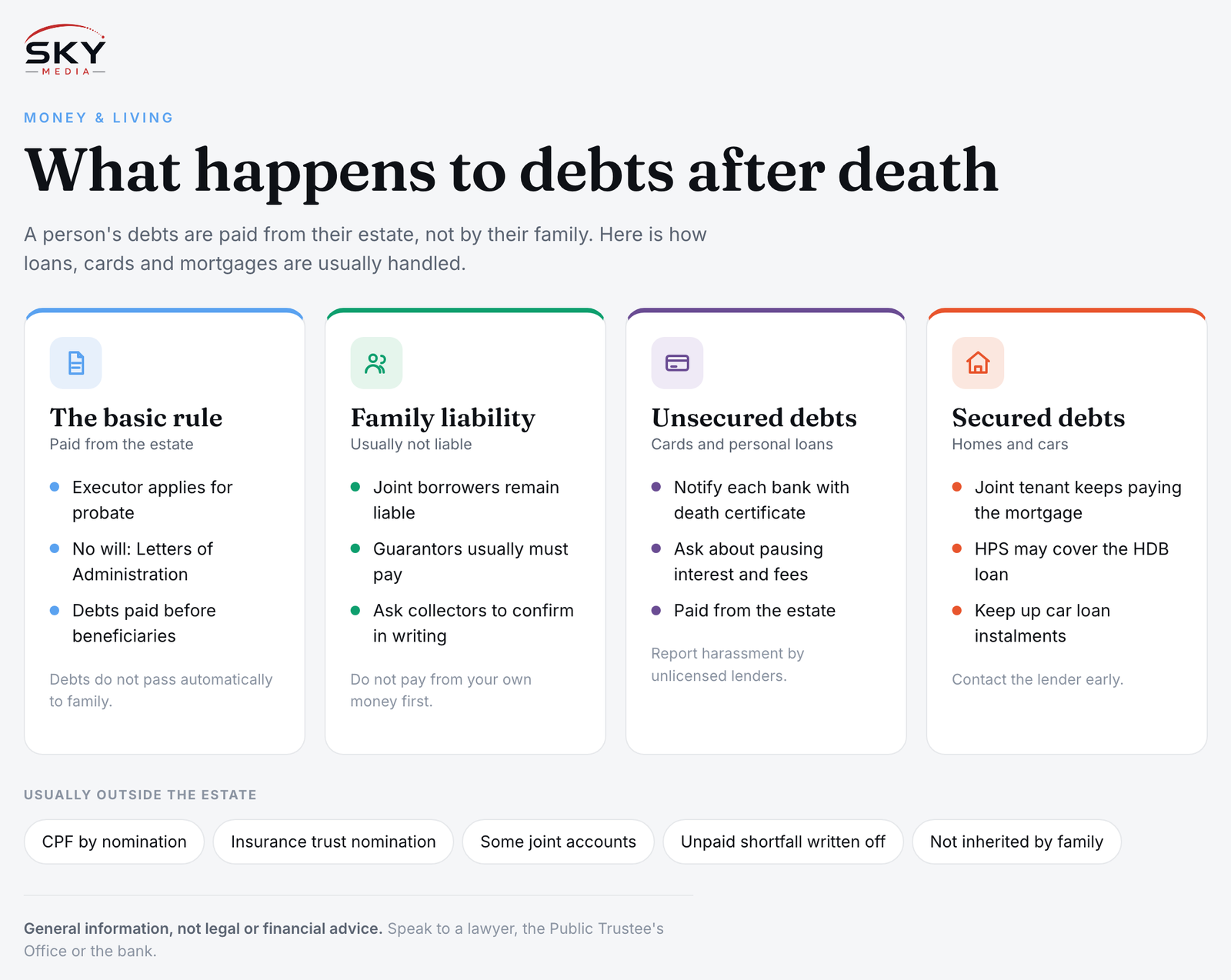
The Basic Rule: Debts Are Paid From the Estate
When someone dies, their debts do not disappear, but they also do not pass automatically to their spouse, children or parents. Instead, the debts are paid from the estate, which is everything the person owned in their sole name: bank balances, investments, a share of property, a car, valuables and money owed to them.
The person in charge of the estate is the personal representative:
- An executor if the person left a will naming one. The executor applies to the Family Justice Courts for a Grant of Probate.
- An administrator if there is no will. A family member usually applies for Letters of Administration.
- For some smaller estates without a will, the Public Trustee’s Office may handle the administration. Check its website for the current criteria.
The personal representative collects the assets, pays the debts and expenses, and only then distributes what is left to beneficiaries under the will or, without a will, under the Intestate Succession Act. Beneficiaries receive their share only after valid debts are dealt with.
Is the Family Personally Liable?
Generally, no. Family members are not responsible for a relative’s debts just because they are related. However, a person can be liable in their own right in certain situations:
| Situation | Is the family member personally liable? | Why |
|---|---|---|
| The deceased had a credit card or personal loan in their sole name | Usually no | The debt belongs to the estate |
| You were a joint borrower on a loan | Usually yes | You signed as a borrower and remain responsible |
| You signed as a guarantor | Usually yes | A guarantee is your own promise to pay if the borrower does not |
| You held a supplementary card on their account | Usually no for the principal’s balance | Supplementary cards are normally cancelled; check the card terms on any spending after death |
| You co-own a property with an outstanding mortgage | The mortgage still needs to be paid | The loan is secured on the property, and lenders can act on it |
| The estate does not have enough money | Usually no | Unpaid unsecured debts are generally written off once the estate is exhausted |
If a debt collector contacts you, ask them to confirm in writing what they say you owe and why. If you were not a borrower or guarantor, refer them to the personal representative and do not pay from your own money just to make the calls stop.
Credit Cards and Personal Loans
Credit cards and unsecured personal loans are unsecured debts, meaning no particular asset backs them. The usual steps:
- Notify each bank with a copy of the death certificate. The bank will freeze or cancel cards and accounts.
- Ask about interest and charges. Some banks may suspend late fees or interest while the estate is being sorted out, but this is at their discretion.
- Gather statements so the personal representative can see the full picture.
- Pay from the estate once probate or letters of administration are granted, or as otherwise agreed with the bank.
Banks may set off money in the deceased’s account at that same bank against debts owed to it, depending on the account terms. Our guide to what happens to bank accounts when someone dies explains how bank balances are released.
If the person borrowed from licensed moneylenders, the same principle applies: the debt is claimed against the estate. Unlicensed lenders have no right to harass family members, and any threats or harassment should be reported to the police.
Mortgages, Car Loans and Other Secured Debts
Secured debts are tied to an asset. If they are not paid, the lender can usually take and sell that asset.
Home loans. What happens depends on how the property was owned and whether insurance applies:
- Joint tenancy. The surviving owner automatically takes the deceased’s share, but the mortgage remains. The survivor needs to keep up repayments and should contact the lender early.
- Tenancy in common or sole ownership. The deceased’s share forms part of the estate, and the mortgage has to be dealt with as part of the estate.
- Mortgage insurance. HDB flat owners paying with CPF are generally covered under the Home Protection Scheme (HPS), which can pay off part or all of the outstanding HDB loan depending on the cover share. Private property owners may have mortgage reducing term assurance. Check the policy and claim promptly.
Our guide on what happens to an HDB flat when an owner dies covers the property side in more detail.
Car loans. The car is usually the security. The estate can repay the loan and keep or sell the car, or transfer it to a beneficiary with the finance company’s agreement. Keep paying instalments, or speak to the lender, so the car is not repossessed while the estate is being handled.
Business debts. If the deceased ran a sole proprietorship, its debts are personal debts and fall on the estate. If they ran a company, the company’s debts generally stay with the company, unless the deceased signed personal guarantees.
Assets Usually Kept Outside the Estate
Some money passes outside the estate and is generally protected from the deceased’s ordinary creditors. This is why the family is not always left empty-handed even when debts are high.
- CPF savings are paid out by the CPF Board according to the CPF nomination. Without a nomination, the money goes through the Public Trustee’s Office for distribution. CPF monies are generally protected from creditors, but check with CPF Board for your case.
- Insurance with a trust nomination is usually paid to the nominated beneficiaries and does not form part of the estate. Policies without a nomination, or with certain types of nomination, may be paid into the estate instead.
- Jointly held accounts may pass to the surviving account holder, depending on the bank’s terms.
Our guide to claiming CPF and insurance after a death explains the claims process step by step.
When the Estate Cannot Cover All the Debts
An estate that owes more than it owns is insolvent. In this case, the law sets an order of payment. Funeral and administration expenses usually come first, secured creditors rely on their security, and the remaining money is shared among unsecured creditors in the order the law requires. Any debts left after the estate is used up generally go unpaid, and family members do not inherit the shortfall.
Personal representatives must be careful here. Paying one creditor in full, or distributing gifts to family before debts are settled, can create personal liability for the executor or administrator. If the estate looks insolvent, get legal advice before paying anyone.
Practical Steps for Families
- Do not pay any of the deceased’s debts from your own money until you know you are liable.
- Collect all bills, statements and letters in one folder.
- Check for income tax owed; IRAS will want final returns filed and any tax paid from the estate.
- Keep paying essentials such as the mortgage and utilities where needed to protect assets.
- Seek advice from a lawyer, the Public Trustee’s Office or the Law Society’s pro bono services if money is tight.
Losing someone is hard enough without worrying about their bills. Knowing that the estate, not the family, usually carries the debts can make the next steps a little easier.