

Most Singaporeans who visit Cambodia stop at the temples of Angkor or the riverfront of Phnom Penh. Battambang, in the country’s north-west, is the place many travellers say they wish they had found sooner. It is a relaxed riverside town of old French-era shophouses, surrounded by rice fields, fruit orchards and limestone hills topped with temples. Getting to Battambang from Singapore takes a little more effort because there is no direct flight, which is partly why it still feels unhurried.
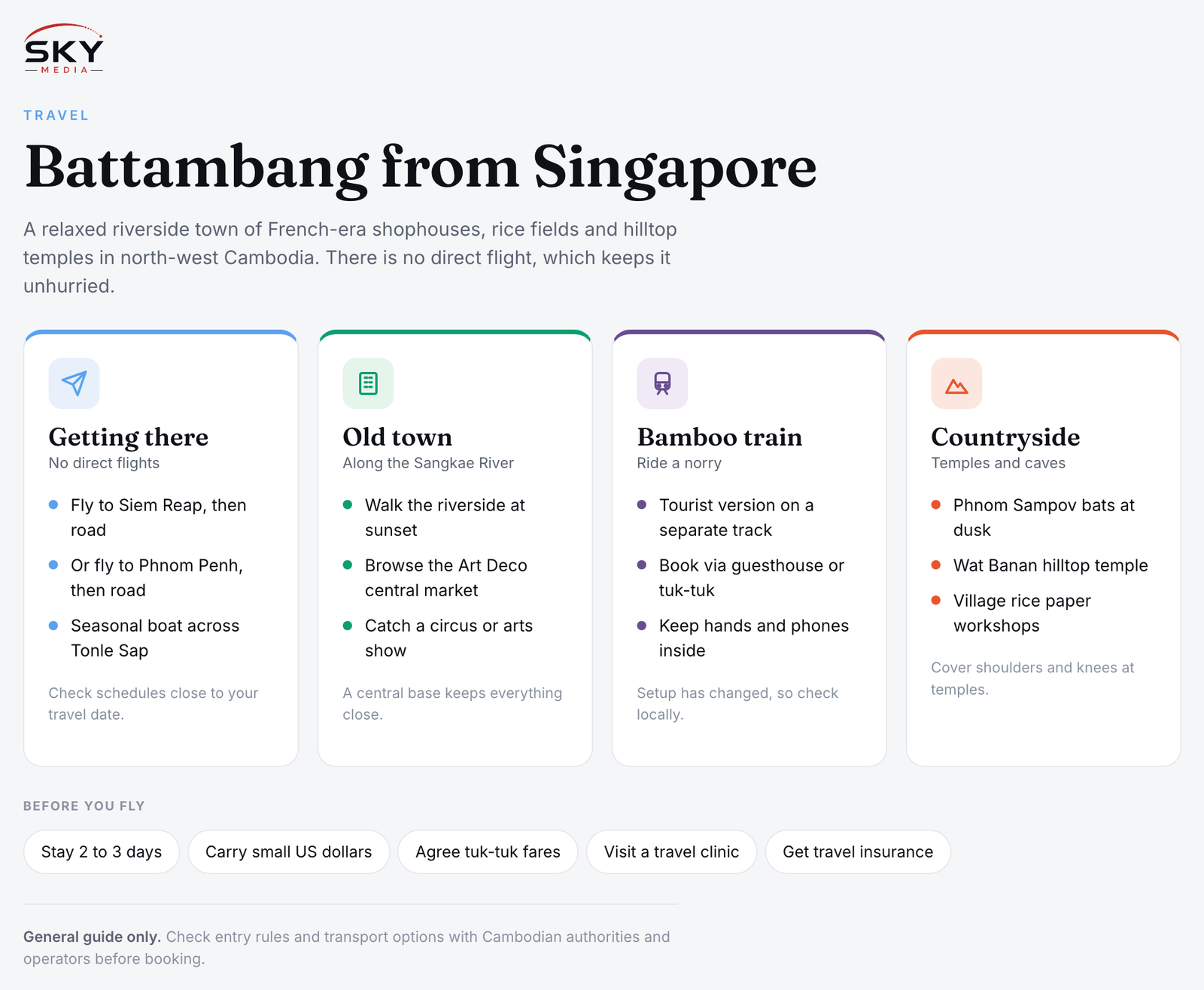
Getting to Battambang From Singapore
There are no direct flights between Singapore and Battambang. The usual approach is to fly into one of Cambodia’s two main international gateways and continue overland.
- Via Siem Reap. Siem Reap is the closer gateway, and many people pair a few days at Angkor with Battambang. The journey between the two is by road, usually by bus, minivan or a private taxi arranged through your hotel. Expect most of a morning or afternoon on the road.
- Via Phnom Penh. The capital has more flight options from Singapore. From there, Battambang is a longer road trip, so most people treat it as a full travel day. Cambodia’s restored railway has also run passenger services on the line towards Battambang at times, which is a slower but scenic option if a train is operating when you visit.
- By boat from Siem Reap. A river boat across the Tonle Sap lake and up the Sangkae River is a famous slow route through floating villages. It is long, basic and depends heavily on water levels, so it may not run in the dry season. Treat it as an experience rather than transport.
Flight schedules, bus operators and train timetables change, so check current options with airlines and operators close to your travel date.
| Route from Singapore | What the journey involves | Best for |
|---|---|---|
| Fly to Siem Reap, then road | Shorter flight connection, then a few hours by bus or taxi | Combining Angkor and Battambang in one trip |
| Fly to Phnom Penh, then road | More flight choices, then a long road day | Travellers also visiting the capital or the south coast |
| Fly to Phnom Penh, then train | Slow, scenic rail journey when services run | Rail fans with flexible time |
| Fly to Siem Reap, then river boat | A long day on the lake and river, seasonal | Adventurous travellers wanting village scenery |
If you are building a longer loop, our guides to Phnom Penh from Singapore and Kampot and Kep pair naturally with a few days in Battambang.
The Colonial Old Town Along the Sangkae River
Battambang’s centre is compact and easy to explore on foot or by bicycle. The core sits on the west bank of the Sangkae River, where rows of shophouses from the French colonial period line the streets around the central market. Many have tiled floors, shuttered windows and faded pastel facades, and some have been turned into cafes, galleries and guesthouses.
Things worth doing in town:
- Walk the riverside promenade in the early morning or around sunset, when locals come out to exercise and street vendors set up.
- Visit the central market, an Art Deco style building where you can browse produce, dried fish, textiles and jewellery stalls.
- Look for the town’s art scene. Battambang has a strong creative reputation, with small independent galleries and a well-known circus and performing arts school run by a local non-profit. Its shows are a popular evening activity, so ask your guesthouse what is on.
- Join a cooking class. Several guesthouses and small businesses offer half-day classes that start with a market visit, a good introduction to Khmer flavours such as kroeung (a herb and spice paste) and prahok (fermented fish paste).
Hotels in Battambang range from simple guesthouses to boutique properties in restored buildings. Since it is a smaller town, a central base keeps everything within easy reach.
Riding the Bamboo Train
The bamboo train, called a norry locally, is the experience most people associate with Battambang. Originally, villagers built these platforms from a bamboo frame on two sets of train wheels, powered by a small motor, to move people and goods along the old railway line. When two norries met head-on, one was simply lifted off the tracks so the other could pass.
When Cambodia restored its national railway, the original norry ride on the main line came to an end. A tourist version now runs on a separate stretch of track outside town, so you can still ride one, though the experience is shorter and more organised than the old version. Rides usually stop at a village where you can take a short break before returning.
Practical tips:
- Arrange the ride through your guesthouse or a tuk-tuk driver, who will usually combine it with other countryside stops.
- Sit back on the cushions provided and keep hands, bags and phones inside the platform, as it moves faster than it looks.
- Check current arrangements locally, as the location and setup have changed over the years.
Temples, Caves and Countryside Beyond Town
The real reward of Battambang is the countryside. Many visitors hire a tuk-tuk driver for a full day, which is the easiest way to link the main sights.
- Phnom Sampov. A hill south-west of town with temples, viewpoints and caves. Some caves are memorials to victims of the Khmer Rouge period, so visit them quietly and respectfully. At dusk, a huge stream of bats pours out of a cave at the base of the hill, one of the region’s most memorable sights.
- Wat Banan. A hilltop temple from the Angkorian era, reached by a long stone staircase. It is often compared to a smaller version of Angkor Wat, with far fewer visitors.
- Wat Ek Phnom. Another old temple, partly ruined, set beside a newer pagoda and a large Buddha statue.
- Village life. Along the way, drivers often stop at family workshops making rice paper, rice wine, dried banana or fish paste. These are working homes, so ask before taking photos and consider buying something you will enjoy.
Bring plenty of water, a hat and sun protection, and wear shoes you can climb steps in. Temples are active religious sites, so cover your shoulders and knees, remove shoes where asked, and avoid touching monks or statues.
How Long to Stay and When to Go
Two to three full days in Battambang is enough for most travellers: one for the old town and arts scene, one for a countryside circuit with the bamboo train and temples, and a spare day for cycling, a cooking class or simply slowing down.
Cambodia’s weather follows a broad pattern of a cooler, drier season around the end and start of the year, a very hot spell before the rains, and a wet season when the countryside is greenest. The dry, cooler months are the most comfortable for sightseeing, while the wet season brings lush rice fields and fewer visitors.
Practical Tips Before You Fly
- Entry requirements. Singapore passport holders have generally been able to visit Cambodia visa-free for short tourist stays under ASEAN arrangements. Rules for other nationalities differ, and some need an e-visa or visa on arrival. Check the current requirements with Cambodian authorities before booking.
- Money. US dollars are widely used alongside the Cambodian riel, with small change often given in riel. Carry small dollar notes in good condition, as torn notes may be refused.
- Getting around. Tuk-tuks are the main way to get around. Agree a price before setting off, or use a ride-hailing app if one operates in town.
- Health. Check with a travel clinic or your GP about recommended vaccinations and mosquito protection well before you travel.
- Travel insurance. Make sure your policy covers cycling and road travel.
Battambang rewards travellers who prefer slow mornings, market food and long rides past rice fields. Pair it with Angkor or the capital and you will see a side of Cambodia that many visitors miss.
Explore more: Train Travel in Asia and Europe
Further reading: Siem Reap from Singapore: Angkor Guide