
Hat Yai is southern Thailand’s busiest commercial city, and for many Singaporeans it has long been a nostalgic weekend escape for shopping, cheap massages and fried chicken. It sits in Songkhla province, close to the Malaysian border, which means you can reach it in more ways than most Thai destinations. This guide to Hat Yai from Singapore compares the train, coach and flight options, explains the border crossings, and suggests how to spend a short trip.
Schedules, operators and fares change often, so treat this as a planning guide and confirm the latest details with the operators and official sources before you book.
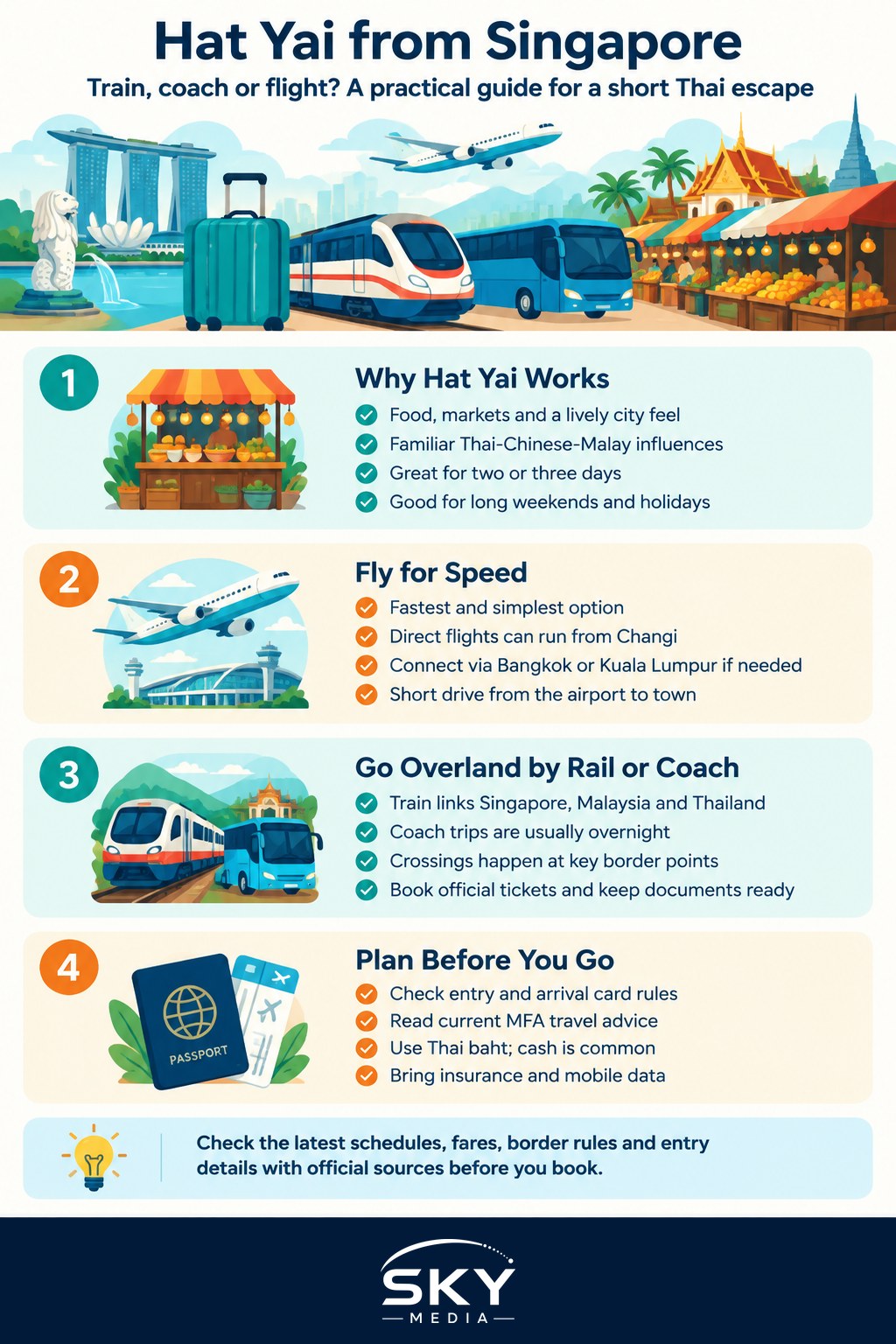
Why Hat Yai Is Worth a Trip
Hat Yai is not a resort town. Its appeal is food, markets and a lively mix of Thai, Chinese and Malay influences that feels familiar to Singaporeans. Highlights commonly enjoyed by visitors include:
- Kim Yong Market, a busy covered market for dried seafood, snacks, nuts and imported goods.
- Hat Yai fried chicken (gai tod Hat Yai), marinated, deep fried and topped with crispy shallots, usually eaten with sticky rice.
- Dim sum breakfasts, reflecting the city’s strong Chinese heritage.
- Night markets, with street food, clothes and souvenirs.
- Hat Yai Municipal Park, a hillside park with a large seated Buddha statue and city views.
- Day trips to Songkhla town, with its old town shophouses and Samila Beach.
The city is compact enough to enjoy in two or three days, which is why it suits long weekends and school holidays.
Option 1: Flying Direct From Changi
Flying is the fastest and simplest way to reach Hat Yai from Singapore. Direct flights to Hat Yai International Airport have been operated by budget carriers, though routes and frequencies change by season. If there is no direct service when you travel, you can connect via Bangkok or Kuala Lumpur.
What to know:
- Book early for school holidays and long weekends, when fares rise.
- Check baggage allowances. Budget fares often exclude checked bags, and Hat Yai shopping hauls add up quickly.
- Getting into town: the airport is a short drive from the city centre. Use airport taxis, minivan shuttles or ride-hailing apps that operate in Thailand.
Flying is best if you have limited days off or are travelling with young children or older relatives.
Option 2: Going Overland by Train
The train route is slower but rewarding if you enjoy the journey itself. It links three rail systems: Singapore to Johor Bahru, Malaysia’s west coast line, then Thai railways from the border.
A typical sequence looks like this:
- Cross into Johor Bahru. The KTM Shuttle Tebrau runs between Woodlands Train Checkpoint and JB Sentral. The Johor Bahru to Singapore RTS Link, a cross-border rapid transit line between Woodlands North and Bukit Chagar, is also planned. Check which service is running when you travel.
- Travel up Malaysia’s west coast. KTM’s ETS (Electric Train Service) runs north towards Padang Besar on the Thai border. Depending on how far the electrified line extends from Johor when you travel, you may need to connect via Gemas or another station. Book through KTMB’s official channels.
- Cross the border at Padang Besar. Malaysian and Thai immigration are handled at the station area.
- Continue to Hat Yai Junction. Thai trains run from Padang Besar to Hat Yai, though timings are limited. Many travellers take a minivan or taxi for this short last leg instead.
Most people break the journey with a night in Kuala Lumpur or another Malaysian city. Our guide to going overland to Malaysia by bus and train explains the Johor crossing and Malaysian rail booking in more detail.
Option 3: Taking a Coach
Long-distance coaches between Singapore and Hat Yai have been a classic choice for budget travellers and shoppers. Journeys are long and usually overnight, with stops along the North-South Expressway in Malaysia and two border crossings: at Woodlands and Tuas into Malaysia, and at Bukit Kayu Hitam and Sadao into Thailand.
Tips for the coach option:
- Choose a reputable operator with clear pick-up points, reviews and a proper ticketing system.
- Pick a seat layout that suits you. Some coaches have wider, reclining seats in fewer rows.
- Keep your passport, arrival card details and a pen handy for each checkpoint. You will usually get off the coach with your bags to clear immigration.
- Pack snacks, water, a jacket and a neck pillow. Coach air-conditioning can be cold.
- Allow for delays. Border queues around public holidays can add hours.
Train, Bus or Flight: Which Should You Choose?
Each route suits a different traveller. Use this comparison to decide.
| Route | Journey experience | Best for | Watch out for |
|---|---|---|---|
| Direct or connecting flight | Fastest, least tiring, airport transfer at the end | Short trips, families, seniors | Baggage fees, seasonal routes |
| Train via Malaysia | Scenic, comfortable, can be broken into stops | Slow travellers, rail fans, multi-city trips | Several bookings, limited Thai-side timings |
| Overnight coach | Single ticket, door to door from city to city | Budget travellers, groups of friends | Long hours, two land borders, holiday queues |
If you want to see Malaysia on the way, the train is ideal. If you only have a long weekend, fly.
Entry, Money and Safety Basics
Before you go, check the following with official sources:
- Entry rules: Singapore passport holders are generally able to visit Thailand visa-free for short tourist stays, but rules change. Check the Royal Thai Embassy in Singapore or Thai immigration channels, including any digital arrival card requirement. If you are travelling overland, also check Malaysian entry rules.
- Travel advisories: some provinces in Thailand’s deep south have long-standing travel advisories. Read the current advice on the Ministry of Foreign Affairs (MFA) website and register your trip through MFA’s eRegister service.
- Money: Thai baht is the local currency. Cash is still widely used at markets and street stalls, while QR and card payments are increasingly common in malls.
- Mobile data: buy a Thai SIM or eSIM, or check your Singapore telco’s roaming plan.
- Insurance: buy travel insurance that covers your mode of transport and any activities planned.
A Simple Three-Day Plan
- Day 1: arrive, check in, fried chicken lunch, evening at a night market.
- Day 2: dim sum breakfast, Kim Yong Market, massage, sunset at Hat Yai Municipal Park.
- Day 3: half-day trip to Songkhla’s old town and Samila Beach, then head home.
If you enjoy shorter Thai escapes beyond the beaches, our Khao Yai from Singapore guide covers a very different, nature-focused trip. Hat Yai rewards those who come hungry, pack light on the way in and leave room in the luggage for the way out.
Further reading: Taking the KTM Train From Singapore to Malaysia: Shuttle Tebrau and ETS